You Can Win the Wrong Game for Years
You usually cannot tell whether you are playing the wrong game. Write down what would prove it, and by when.
How this is checked 18 sourced claims · checked 13 Sep 2026
- What would prove it wrong
- The frame fails if: (a) in complex, ambiguous domains, execution quality consistently dominates game-identification — the boundary grows until it swallows the claim; or (b) the game-check cannot in practice separate a real wrong-game situation from a sufficient-statistic one, i.e. "has the deciding game moved?" has no operable answer, making the diagnostic unusable.
- Evidence
- 18 claims, each with the primary source it was checked against, plus the ones struck before publication.
New here Contents sit in the right margin. Press F to read with nothing else on screen. Save keeps an essay in this browser so it opens offline, and nothing leaves it. The bar at the foot of the screen holds the contents, text size and focus mode. Save keeps an essay in this browser so it opens offline, and nothing leaves it.
You usually cannot tell whether you are playing the wrong game. Write down what would prove it, and by when.
The Roman Inquisition is remembered as the enemy of science, the machine that put Galileo on trial. The historian Ada Palmer, whose next non-fiction book is a history of censorship, tells a different story. By her count there were twelve trials of scientists over their science, Galileo’s among them, and only one ended in an execution, Giordano Bruno’s. She quotes inquisitors writing to one another that there was no need to bother censoring Lucretius, whose poem sets out a materialist account of nature, since only learned people could read him; what needed censoring was “all of these fine minutiae of Protestantism”. Her conclusion is that censors are always wrong, from where we stand, about what deserved their attention.1
That is the shape worth seeing. The effort went into one game. What mattered was happening in another. And the people spending the effort were disciplined, organised, and pointed with real precision at the wrong thing.
Right about the technology, wrong about the stock
You can watch the same gap open in a market. Ray Dalio, describing what people miss in a bubble, put it flatly: “they think that they are betting on the technology when they buy the stocks in the companies. That’s not true.”2 Technology and the companies built on it are two different games. The internet was every bit as transformative as its believers hoped, yet a great many of the companies that rode it into the public markets in 1999 did not survive the crash that followed.
Being right about the technology and being right about the equity were separate bets.
In both cases the wrong game was the one that felt like progress. Hunting heretics felt like defending the faith. Buying the obvious winner felt like conviction. When effort feels productive, treat that feeling as the cue to check which board you are on. Hold that thought, because the usual cure has a trap of its own.
The trap in looking up
The advice that follows from stories like these is to look one level up. Stop optimising the visible game and find the real one behind it. It is good advice, but following it is also a game you can lose: the instinct to look up can misfire in two ways, and both feel like sophistication.
The dead end that worked
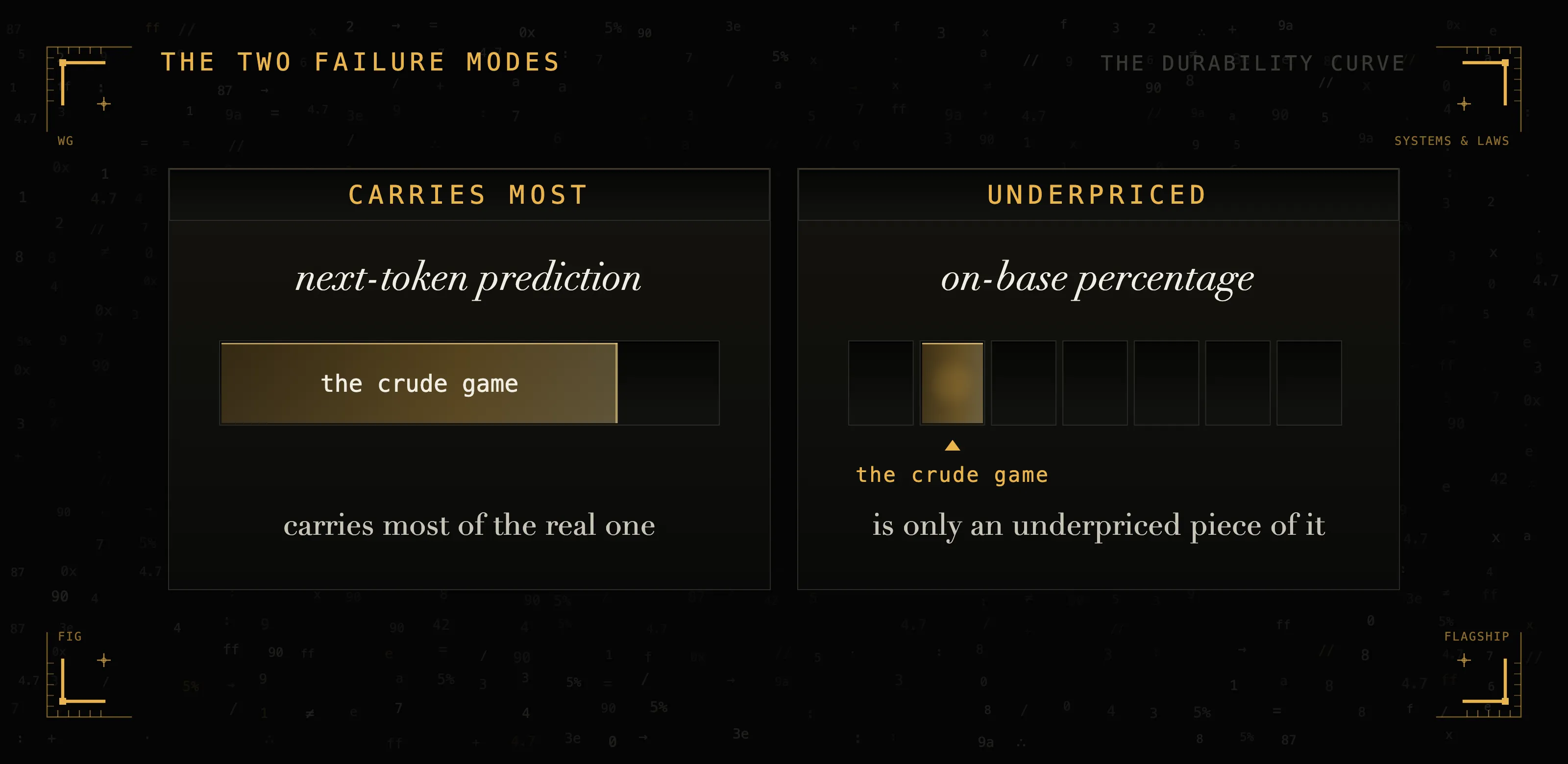
The first is that the crude game you are dismissing quietly carries most of the real one. Take the objective that trains a large language model: predict the next token. For years this was the textbook wrong game. Serious people argued that a system doing nothing but guessing the next token could never understand anything, that it was autocomplete and nothing more, and for a long time the evidence seemed to be on their side, because the outputs were fluent and hollow.3
Then scale turned the same crude objective into the most capable systems we have. Get good enough at predicting the next token, across enough of what people have written, and a great deal of what the sceptics said it could never do comes along with it. Whether that adds up to understanding is still argued over; the capability is plain. The strongest systems add later rounds of training on top, and the core surprise survives them. The people looking one level up were doing the sophisticated thing, refusing the crude surface for the deeper read.
The underpriced number
The second way is different, and worth keeping separate. Here the crude game is a genuine but underpriced piece of the real one, and the sophisticated eye throws it away. Baseball scouts judged a hitter the refined way: the whole player, the swing, the body, the read of someone who had watched a thousand games. They treated the crude stats as beneath that judgement. One of those stats, on-base percentage, the plain rate at which a batter reaches base, was underpriced across the market. Winning still took pitching and a great deal else, and on-base percentage was never the whole game. But it was a real input the practised eye had dismissed, and the Oakland A’s, who bought it cheaply, won as many games in 2002 as a Yankees team paying about three times as much. The economists Jahn Hakes and Raymond Sauer later put numbers to the story: the ability to get on base was valued inefficiently, a team that could read the statistics exploited the gap, and once the knowledge spread the market corrected.4
Both look the same from here
Name the two plainly. Sometimes the crude game carries most of the real one. Sometimes it is only an underpriced piece of it. In both of these cases the person insisting you look one level up misread what the crude game could do.
What makes this genuinely hard: from the inside, you usually cannot tell which case you are in, or whether the sceptics are simply right and the crude game is the dead end they say it is. The model doubters had real evidence for years. The scouts sincerely believed a number could not hold a ballplayer. A flat result, or a crude proxy, does not tell you in advance who is right.
Commit the test before you act
So what do you do when you cannot tell? You give up the verdict and keep the discipline. Start by making the gap visible: write down where your effort actually went last cycle, the hours and the attention, and separately what moved the outcome you care about. In slow work, where the outcome has not landed yet, use the nearest honest signal instead, the leading indicator you would stake money on. When the two lists barely overlap, you have a suspect worth testing.
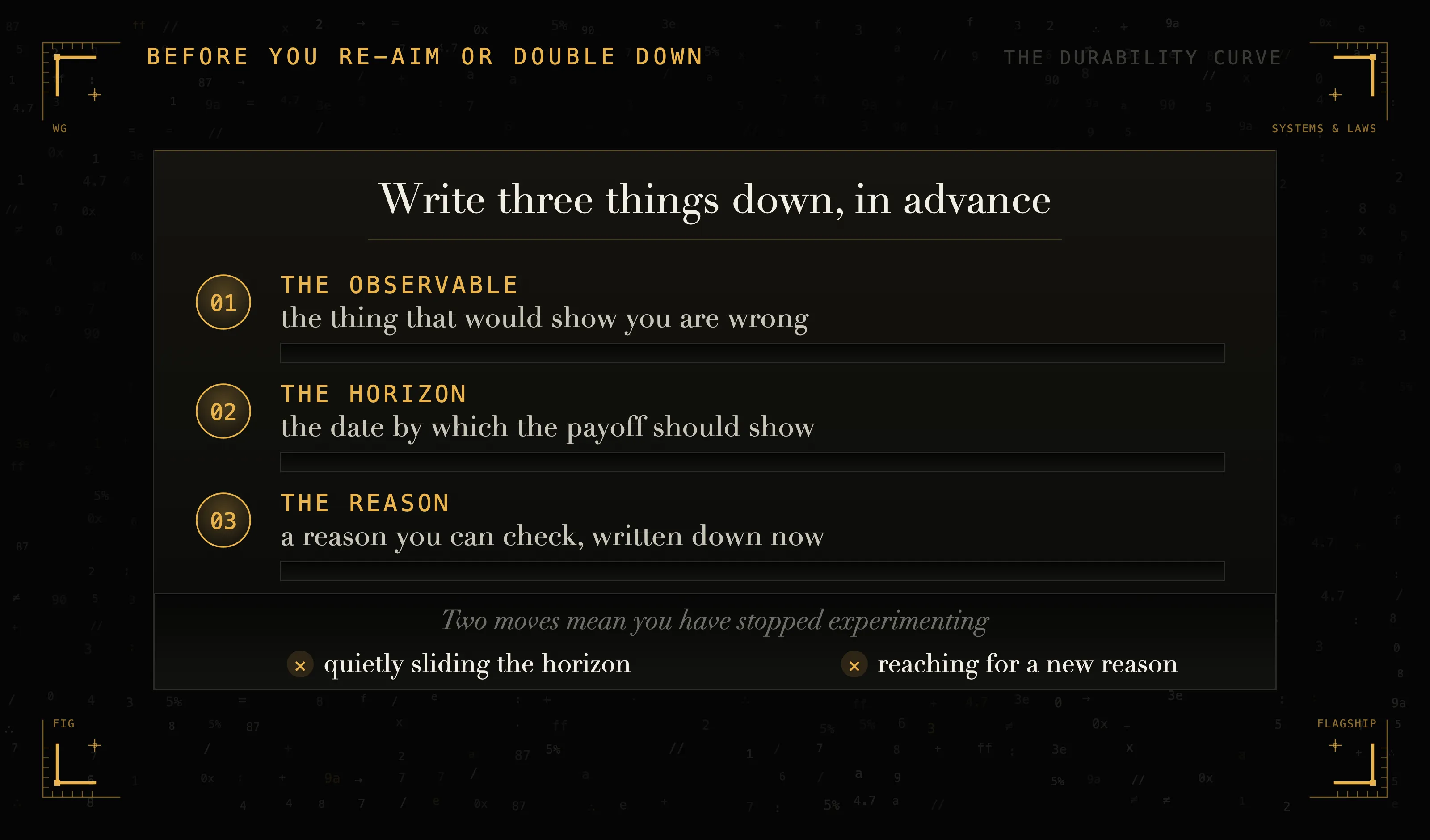
The move that matters comes next, and it is the whole point. Before you re-aim, and just as much before you double down, write down three things: the observable that would prove you wrong, the date by which the payoff should show, and the reason you expect a payoff at all. Take the observable from the outcome that gets scored, or from a signal you trust to track it; one drawn from the game you are playing is a test you can pass while losing. In her book Quit, Annie Duke builds kill criteria from the first two, a state and a date.5 The third keeps them honest: a reason you could check, written down before the result comes in.
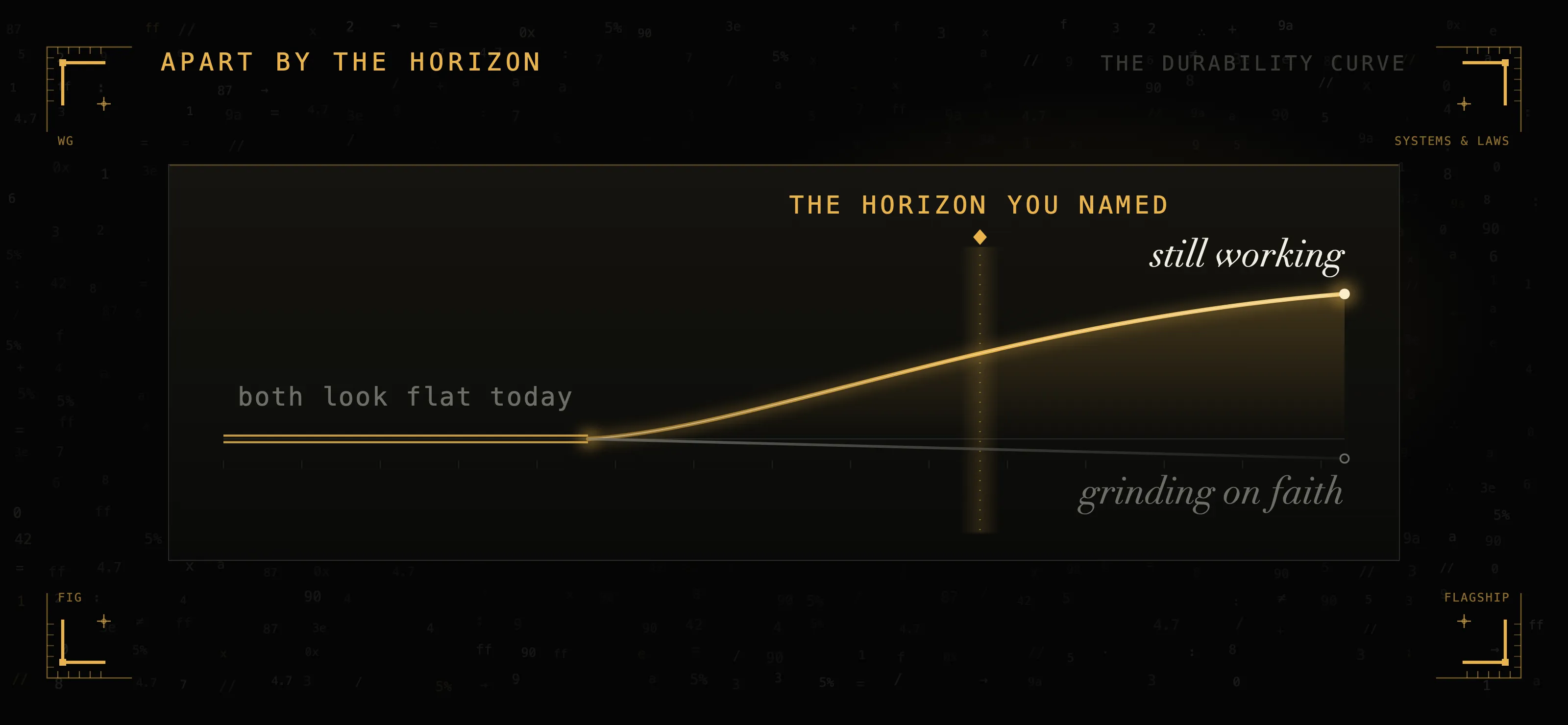
A game you are grinding on faith and a game that is quietly working both look flat today.
What separates them is what happens by the horizon you named in advance. A result still flat past that date, or showing the sign you said would prove you wrong, counts as evidence against the bet, even if the reason sounds right; the reason only tells you which part of the bet failed. A bet that is flat but inside the horizon, with the reason intact, is still live.
Two moves give the game away: quietly sliding the horizon each time you reach it, and reaching for a new reason every time the old one expires. Either one means you have stopped running an experiment and started telling yourself a story.
Where it matters most
This discipline earns its keep in one place above all: the high-conviction, long-horizon commitments where the payoff is slow and the feedback is thin. The career you have given a decade to. The strategy the whole team believes in. The research bet, the company, the thesis you have already paid for. Those are exactly the places where a flat result tells you least and costs you most.
The inquisitors combed Protestant fine print and judged a materialist poem harmless. The people who called next-token prediction a dead end read the evidence correctly for years and still got the outcome wrong. The scouts trusted their eyes while a team that bought what they had dismissed won as many games on a third of the Yankees’ payroll. You can play your game well and still lose the one that gets scored, and not know until far too late. Before your next big push, name the observable, the date, and the reason, then believe the answer when it arrives.
Free download: The Game Check. A one-page card for naming what would show you wrong, and by when, before your next big push. Name the observable, the horizon, and a reason you can check, then come back on the date. Yours to keep. Get the free card →
Footnotes
-
Ada Palmer in conversation with Dwarkesh Patel, “Why Leonardo was a saboteur, Gutenberg went broke, and Florence was weird”, Dwarkesh Podcast, 6 March 2026. The trial count, the inquisitors’ letters and her conclusion about censors are in her own words in the episode transcript. ↩
-
Quoted in Thomas Kent, “Ray Dalio says AI investors think they’re betting on technology but ‘that’s not true.’ Why most stocks may not survive”, Moneywise via Yahoo Finance, 21 March 2026, reporting Dalio’s remarks on the All-In podcast. ↩
-
For a careful version of the argument, see Emily M. Bender and Alexander Koller, “Climbing towards NLU: On Meaning, Form, and Understanding in the Age of Data”, Proceedings of the 58th Annual Meeting of the Association for Computational Linguistics, 2020, which argues that a system trained only on linguistic form cannot learn meaning. ↩
-
Jahn K. Hakes and Raymond D. Sauer, “An Economic Evaluation of the Moneyball Hypothesis”, Journal of Economic Perspectives 20, no. 3 (2006), pages 173 to 186. The 2002 records (Oakland 103-59, New York 103-58) and Opening Day payrolls (Oakland $39.7 million, New York $125.9 million) are from Doug Pappas, “Payroll vs. Performance, 2002”, Society for American Baseball Research. ↩
-
Annie Duke, Quit: The Power of Knowing When to Walk Away (Portfolio, 2022). Her kill criteria are set out in an excerpt, “Mental Models to Help You Cut Your Losses”, Behavioral Scientist, 7 November 2022. ↩