The Brief 4 of 4
Your AI Complaint Says Things You Never Said
A study found AI-written complaints win relief more often. Its own AI edit of one says 'I do not own a cell phone'. The consumer never said so.
Contents · 4 sections
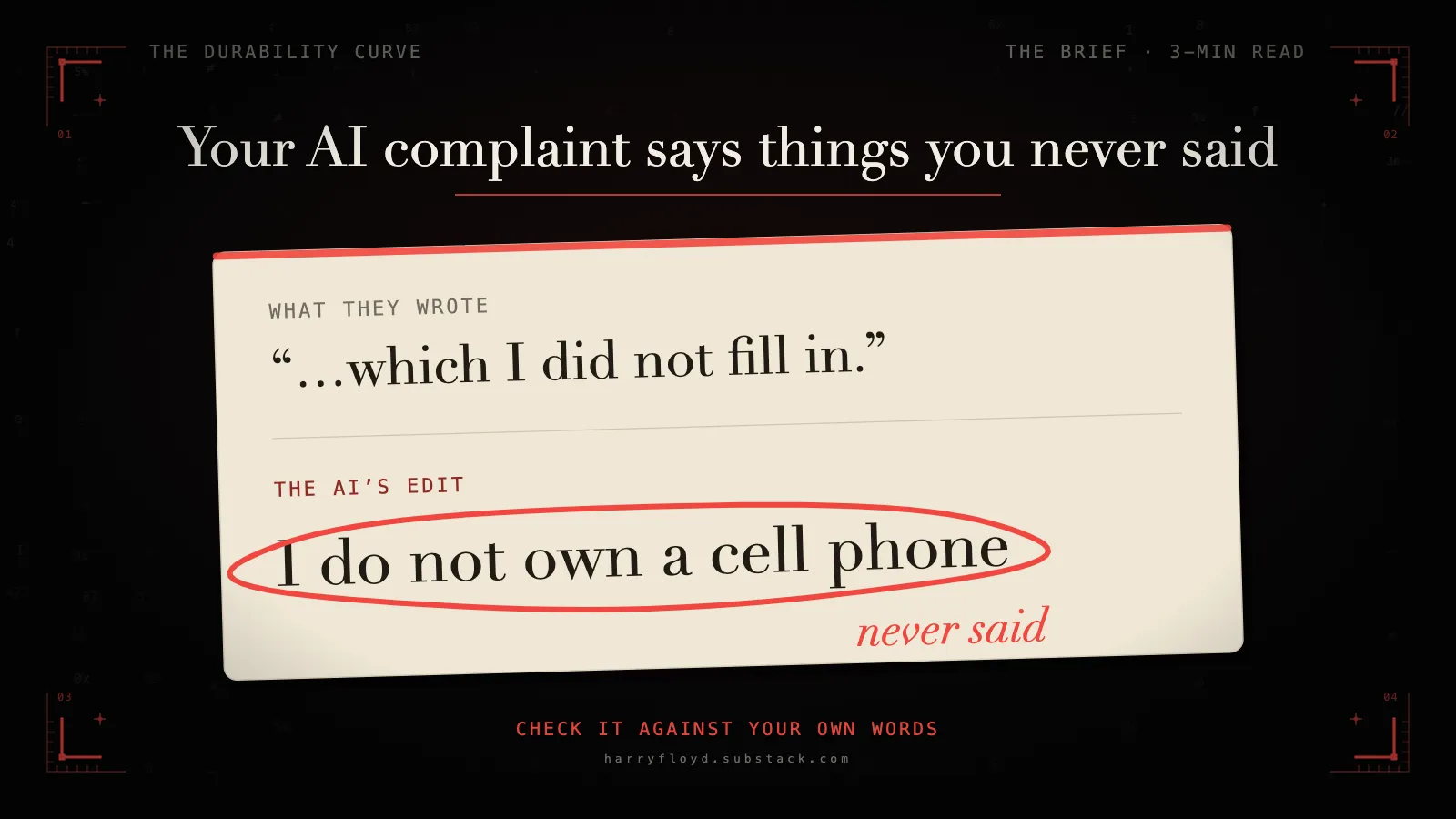
A study found AI-written complaints win relief more often. Its own AI edit of one says ‘I do not own a cell phone’. The consumer never said so.
You have a complaint about your bank, and it reads the way you feel. Asking a chatbot to make it clearer is a sensible move. A study of 1,134,512 complaints to the US Consumer Financial Protection Bureau estimated that using AI raised a complaint’s chance of winning relief from the firm by about 7 percentage points, where relief can be money or another fix. The paper says the AI did this “without altering factual content.”
What the study’s own edits say
To test why, the researchers ran experiments. People imagined handling complaints and said how likely they would be to pay out. Some complaints were as consumers wrote them, and some had been edited by ChatGPT. The researchers published the complaints they used.
One consumer had tried to get a credit report online. They wrote that TransUnion already had their landline, and that the form requested a cell phone number, “which I did not fill in.”
The study had ChatGPT edit that complaint three times, to be more clear, more coherent and more professional. All three versions say the consumer doesn’t own a cell phone. The professional one reads: “Although I had already provided my landline number, I could not fill the cell phone field as I do not own a cell phone.”
It may be true. The consumer never said it, and these edits were among the complaints people rated. That doesn’t overturn the 7-point finding, which comes from complaints people actually filed. It does mean a chatbot can fill your complaint’s gaps with the likeliest story, and that story goes out under your name.
Three steps
-
Write your facts first. A short numbered list: what happened, when, what the firm said or did, what it cost you, and the one thing you want them to do. Don’t skip that last item: the prompt below asks the chatbot to end with how you want the complaint resolved, and if you don’t say, it will guess. Leave out account numbers and any health or banking details, and add them yourself afterwards.
-
Use an ombudsman’s own prompt. The Public Service Ombudsman, which handles complaints about the NHS in England, publishes this one, and nothing in it is specific to the NHS. Paste it, then your list:
Rewrite the text below as a clear, polite complaint. Use only the information I have provided. Do not add or invent new facts. Be concise and professional, but not too formal. Include a closing paragraph suggesting how I would like the complaint to be resolved.- Read it against your list. One sentence at a time. Anything you never said comes out. Any law or rule you didn’t write yourself stays out unless you can confirm it on the regulator’s or ombudsman’s own website.
The third step is the one that matters. We gave the ombudsman’s prompt to Claude Sonnet 5 and GPT-5.6 with three of the study’s real complaints. With the cell-phone complaint, Claude still wrote, “I do not have a cell phone number to provide.” With a debt-collection complaint, it called the consumer’s $1,000 claim “statutory damages”, a legal term the consumer never used. GPT stayed closer to what the consumers wrote, though one of its three rewrites still implied the consumer had raised concerns before. Reading each version against the original catches all of these. That was three complaints and one run per model, read by an AI agent rather than a person, so take it as an example, not a rate.
Why it works
A chatbot writes the most plausible complaint it can, and only you know which parts happened. The ombudsmen put the check on you. The Public Service Ombudsman says, “Always check AI-generated text to make sure it’s accurate and reflects your own personal experience.” The Financial Ombudsman Service says, “You are responsible for making sure the resulting text is accurate, relevant and truly represents your experience. If you don’t, you may experience delays.”
Let the AI do the clarity. The facts are yours.
Where it goes next
In the UK, a bank or other financial firm has up to 8 weeks to answer most complaints. For fraud and scams, payment services or electronic money, it usually has 15 working days. If it hasn’t replied in time, you can take the complaint to the Financial Ombudsman Service. If it has sent a final response you’re unhappy with, you have 6 months from that response. The service is free, and you don’t need a lawyer.
In the US, before you complain to the CFPB about a credit bureau over an error on your report, the law requires you to dispute it with the bureau first. Then file with the CFPB, which sends your complaint to the company. You generally can’t file a second complaint about the same problem, so put everything in the first one.
An earlier piece, Show It an Example, showed the AI doing this with tone of voice: whatever you don’t pin down, it fills with the likeliest version.
Comments are on the Substack copy. If an essay was worth one, buy me a coffee.
It rests on Law IV, Instruments Over Theory, one of the laws this publication tests against the evidence.
Claude and ChatGPT can search this archive and its claim ledgers once you add the connector.