Law IV
Instruments Over Theory
Hidden structure stays hidden until you build the instrument that measures it. That holds wherever we build things first and understand them later. In fundamental physics and pure maths, theory usually leads.
- StandingRevised under pressure, relied on
- Last tested21 Jun 2026
- RevisedOnce
- AppliesAt any time scale, in fields where things are built before they are understood
Narrowed in scope in June 2026: it no longer claims fundamental physics or pure maths.
Ask this of your own work
What would make the hidden structure visible?
An example
Teams argue about whether an agent is reliable without a trace they can replay, and about whether a model is better without naming the test that produced the score. The trace, or the named test, is the instrument that settles the argument.
Run it on your own work
Start with
- Same Model, Different Product: The Case for Harness Engineering Hold the model fixed and the surrounding harness can still move task success, cost and reliability. Here are the layers that do it.
- Never Let Claude Code Tell You It's Done A test the agent can't talk its way past, wired to run itself.
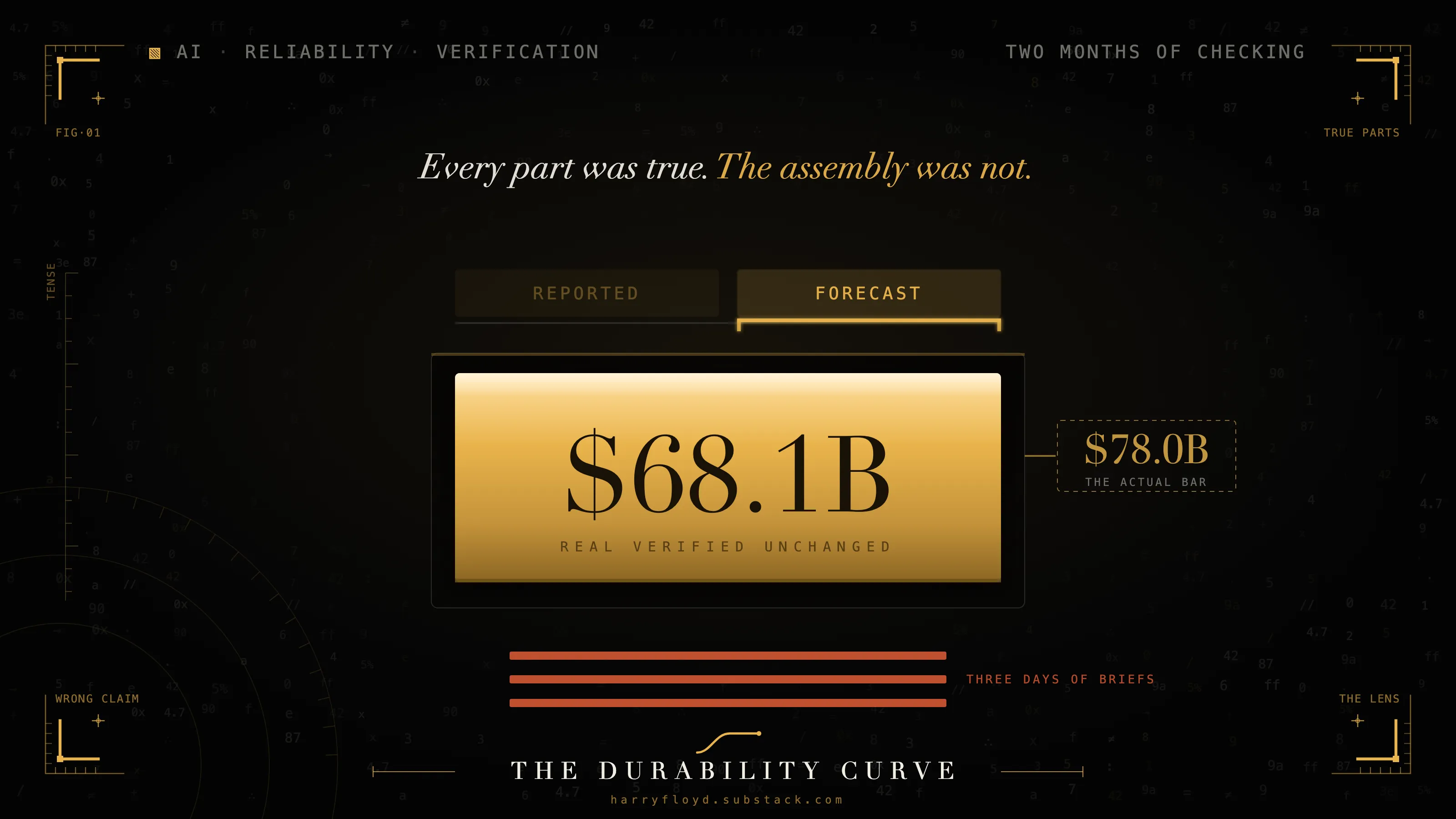
- The Most Expensive AI Errors Are Made of True Numbers Two months auditing an AI research agent. Nine ways a true number lies, and the check that catches each.
The other 16 essays under Law IV
- Don't Tell Your AI Your Answer12 Oct 2026
- Your AI Complaint Says Things You Never Said5 Oct 2026
- AI Can Take the Practice Without Taking the Job2 Oct 2026
- The Things You Used to Know by Heart29 Sep 2026
- One Question for Any AI Model Headline: Can You Use It?25 Sep 2026
- Show It an Example17 Sep 2026
- Ask for the Step Before the Answer16 Sep 2026
- The Work That Comes Due After You Leave25 Aug 2026
- Stop Re-Priming Claude Code by Hand10 Aug 2026
- The Guardrail Your Agent Can Reach8 Aug 2026
- The Average Is Nobody's Result4 Aug 2026
- Your Robot Coworker Is Still a Pilot1 Aug 2026
- Your AI Stack Has Three Bugs Other Fields Already Fixed25 Jul 2026
- Your Tests Pass. So What?14 Jul 2026
- Where Your Metrics Fold12 Jul 2026
- How Reliable Is Your AI Agent?15 Jun 2026
How it could be wrong
What would break it
What would count as proof it is wrong. When a test meets the old version, the law is rewritten and the change is recorded beside it.
A breakthrough that came from theory alone, with no new way of observing. Since June 2026 that counts only in fields where things are built first and understood later.
What changed, and why
· scope narrowed
It is not claimed for fundamental physics or pure maths, where theory usually comes first, often by years or a century: general relativity (1915) was confirmed in 1919, and its gravitational waves were detected in 2015. It holds where things are built first and understood later, which is where this publication works.
The exact wording, as the framework records it
Hidden structure stays hidden until you build the instrument — in engineering and applied domains.
The full statement
Hidden structure exists in every domain; it stays hidden because the instrument to reveal it hasn't been built yet — and building it changes the thing being observed. Progress comes from new observables, not more theory. AMENDED 2026-06-21: this holds in engineering and applied domains, where we build things and then understand why they work, so progress is instrument-led; in fundamental physics and pure mathematics the order systematically reverses (theory precedes the confirming instrument, often by years to a century), and the law is not claimed as universal across fundamental science.