AI & Work 8 of 8
AI Can Take the Practice Without Taking the Job
The practice that builds judgement can disappear while every junior keeps their seat. This audit checks whether it has on your team.
How this is checked 67 claims · 63 verified at the source · last checked 1 Oct 2026
- Rests on
- Law IV, Instruments Over Theory. It has been put to a real test and amended or narrowed under that pressure. Last tested 21 Jun 2026.
- Evidence
- 67 claims: 63 verified at the primary source and 4 from runs made for the piece.
Contents · 4 sections
In the operating theatres Matt Beane studied, the senior surgeon sat at a console and worked the robot’s arms alone. The surgical resident was still in the room. Beane described what residents did there: they “held a laparoscopic tool to remove smoke and fluids from the patient, or watched the surgical action from a second trainee console.”
Open surgery needed the trainee. In Beane’s words, the open procedure “required four hands and two people most of the time,” and trainees learned by taking on more of each operation as they went. The robot let one expert operate alone, and “the trainee was optional.”
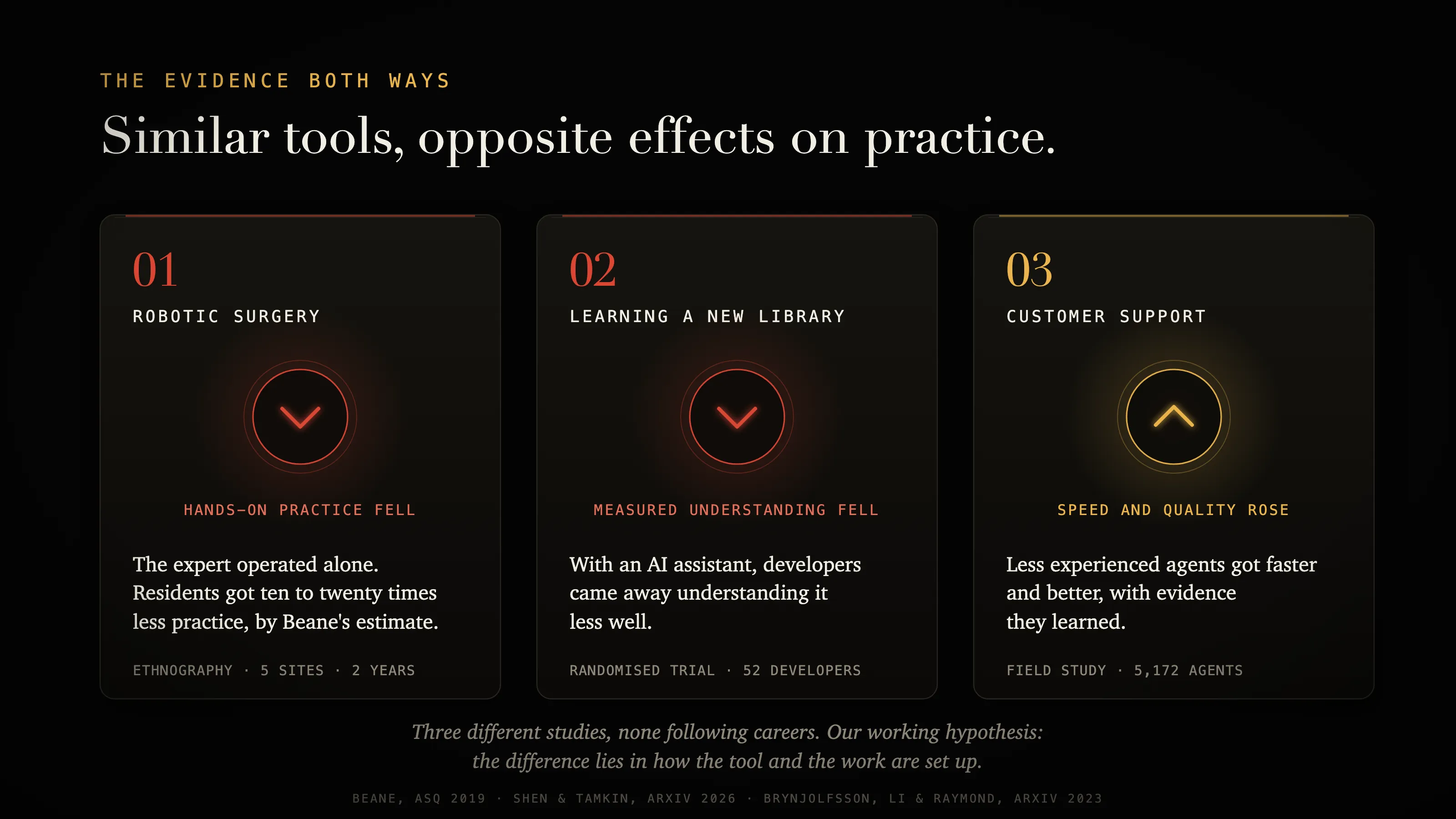
Beane’s study, two years of observation at five sites plus interviews about training at 13 top US teaching hospitals, found that under the robot only a minority of trainees came to competence. In UC Santa Barbara’s write-up of the work, he estimated that residents were getting “ten to twenty times less practice,” and said they were “finishing their residencies licensed to use robots in the operating room, but many are graduating without crucial surgical skills because they did not receive enough practice or mentorship.”
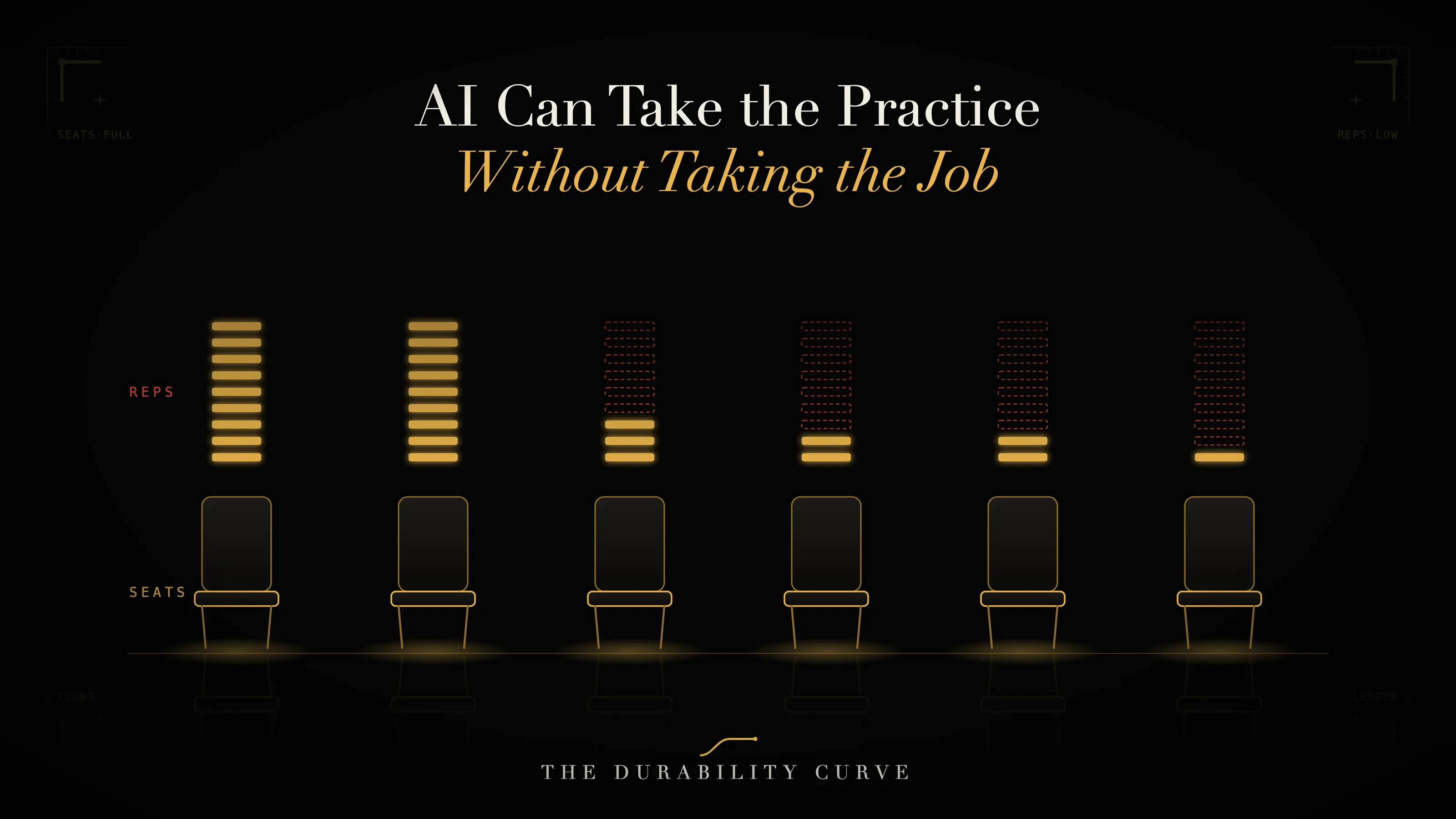
Residents could still complete their programmes. What thinned out were the reps: the repeated, real cases a person handles, with someone better beside them, until judgement forms.
A count of residents could not show that. That is the risk this piece is about: the expertise pipeline can break while the headcount holds, because the job stays but the cases move to the machine and the learner moves away from the person who knows the call best.
So, on your team: who is at the second console?
The count
In August, Stanford’s Digital Economy Lab published a revision of its study of AI and young workers. Erik Brynjolfsson, Bharat Chandar and Ruyu Chen work from ADP payroll records covering millions of US workers. Employment of 22 to 25 year olds in highly AI-exposed occupations is about 19% lower than it would be had it kept pace with people the same age in less-exposed jobs. A year earlier, by the same measure, the figure was 15%. (The 13% you may have seen was an earlier, model-adjusted estimate.)
The authors call these descriptive facts, not a causal estimate. The gap is larger in ADP’s data than in national surveys; some of the divergence predates generative AI, though by November 2022 the young workers’ position had returned to roughly its pre-pandemic level; and controlling for each occupation’s education level shrinks the estimates, which could be an alternative explanation or the channel AI works through.
The gap survives removing tech firms and computer jobs and controlling for interest rates and remote work, and it kept widening after interest rates peaked; estimates that adjust for firms’ overall hiring point the same way but shift with modelling choices.
The paper also says where the gap sits. It runs through hiring: the authors find it works “primarily through reduced hiring rather than increased separations.” Using usage data from the Anthropic Economic Index, they find declines concentrated in occupations where observed AI usage substitutes for human tasks, with employment flat or rising where AI complements workers, and the link is strongest for the youngest. Experienced workers in the same occupations, which the study uses as a placebo check, show no comparable gap.
That is the first layer of this story, the jobs a payroll can count. The second layer sits inside the jobs that remain.
Codified and tacit
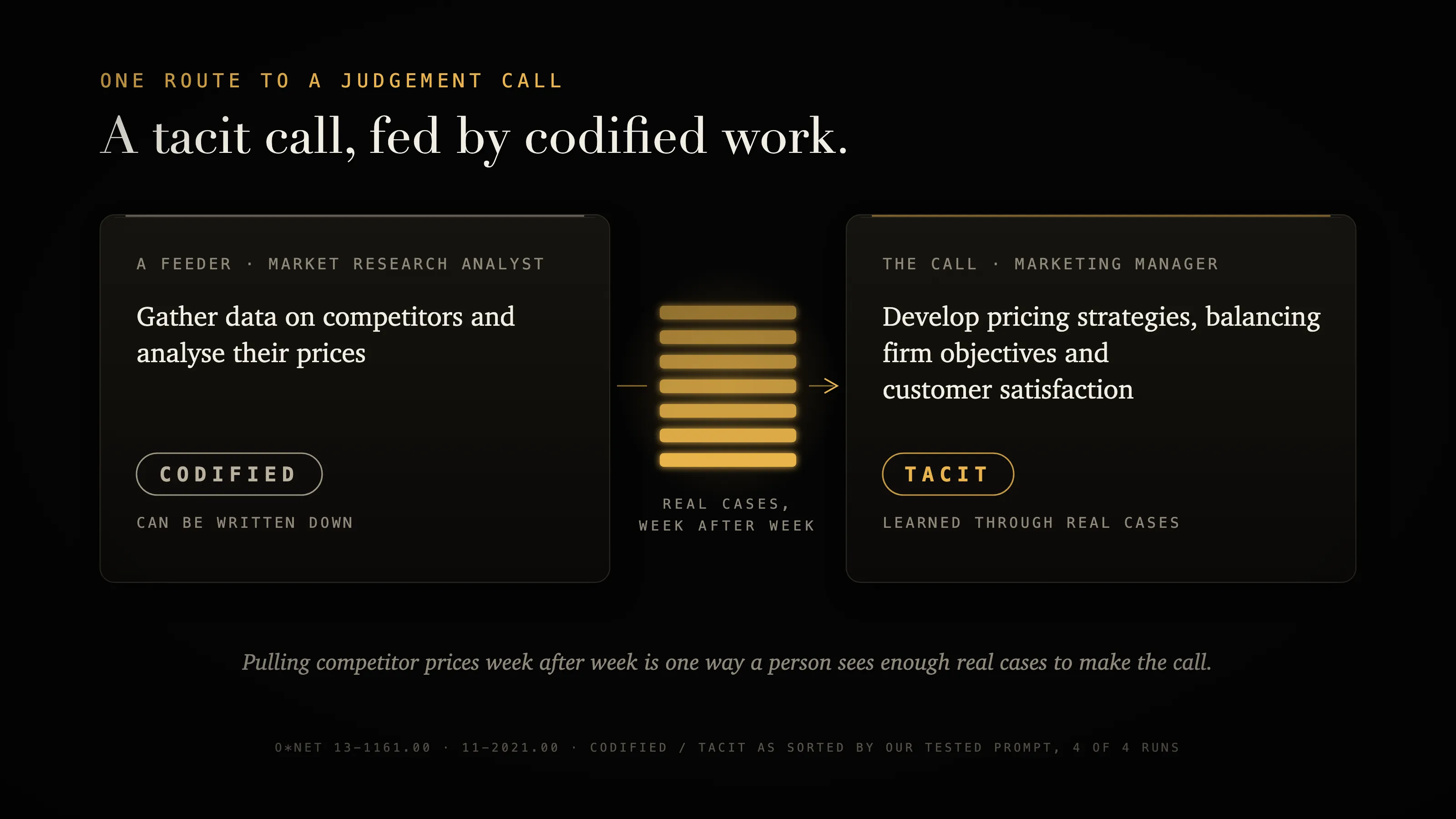
The authors also look at which occupations experienced workers are growing in. They scored occupations, partly by having a language model read job descriptions, for how much they rely on two kinds of knowledge: codified knowledge, which can be “taught through education, textbooks, or written procedures,” and tacit knowledge, which is “difficult to write down or teach in a classroom.”
Young workers lost ground in occupations that lean on codified knowledge, and experienced workers grew faster in occupations that lean on tacit knowledge. Only the second survives a check the authors ran on their own work: once they control for the share of college graduates in each occupation, the codified pattern stops being significant. The authors call these estimates “non-causal and purely suggestive.”
By the definition the authors used, tacit knowledge is “acquired through practice, mentorship, hands-on experience, and repeated exposure to real situations.” That is the surgeon’s route: years of taking on more of each operation, beside someone who already knows how.
O*NET, the US government’s occupation database, helps picture what the route can look like at a desk. A marketing manager is expected to “develop pricing strategies, balancing firm objectives and customer satisfaction.” A market research analyst, a role whose work can feed that call, is expected to “gather data on competitors and analyze their prices, sales, and method of marketing and distribution.” Pricing well is the judgement call in this example. Pulling competitor prices week after week is one way a person sees enough real cases to make it.
The authors suggest a mechanism for the gap, citing the economist Enrique Ide among others: AI “may be automating the checkable, process-intensive tasks that historically justified entry-level headcount,” while letting experienced staff get more done.
The loss the count can’t see
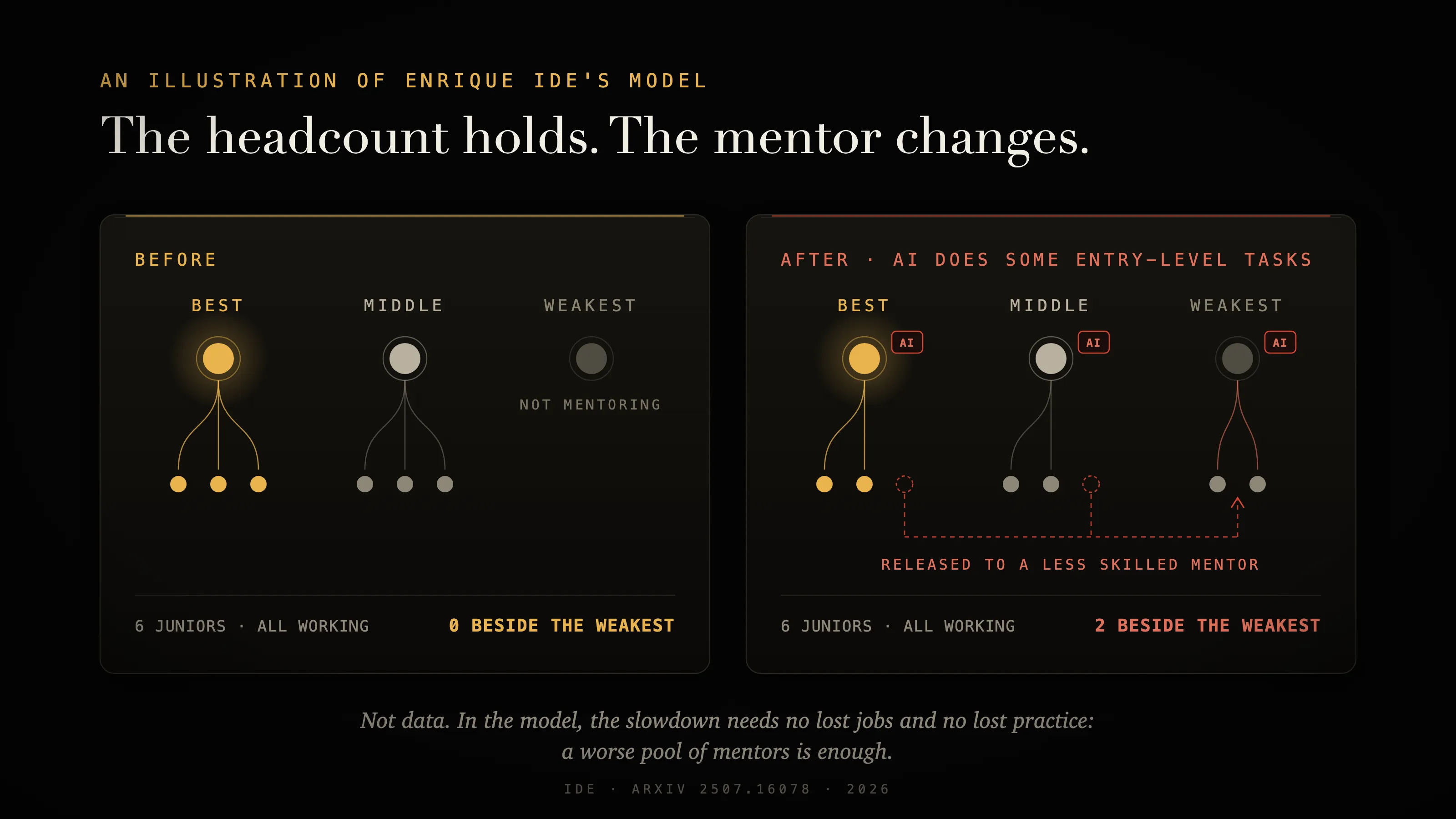
Ide, at IESE Business School, built a model of how expertise passes from one generation to the next (arXiv 2507.16078). He starts from the worry that AI, “by allowing senior workers to accomplish more tasks independently,” may cut the entry-level work juniors trade for training. In his model, “novices acquire tacit knowledge by working alongside experts,” and the best experts pass their expertise to several novices at once.
His result is quieter than lost jobs. Automating entry-level work raises output straight away. It can also slow growth and leave people worse off, because automation can “reallocate novices away from the most productive experts.” The juniors keep working. They learn beside weaker mentors.
His slowdown, he notes, needs neither fewer entry-level jobs nor novices losing hands-on practice: “a compositional deterioration in the pool of mentors is sufficient.” His conclusion is about exactly the number this debate watches: “policy assessment should look beyond aggregate entry-level employment: the deployment of new technologies may reduce welfare even if the total number of entry-level jobs remains unchanged, provided it reallocates novices away from the most skilled experts.”
An overall count cannot see who is learning beside whom. Ide’s model points to that. Beane’s theatres point to the practice itself, the part juniors lose when the expert can work alone. And in a small randomised trial of 52 developers by Anthropic researchers, covered in Use AI to Learn Without Getting Worse at It, those learning a new library with an AI assistant came away understanding it less well.
The evidence also runs the other way. In a field study of customer support agents (5,172 in the data, 1,636 of them observed after getting an AI assistant), Brynjolfsson, the first author of the Stanford study, with Danielle Li and Lindsey Raymond, found that less experienced workers given the assistant improved in both speed and quality, and found evidence that the assistance “facilitates worker learning.”
Ide’s model has the mirror case: technology that increases “the number of novices learning from the most productive experts” strengthens the passing-on of knowledge and raises growth.
The same kind of tool can drain the practice that makes experts or speed it up.
The support study’s authors suggest their assistant may have been “capturing and disseminating the behaviors of the most productive agents”; in the theatres the robot let the expert work without the trainee, and in the trial developers could hand the coding to the assistant.
Our working hypothesis, which these studies point to without proving, is that the difference lies in how the tool and the work are set up: whether the AI carries your best people’s practice to juniors or does their work for them, and who does the feeder tasks, beside whom. An overall headcount cannot tell the two apart.
Counting reps
A team lead can look for the difference with three questions.
What judgement calls is your team paid for? These are the things done well because someone has seen many cases: pricing a deal, spotting the wrong number in a model, knowing which customer complaint is the dangerous one.
Which everyday tasks gave you those cases? If yours were the checkable tasks you did early on, they are the kind Stanford’s authors suspect AI is now taking. Not every task an AI takes was teaching anyone, and the audit helps you name the ones that were. You Reach Before You Think was the individual version; this is the team version.
Who does those tasks now, and beside whom? A junior doing them by hand next to your best person is a different answer from a junior forwarding what an AI wrote, and both are different from nobody.
The limits, in one place. The labour data is American and descriptive; the gap shrinks with an education control and is muted in occupations full of graduates, which may include yours.
The evidence that practice itself can drain is one study of surgeons and one short trial of developers, neither following careers; the evidence that it can speed up is one study of support agents. Our sorting step uses a language model and was tested on two lists with one model, Claude Sonnet, so it is a demonstration. Nothing here scores your risk, and you overrule any call you disagree with.
In the rest of this piece: three changes that put reps back on a team; a version for team leads and one for anyone early in their career; the Second Console Map worksheet and the sorting prompt we tested; and a worked example of the hard case. The stake: if your best people now do more on their own with AI, the people who should come after them may be learning beside someone else, or not at all, and a headcount will not show it.
Comments are on the Substack copy. If an essay was worth one, buy me a coffee.
It rests on Law IV, Instruments Over Theory, one of the laws this publication tests against the evidence.