Law V
The Targeting Problem
Misaimed capability always wastes the effort, but it only harms the system when the miss is hard to spot or correct. When a target looks wrong, treat that as a hypothesis and test it before you re-aim.
- StandingRevised under pressure, relied on
- Last tested2 Sept 2026
- RevisedOnce
- AppliesAt any time scale
Narrowed in September 2026 after two tests, each of which found one contested counter-case. It held, which is not the same as passing cleanly.
Ask this of your own work
Is this aimed at the right target, and how cheaply would you find out if it is not?
An example
Sildenafil was developed for a heart condition. The miss was spotted and the drug was re-aimed, as Viagra. Leaded petrol did its harm where the people aiming it were not looking. What differed was whether anyone could see the miss and correct it.
Run it on your own work
Start with
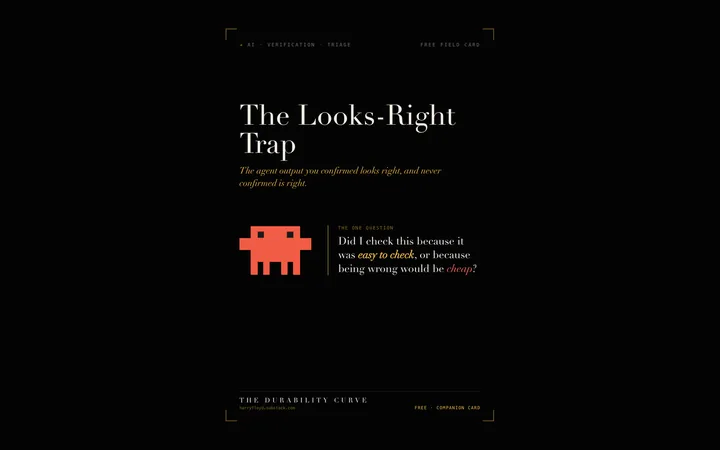
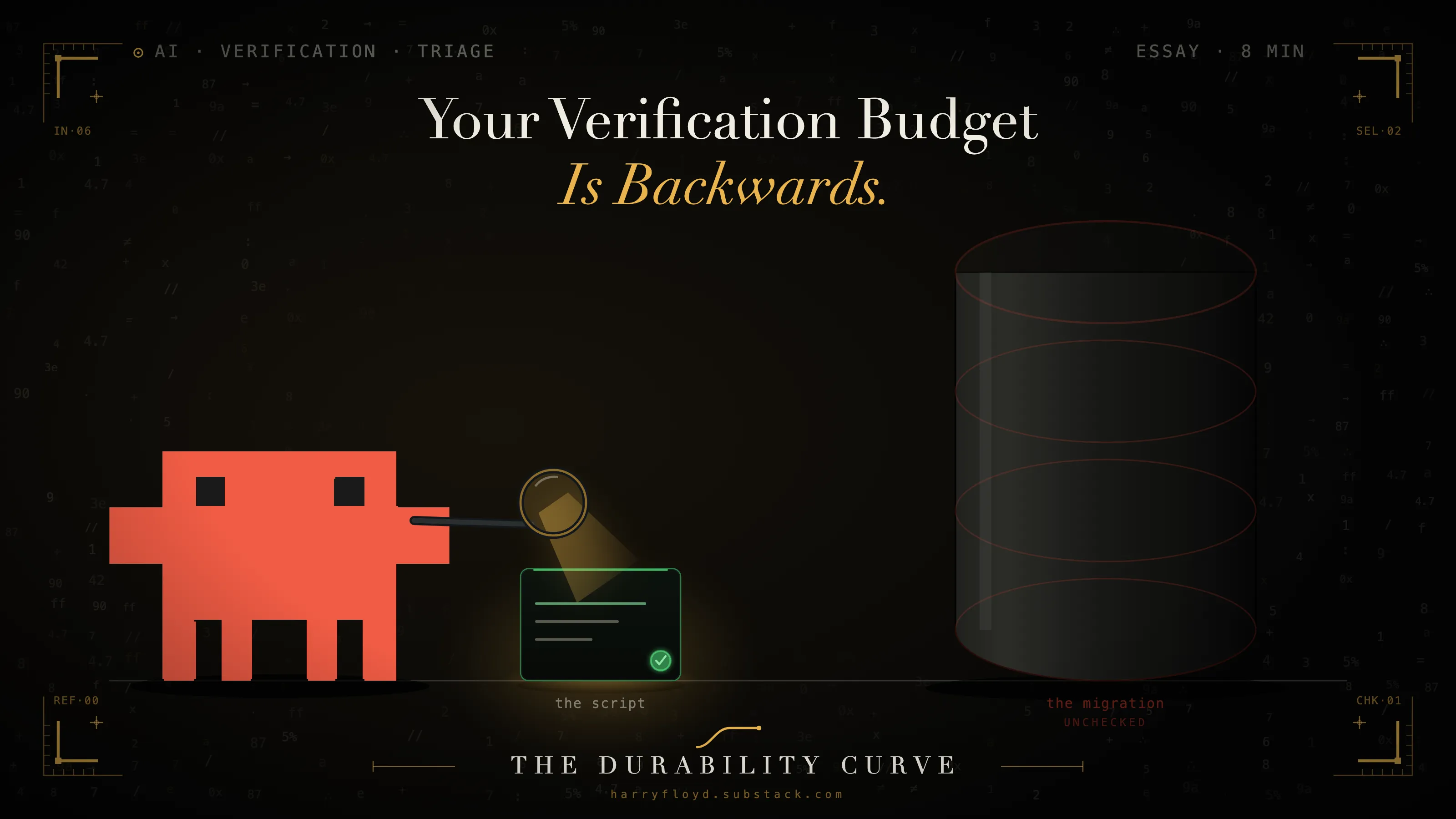
- Your Verification Budget Is Backwards You can't check everything your agents produce, so you're already triaging. Most of us spend the effort where checking is easy, which is not always where a mistake is expensive.
- Your AI Looks Best Where You Can Check It Least When the first failure is terminal, you cannot iterate your way back.
- You Reach Before You Think What leaning on AI for every small decision quietly does to your own judgement.
The other essay under Law V
How it could be wrong
What would break it
What would count as proof it is wrong. When a test meets the old version, the law is rewritten and the change is recorded beside it.
A system that aimed its capability at a poor stand-in for the real goal, where the miss could not be spotted or could not be corrected, and which still improved over time.
Rewritten on 2 Sept 2026, when two tests met the old version.
What changed, and why
· after two tests
Two separate tests each found one contested break in the old wording, which said more capability on the wrong target makes things worse. Aiming wrong always wastes the effort; whether it harms the whole system depends on whether the miss can be spotted and corrected. Sildenafil, aimed at the heart, was spotted and re-aimed; leaded petrol’s harm went unseen by those aiming it; microfinance, seen late, ended up costly and roughly neutral. And a target that looks crude can turn out to be enough, as predicting the next word was for language models. So a suspected wrong target is now a hypothesis to test, not a verdict.
The exact wording, as the framework records it
Misaimed capability always wastes the aimed-at effort, but harms the system only when the misfire is hard to detect or re-aim — so treat a suspected wrong target as a hypothesis to test, not a verdict.
The full statement
When a system underperforms, the failure is frequently misdirection rather than insufficient capability — the system has the capacity but aims it at the wrong level of abstraction. AMENDED 2026-09-02: this is a diagnostic HYPOTHESIS, not a certainty. Misaiming always wastes the aimed-at effort, but whether it harms the SYSTEM is conditional on whether the misfire is cheaply detectable and re-aimable: detectable and re-aimable, misaiming becomes search and the system improves (drug repurposing); undetectable within the aimed-at frame, it becomes harm (leaded petrol); detectable only late and not re-aimable, it becomes expensive neutrality (microfinance) — a third outcome the original "worse, not better" dichotomy omits. And because a crude-looking target may be a sufficient statistic for the objective, which you usually cannot know in advance (LLM scaling on next-token prediction), the right response to a suspected misaim is to test it with a cheap independent signal, not to assume adding capability will harm.