The Day Job 1 of 2
The Work That Comes Due After You Leave
A checklist can only confirm the steps you remembered to put on it. The one you forgot is caught by a record you did not write.
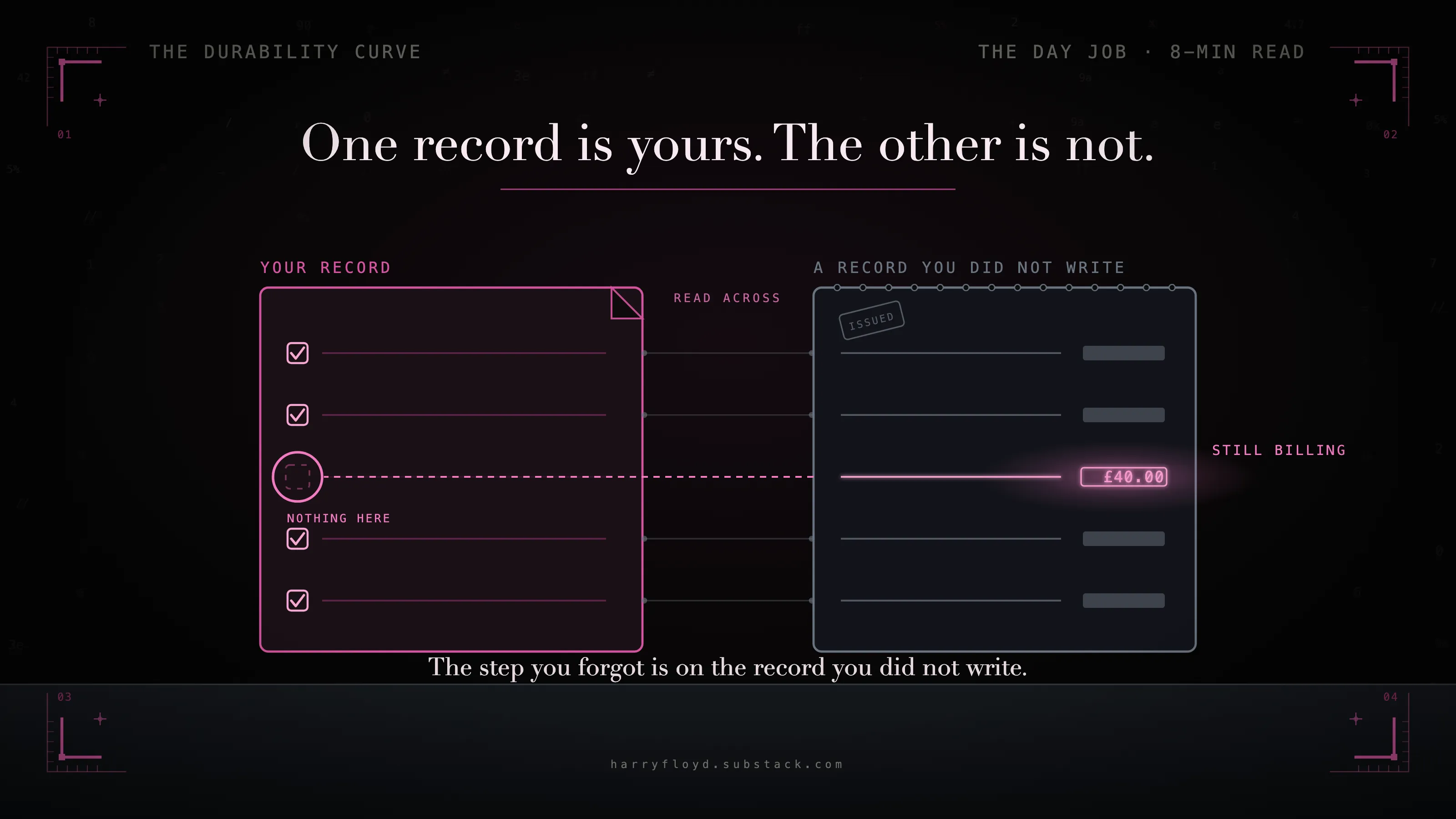
You finish something. A project wraps, a client signs off, a piece of work goes out for the last time. Then there is the tail, the small handful of things you do afterwards, none of which take any real time. Mark it done. Tell them it is finished. Cancel the paid seat you bought for it. Switch off the weekly update that goes out to them every Monday.
Four steps, four different places: the tracker, your email, wherever the card gets charged, whatever tool sends that update. Later you check one of them, probably the tracker, because that is where you look to see whether things are finished. It tells you the job is done, and it is telling the truth about the only step it can see.
Switching off the update is the one that did not happen. Months later it is still arriving, every Monday at nine, to someone who stopped being your client a long time ago. Nothing is wrong with the system that sends it. It is doing exactly what it was told, on time. From where you are standing, the failure looks exactly like everything working, and that is the whole of the problem.
The tracker is not lying. A job that touches four systems has four different ways of still being open, and the tracker sees only the one it holds. Done was never one state; a single word just made it look like one.
Why the small steps are the ones that go missing
The tempting explanation is that you were busy, or careless, or need a better checklist. I want to offer a more specific one, because it tells you which steps will go wrong instead of telling you to try harder.
A checklist is a list of the steps you thought of. It is good at holding you to those. What it cannot do is mention a step that never went on it, and the steps that never go on it are not random. They are the ones that cross into a system you do not quite think of as part of the job. You wrote the list around the place you do the work, and the step that lives somewhere else did not occur to you, for the same reason it will not later occur to you to check whether it happened.
Making a second list does not save you, and that is the part worth sitting with. If you build the second list from the same picture of the job, the same step is missing from it too, and now you have two records that agree with each other and are both wrong. That is not a hypothetical: your tracker is that second list. You filled it from the same picture of the job, so it agreed the work was done and was wrong in the same place you were.
And a missed closing step does not stay missed quietly. An ordinary task you skip just sits there until you come back to it; a closing step you skip stays open until something closes it, and until then it keeps acting, every day or every month, on its own.
The check has to come from somewhere you did not write
So the thing that catches the missing step cannot be your own account of the work. It has to be a record that something else kept, for its own reasons, whether or not you remembered the step.
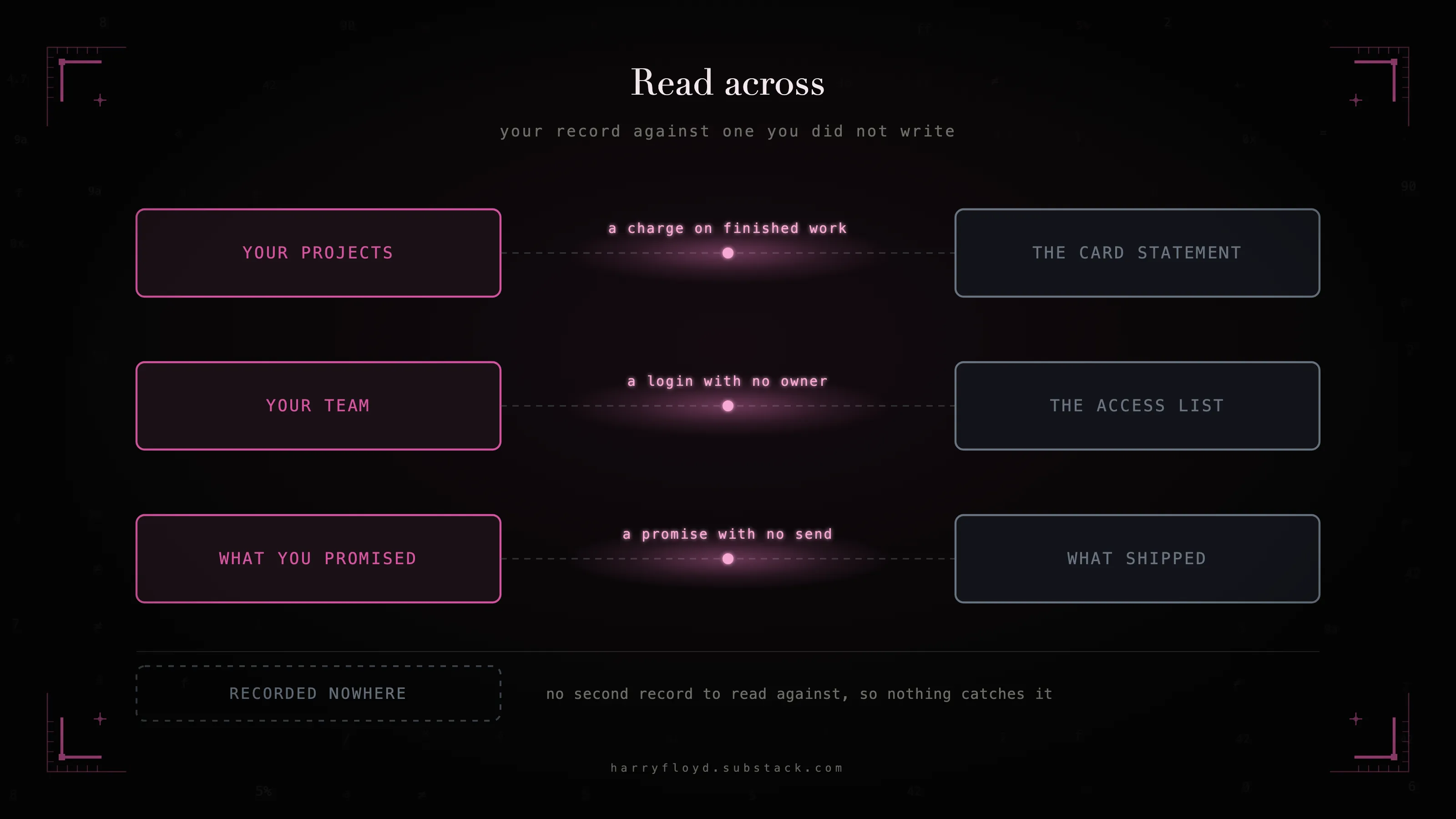
You already have several of these. You just do not read them against the job. The card statement is one: the bank records the charge whether or not you remember the seat you meant to cancel, so the seat that is still billing turns up as a line you cannot attach to any live piece of work. The access list is another: the system logs who can get in whether or not anyone told it that a person left, so the account that outlived the project is a login with no current owner. What actually shipped is recorded by the thing that shipped it, so a promise you made and never delivered stands as a commitment on one side with no send on the other.
Even with a checklist I take seriously, I did this. I keep a written routine for finishing an essay, detailed, with a warning next to the item that slips most, and my archive quietly slipped twenty-three pieces behind what I had published since late spring. Copying each finished piece across to that archive had never been a line on the routine at all: it lived on a different system, so it never occurred to me to write it down. What caught it was the published record of what had actually gone out, kept by the platform and owing nothing to my memory. Held against the archive, it showed the twenty-three at once.
The move itself is old. Accountants have reconciled two sets of books this way for centuries, and there is nothing here to invent. What is easy to get wrong is what makes the second record worth anything: not that it is a second record, but that something other than your own memory produced it. Two dashboards drawn from the same database, or two lists built from the same picture of the job, only look like a check, because the same forgetting shaped both. A record can catch you only when your forgetting could not have reached it too.
One question to carry
That gives you a single question, and it is worth more than any checklist. Of anything you lean on to tell you a job is finished, ask: would this still be here, and still say the same thing, if I had forgotten the step entirely?
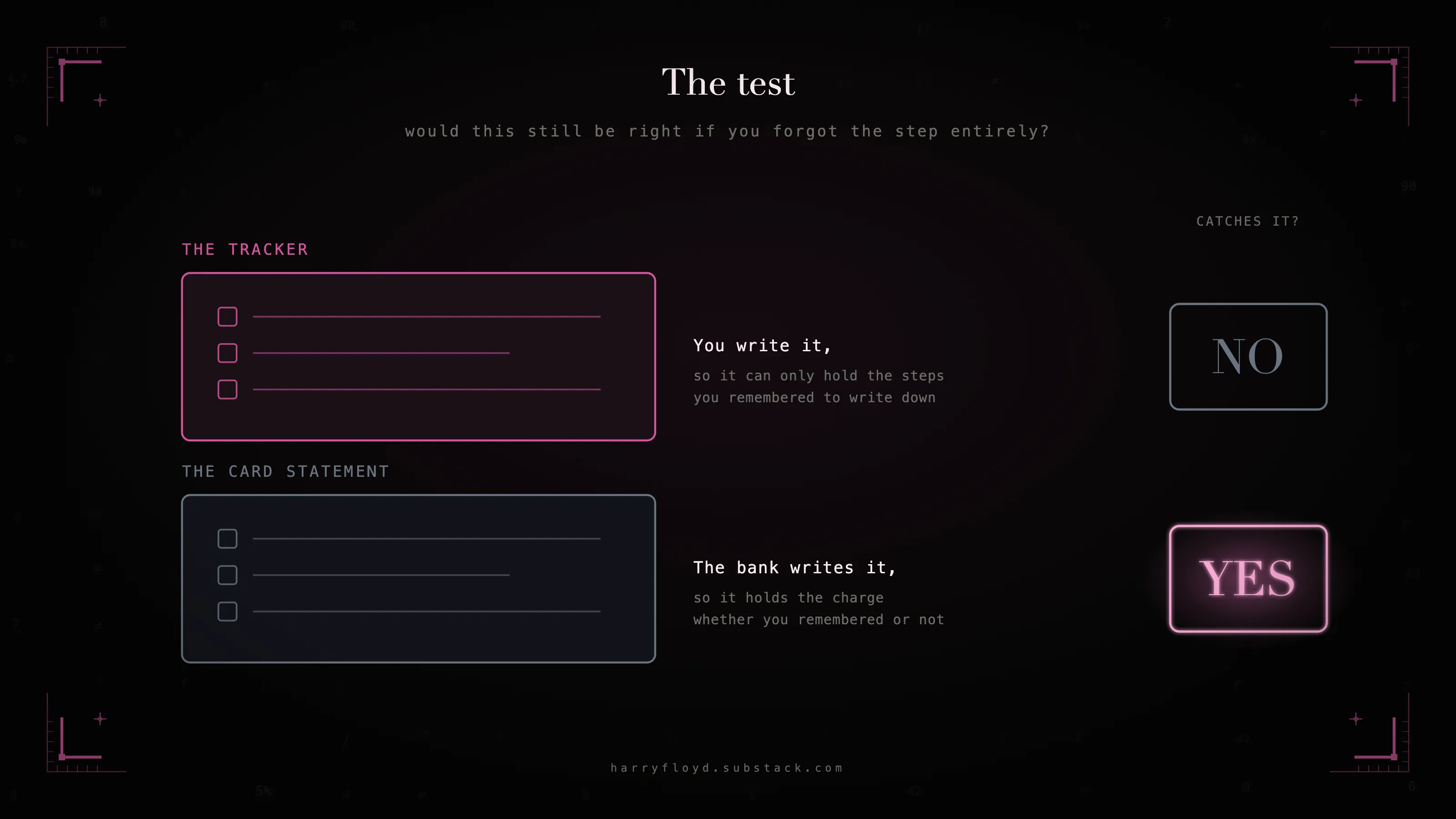
The tracker fails that question: you fill it in yourself, so a step you forget is a step you also forget to log, and it stays green over a gap it never knew about. The card statement passes, because the charge is there whether or not you remembered the seat. A check built from your own memory cannot expose the step that memory left out.
The question keeps its shape as the instrument gets bigger. A tracker, a dashboard, a report you write on your own project: each is an instrument you fill from your own picture of the work, and each is blind in the same place you are. The statement is worth more than any account you write of what you meant to do, for the same reason an audit leans hardest on evidence the audited side did not get to shape.
The part you can use
Here is the version you can run on your own job this week.
Write out the routine you run after you finish something, every step, including the ones that feel too small to be worth writing down. Mark each with the system it touches: the tracker, the calendar, the billing account, the shared drive, the tool somebody set up before you arrived. This is not the check yet. It is how you find which records are worth reading against each other, and it usually turns what felt like one job into the three or four systems it was always made of.
Then there are two ways to keep a step from being lost, and the first is much stronger. Where you can, do not rely on catching the step at all; arrange things so that forgetting it does no harm. Anything that runs on its own, a payment, a subscription, a recurring invite, an access granted for a single project, gets its end date on the day you set it up, while you still know what it was for. Something that expires unless it is renewed cannot outlast your forgetting, because forgetting it and ending it become the same act. Reach for this first; it removes the obligation instead of watching it. Its limit is the one this piece began with: you can only set an end date on a step you thought of, and the step that never made the list cannot be made self-closing.
For everything you could not foresee, or cannot make expire, there is the slower move: read your own record against one you did not produce. Your active-projects list against the vendor or card statement, looking for a charge attached to work that has already finished. Your list of who is on the team against the access export from whatever holds the accounts, looking for a login with no owner. The commitments in a signed contract against what your team actually sent, looking for a promise with no matching send. Choose the second record by the causal test, not by where it happens to be stored: pick the one your own memory did not shape.
How often you look depends on how much damage you will let build up first. A ten-pound seat can wait a month; a former colleague who can still open every file cannot, and something confidential still reaching the wrong person is not a scheduled job at all. None of it needs a tool you have to build: a read-only export or a screenshot is enough, and where you cannot pull the record yourself, the person who can is an email away, not a project. And reading across only points to a mismatch; you still have to look and decide whether it is a real miss, a timing lag or a duplicate, and keep that verdict for yourself.
What none of this fixes
Two things survive all of it, and I would rather say so than leave the tidy version standing.
The first is the record that was never kept. If something gets finished and lands in no system at all, no charge, no log, no row anywhere, then there is no second record to read it against. You cannot check against a record that does not exist. That case surfaces only when a person happens to notice, or is told.
The second is quieter, and more common. If the same blind spot sits in both records, they agree, and the agreement looks like an all-clear. This is the failure I walked into the first time I tried to build a check like this for myself. I searched my files for links to the publication. That sounds like reading an independent record, until you notice it read the same surface I would have: it counted the times I had linked to old pieces inside new ones as though that proved the old ones had shipped. Independence is the whole of the mechanism, and when it is missing it fails without a sound.
So the honest tally is smaller than the tidy one. The obligations that leave a trace in a record I did not write, I can now catch, once in a while, in half an hour. The ones that touch nothing outside my own attention, I am still carrying in my head, and I have learned how little the word covers when I say nothing is wrong. Nothing is wrong and nothing I can see is wrong are different sentences, and most of the time only one of them is available to any of us.
Comments are on the Substack copy. If an essay was worth one, buy me a coffee.
It rests on Law IV, Instruments Over Theory, one of the laws this publication tests against the evidence.
Claude and ChatGPT can search this archive and its claim ledgers once you add the connector.