Law III
Architecture Outlives Content
Where a system runs a process, the structure persists while the content turns over, so the structure is the moat. Where a system preserves something, it inverts: the content is what matters, and the structure can be rebuilt from it.
- StandingRevised under pressure, relied on
- Last tested18 Aug 2026
- RevisedOnce
- AppliesOver five to twenty years: what survives several changes of bottleneck
Narrowed after a test in August 2026. The narrowed wording has not been tested yet.
Ask this of your own work
Does this system run a process or preserve something? Then ask what survives when the pieces change.
Two examples
Runs a process: if a product can swap the model underneath and its customers barely notice, the value lived in the structure around the model: what it could see, what it could change, how failures were caught.
Preserves something: when the Aleppo gene bank lost the ability to regenerate its seeds in 2012, 83% of its 141,052 seed samples were held in duplicate at Svalbard. Only 1,657 were lost, and the seeds rebuilt gene banks in Lebanon and Morocco.
Run it on your own work
Start with
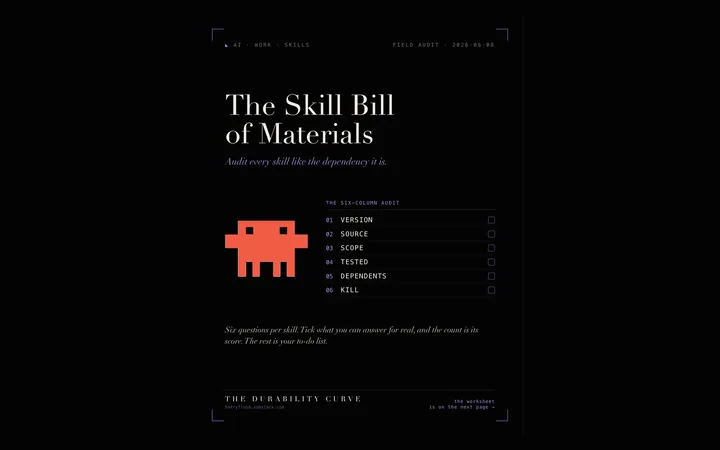
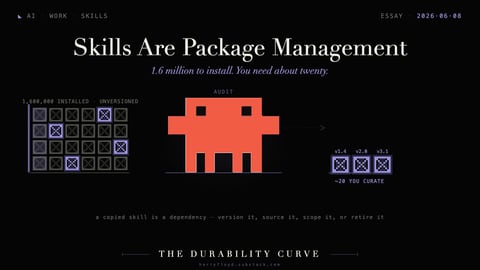
- Skills Are Package Management for Your AI There are millions of agent skill files to choose from. The hard part is deciding which deserve trust, how to version them, and how to retire them.
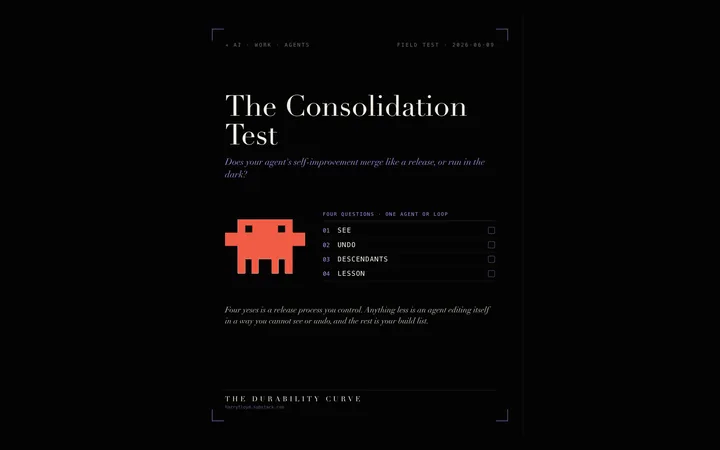
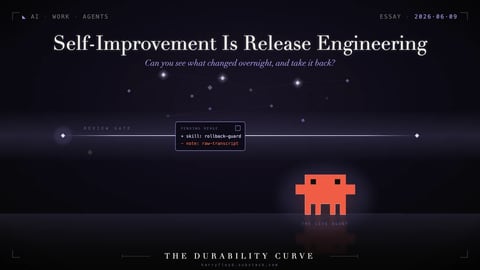
- Self-Improvement Is Release Engineering Your agent can rewrite its own memory and skills overnight. The hard part is whether you can see what changed and take it back. That makes self-improvement a release-engineering problem.
How it could be wrong
What would break it
What would count as proof it is wrong. When a test meets the old version, the law is rewritten and the change is recorded beside it.
A system that preserves something which kept working after it lost the content but kept the institution. Or a system that runs a process which kept working on its content alone, after its structure was gone.
Rewritten on 18 Aug 2026, when a test met the old version.
What changed, and why
· after a test
A test of five cases broke the old wording three times, and every break was a system that preserves something: seed banks, scripture passed down, a musical repertoire. The one survivor ran a process. So the law now splits the two, and it rules out something the old wording allowed.
The exact wording, as the framework records it
Scaffold persists; content turns over; the moat is structure — in PROCESS systems. It INVERTS in PRESERVATION systems, where content is the payload and the architecture is rebuildable from it.
The full statement
In every persistent system — biological, cognitive, or digital — what endures and compounds is the organisational structure, not the individual components. Content turns over; scaffold persists; function is maintained. AMENDED 2026-08-18: this holds where the system's function is PROCESS — the content is a substrate the structure operates on, and structure is what re-instantiates function. It INVERTS where the system's function is PRESERVATION — there the content is the payload, the architecture is replaceable delivery machinery, content continuity is what maintains function, and the architecture can be rebuilt FROM the content.