The Human Layer 6 of 9
The Safe Parts of Your Job Are the First to Go
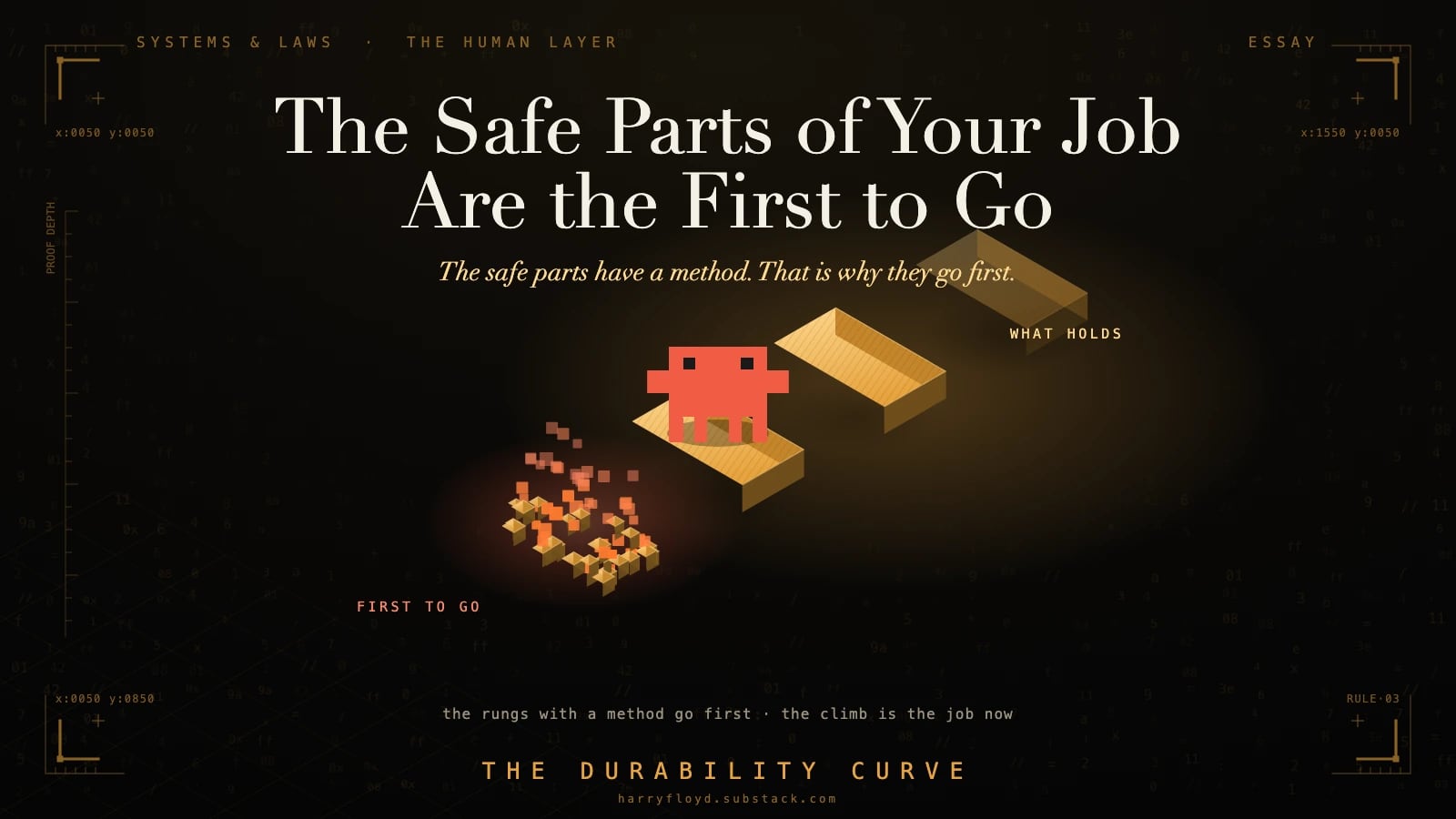
The parts of your job with a method feel the safest. A method is the first thing a machine learns.
A junior analyst spent two years getting good at building financial models. Last month she watched a colleague produce, in ninety seconds and a sentence of plain English, the kind of model that used to take her a careful afternoon. The output was not perfect. It was good enough to be frightening, and it raised the only question that matters: what part of this was ever mine?
The question has a sharper edge. The part of your work you are proudest of may have been valuable only because it used to be hard, and the hard part just got cheap.
The reflexive answers are bad ones. “Humans bring creativity.” “Humans bring the human touch.” These are comfort blankets, too vague to act on. The real answer is narrower, and it comes with a catch. Human judgment survives at five specific places, all of them sitting above the task itself, and each one can be named. Naming them is the easy half. The harder half, the part almost nobody tells you, is that the same cheap generation eating the task is thinning out how many people are left to do the part that survives.
The part that stays yours
Map every time the work genuinely needed a person and the same shape keeps appearing. Someone has to understand what the system is actually doing before trusting it. Someone has to choose which outputs are worth keeping. Someone has to approve the actions that cannot be taken back. Someone has to hold a decision steady while the outcome is still uncertain. And someone has to decide which problems are worth solving at all.
None of those is production. Every one of them is a decision about production. The analyst’s two years went into producing the model. The part that stays hers is the judgment wrapped around it: whether the model’s assumptions survive contact with reality, whether this is even the right question, whether the number is one she will stake her name on.
What survives is the deciding: whether the thing is right, whether it is worth doing, and whether you will stand behind it.
The machine is already climbing two of them
Not all five are equally safe, and pretending they are is how people get caught. Two of them run on a method you can name: understanding what the system is doing, and approving what it produces. Those are the parts that feel safest, the ones with a title on the door and a process you can defend, and that is exactly what makes them the first to go, because a method is a thing a machine can learn.
The first, comprehension, is real and also the most procedural of the five. Think of the analyst who trusts a model all quarter, not noticing it has quietly drifted. The day it is finally wrong, it is wrong in a way she would have caught a year ago, when she still built these by hand. Comprehension is judgment, but the kind that runs on a method, and a method is exactly what these systems learn. It has to be redone as the models drift, and it keeps getting cheaper to do and more dangerous to skip. It survives, but it is not where you want your weight.
Approval gates are the same story one level up. Today a person approves each tweet before it publishes, each budget change before it spends. As the systems get more trustworthy, that gate does not disappear. It rises. You no longer approve individual posts; you approve the strategy that generates them. The judgment moves from the action to the rule. Higher stakes, lower frequency, fewer people needed. If your contribution is approving individual outputs, the machine is climbing toward your rung. The subtler trap is the gate that becomes theatre: you sign off on what the system already decided, and the ceremony of judgment survives while the real deciding has moved somewhere you are not.
A rubber stamp feels like control until someone asks what you actually decided.

Approval that has become theatre: you stamp what the system already decided, and the deciding moves upstream, where you are not.
Three of them grow more valuable as execution gets cheap
The durable places share something, and it is not that machines are bad at them. A model can reproduce the safe middle of what has been done before, and do it well. None of the three asks for more of that. Taste is owning a call no one has made yet. Composure is being on the hook when it goes wrong. Meaning is caring which call was worth making at all, once the rewards are gone. A bigger model closes none of them, because none were ever about capability. A sharper model improves the recommendation; it does not make the choice less yours.
The first is taste, the willingness and the ability to throw most of the work away. A designer generates fifty options and keeps two; the fifty cost almost nothing now, and the value moved into the eye that knows which two deserve to exist. A model can mimic an eye it has been shown, even a strange and particular one. What it cannot do is own the call no one has made yet, staking a name on a judgment before there is any record it was right. So cheap generation does not level the field; it tilts it toward whoever already has the eye to filter the flood.1
Generation is free now, so the value moved into the eye that knows what to throw away. The cheaper the tools, the more your taste is worth.
Taste is the answer most people land on, and it is a right one. The two that follow get left out, because they are harder to name and harder to fake.
The second is composure, the capacity to hold a position when the outcome is uncertain and the pressure is real. A product lead keeps the launch date when the early numbers come in soft, because she sees what the room in a panic cannot. A model can draft every email in that launch, and it can recommend holding the line. What it cannot do is be the one who could overrule that recommendation, the one whose name ends up on the call and who carries what follows. It is the same nerve that keeps a charge nurse steady when the ward turns, or lets a foreman stop a job he knows is wrong before he can prove it, far from any screen. Composure counts only when the holding is a real choice, one you can refuse and sometimes do. A signature you were always going to sign is the rubber stamp from before, not composure. You build the real thing by standing there when the call is yours.
The third is meaning, the choice of which problem is worth the work in the first place. A model can rank your options and argue well for any of them. What it cannot do is be the one the answer belongs to, the one who still cares once the rewards run dry. A manager can ask a model which project earns the most; it cannot decide whether her team is built to move fast or to be the one people trust, a choice that makes it a different company in five years and never shows up in the numbers. That is a commitment someone has to make and then live inside, and it decides which of those ranked projects gets built, defended when it gets hard, and kept alive after the first reward is gone. A model can run any mission you set it flawlessly. It cannot tell you which one is worth a decade of your life.
Three skills, then, harder than the method they replace: the taste to keep what deserves keeping, the composure to own a call you cannot be sure of, and the meaning to choose what was worth doing at all.
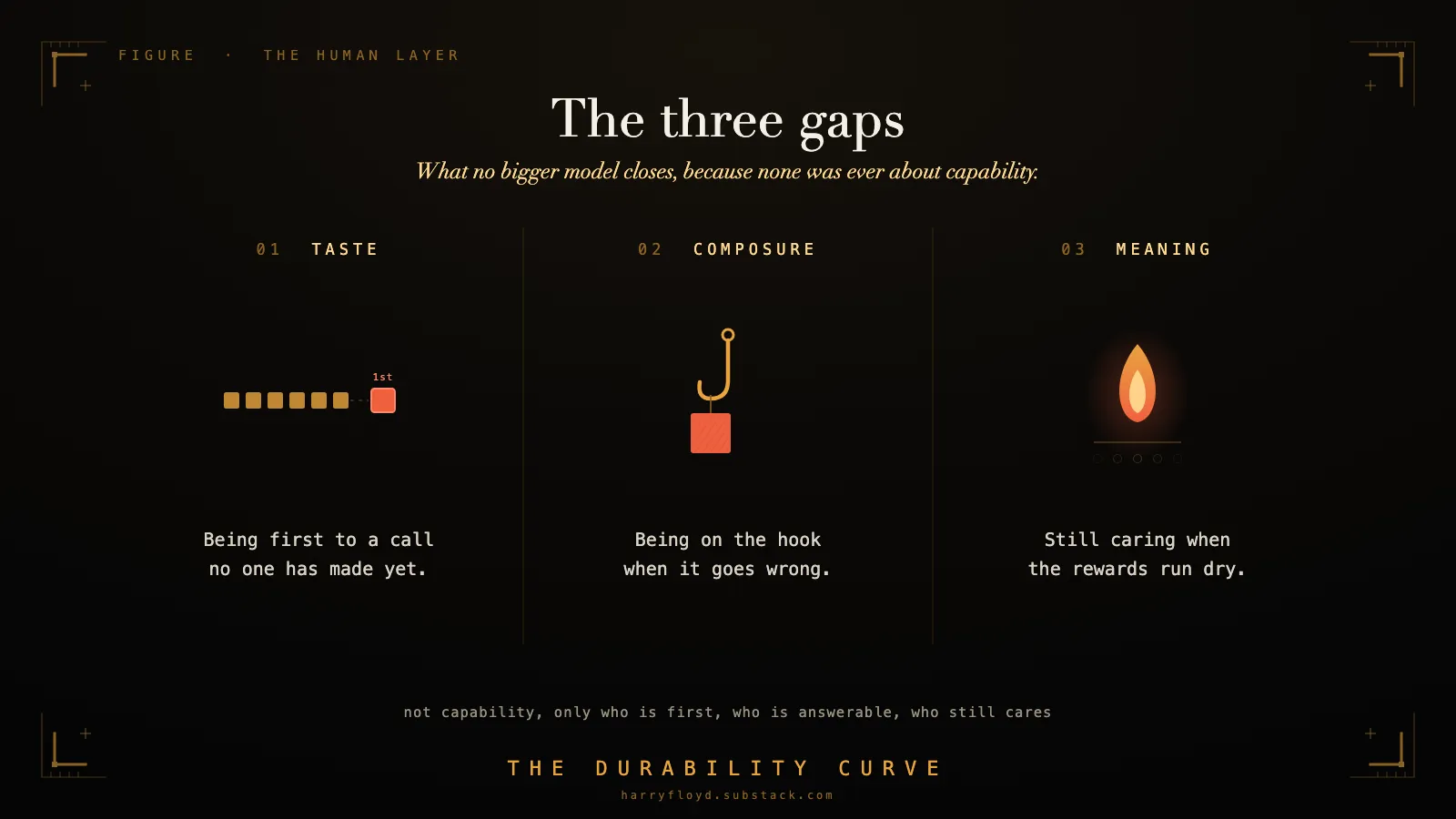
The three gaps a bigger model cannot close: being first to a call no one has made, being on the hook when it goes wrong, still caring when the rewards run dry.
The catch: the durable work is concentrating
Here is the part almost nobody names. Organisations are not only automating the routine; they are rearranging the work so that far fewer people are needed to exercise judgment at all. One person sets the rules an agent runs inside, with kill switches and a review cadence, where a team of ten used to weigh each call. The judgment did not vanish. It pooled into fewer hands, worth more and held by fewer people every quarter. For the people those hands used to belong to, the work flattens into something an agent runs and a single person above them signs off.
So the durable work is real, but it is not a place to hide. It is a narrowing space. As generation gets cheaper, the flood of output makes the eye that sorts it scarcer, and the shape of the organisation makes the seats scarcer at the same time, squeezed from both ends.
That is what turns the whole picture from a reassurance into a deadline. Defending the rung you stand on is the losing move; that rung is where the automation is heading, and the rungs above it are filling up. The play is to climb now, while there is still room, into the judgment that is concentrating before the seats are taken.
Go back to the analyst. She thought the model was the asset, the thing two years bought her. The model is cheap now. The asset was the judgment wrapped around it: whether she knows when not to trust the number it hands her.
Where to start
Run the test on three things you did this week. The weekly status deck is a method: defined inputs, a set format, a right answer. That is the doing, and it is leaving; what stays yours is the judgment around it, which number actually moved a decision and which is decoration. Approving the team’s copy is an approval gate, so ask the honest question, whether you are deciding or signing what the system already chose. If it is the second one, the deciding has moved above you, and the climb is to own the rule that writes the copy. Choosing which of three bets the team makes next quarter runs on no method at all, and your name is on it; that is where an hour of your attention is worth the most. Three answers, and their shape is the shape of your whole job: how much of it is the doing that is going, and how much is the deciding that concentrates.
Then start with the smallest version, because it is the one you can do today. Find one judgment you have been quietly outsourcing to “I just need a better tool” or “I just need more information.” Look closely and the tool was never the missing piece. What you were avoiding is a judgment: a matter of taste, or the nerve to make a call, or a decision about what actually matters. Name it, and start practising it on purpose. That is the work that stays yours.
The larger move is the same thing across the whole week. Each quarter, take one kind of work you have already mastered and hand it to the machine, then spend the hours it frees on the deciding instead of the doing. Hand over only what you have mastered, though, not the work you are still learning from, because the eye that catches a model’s quiet drift is built by having done the work by hand.
And claim those freed hours on purpose, because if you do not, the people above you will. The time you save gets captured upward unless you spend it climbing; left alone, it turns into more of the same work, not hours that become yours. Judgment one rung up is different: it is the rare thing you build that walks out the door with you, where the output you produce was only ever the company’s.
If you have nothing mastered yet, the move inverts. Do not rush to hand the machine the entry work it could do for you; that work is where the eye gets built. Do it by hand first, then check the machine against yourself. Early on, the hours you spend doing are the asset, not the hours you save.
One question for Monday: which judgment have you been calling a tools problem, telling yourself you just need a better system, or a bit more information?
Footnotes
-
The “generate many, keep few” practice and the claim that taste compounds unequally in an AI era are synthesised from working designers and creators alongside the taste-prerequisite stack (exposure, volume, willingness to eliminate). The mechanism: cheap generation removes the production bottleneck and leaves selection as the binding constraint, so accumulated taste becomes more decisive, not less. A model can reproduce an eye it has been shown, even an idiosyncratic one; what it cannot do is own the choice no one has made yet, which is where taste at the frontier has always lived. ↩
Comments are on the Substack copy. If an essay was worth one, buy me a coffee.
It rests on Law I, Bottleneck Migration, one of the laws this publication tests against the evidence.
Claude and ChatGPT can search this archive and its claim ledgers once you add the connector.
2 other essays point here
- The Difficulty You're Escaping Was Making You
Protect the few capacities you want to have built: your judgement, your taste, your way of finding your way.
- Start Here: What Survives When The Surface Changes?
Read The Safe Parts of Your Job Are the First to Go, then The Difficulty You're Escaping Was Making You.