Law I
Bottleneck Migration
Value moves to the most stubborn adjacent layer. Usually that is upward, as the layer below commoditises. When the scarcity is physical or institutional (compute, power, fabs, regulatory access), it moves down instead.
- StandingRevised under pressure, relied on
- Last tested21 Jun 2026
- RevisedOnce
- AppliesOver the next one to five years: where the scarcity sits now
Revised in June 2026, when the publication’s own uses of it pointed down as well as up.
Ask this of your own work
If this layer becomes abundant, where does scarcity move next?
An example
Access to AI models got easy, so the scarce work moved to what sits around the model: the traces, the evals, the contracts and the workflow integration. Generation got cheap; verification became scarce.
Run it on your own work
Start with
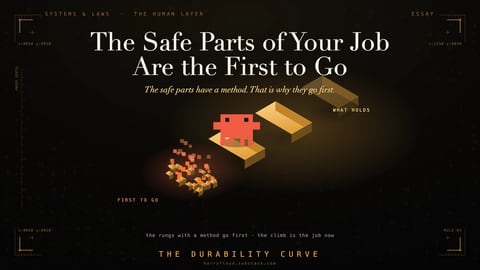
- The Safe Parts of Your Job Are the First to Go The parts of your job with a method feel the safest. A method is the first thing a machine learns.
- Your Tools Got Powerful. Get Boring. The most powerful tools in history reward the most boring strategies. The gap widens every time they improve.
- Three Hidden Bottlenecks the AI Buildout Has Already Moved Past GPUs NVIDIA's GPU shipments are not the binding constraint anymore. The supply chain has voted on what comes next.

The other 10 essays under Law I
- Your Research Agent Cites Sources It Never Read11 Jul 2026
- Your Multi-Agent System Is an Org Chart7 Jul 2026
- Your Benchmark Measures a Sprint. Your Agent Runs a Marathon.1 Jul 2026
- How Long Until Your AI Edge Stops Paying?28 Jun 2026
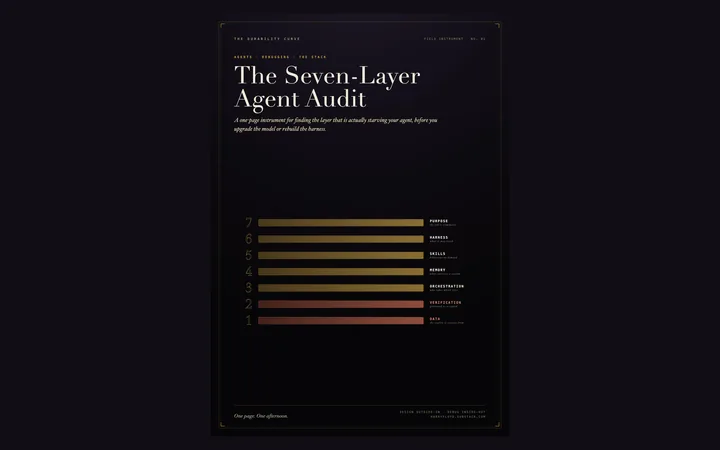
- The Seven-Layer Agent Audit17 Jun 2026
- The Cheaper Fix You Keep Skipping16 Jun 2026
- Right About AI, Wiped Out Anyway6 Jun 2026
- You Only Hold Four Thoughts4 Jun 2026
- The Other Half of Compute3 Jun 2026
- NVDA Q1 FY2027: The Networking Number That Changes the Story21 May 2026
How it could be wrong
What would break it
What would count as proof it is wrong. When a test meets the old version, the law is rewritten and the change is recorded beside it.
A field where a layer became abundant or automated and the value stayed put: the same layer kept earning its scarcity premium, and the bottleneck moved nowhere, up or down.
Reworded on 21 Jun 2026 along with the law, to count a move in either direction.
What changed, and why
· after its own uses pointed both ways
It used to say value always moves up. It can also move down, to the physical or institutional layer, when that is where the scarcity is. Moving up is still the usual case.
The exact wording, as the framework records it
Value migrates to the most-resistant adjacent layer — usually up as lower layers commoditise, down to the physical/regulatory substrate (compute, power, fabs, access) when scarcity is physical.
The full statement
When any layer becomes abundant or automated, value and scarcity migrate to whichever adjacent layer is now most resistant to commoditisation. Usually that is the coordinating, verifying, and selecting layer above it; when the binding scarcity is physical or institutional — compute, power, fabrication, regulatory access — the locus moves down to the substrate. The bottleneck never disappears; it moves to where resistance is highest.