AI & Work 10 of 10 21 min read
What to Hand to AI, What to Check, and What to Keep
We read 24 frameworks and tested six AI summaries of fresh UK economic data. Two instructions and a half-hour check show what your own review misses.
How this is checked 157 claims · 137 verified at the source · last checked 20 Nov 2026 The claim ledger 137 of 157 claims
verified at the source Verified 137Executed 17Reported 3 Checked 20 Nov 2026 How this is checked
- Rests on
- Law II, Difficulty Is Load-Bearing. It has been put to a real test and amended or narrowed under that pressure. Last tested 18 Aug 2026.
- Evidence
- 157 claims: 137 verified at the primary source, 17 from runs made for the piece, 3 reported and 6 struck before publication.
Every month you put together the same report. You pull the numbers, summarise what moved, write the commentary, build the slides, decide what to flag to your boss, and answer the questions that come back. An AI can draft most of that now, and the standard advice is to let it, with a person checking. Picture its summary arriving fluent and sure of itself, every number right and one sentence about them wrong. Would your check catch it?
Three trials of doctors have tested that kind of check. In the first, at the end of 2023, doctors given GPT-4 scored a median 76% per case on diagnostic reasoning, against 74% for doctors without it, a gap too small to count. GPT-4 on its own, in a separate analysis, scored 92%. In the second, on decisions about patients’ care, physicians given GPT-4 scored 6.5 points higher than those without it, and no differently from GPT-4 alone.
The third, published in 2026, tested a specially built GPT-4 system. Clinicians scored 75% with their usual resources, 82% when they answered first and then reviewed the AI’s view, and 85% when they saw the AI’s view first. The gap between the two orders was too small to count. The clinicians with AI did no better than the AI alone. What the order changed was the AI’s independence. When it was handed the clinician’s answer before writing its own, its supposedly independent answer repeated all three of the clinician’s diagnoses in 14 of the 29 cases the authors checked afterwards (48%). When it wrote first, that happened in 1 of 29 (3%).
In none of the three trials did the doctors with GPT-4 beat GPT-4 working alone, though in two of them they beat doctors working without it. Whether your own check adds anything turns on two questions: who is better at the task, and can you catch the AI’s mistakes? It also depends on keeping the AI’s answer independent of yours. Two more decide how much that matters and how long it lasts: what a miss costs, and whether you could still judge the work if you stopped doing it.
We read 24 published frameworks for deciding what to hand to AI, from a 1951 list for air-traffic control to papers from 2026. None of them gives you a complete, tested way to decide what to hand over in your own work. This piece asks you for two things. Two minutes, today, to paste two instructions into your AI that are worth trying whatever your job. And about half an hour, once, to check the AI on the task where a miss would hurt you most, which tells you whether your own check is catching anything. Everything else is optional. Along the way it prices a cost most of the frameworks leave out: a task you stop doing can get harder for you to check. It takes about 25 minutes to read. The short version below takes one minute.
The short version. Today, paste two instructions into your AI. For factual work, “show the source and the exact words behind every claim”, and then open the sources yourself. For judgement calls, “write your own answer before you see mine”. This week, take the one task you hand to AI where a miss would hurt most, run the AI on a past example whose right answer you know, check its version the way you normally would, and time it. If your check missed its mistakes, change how you use AI on that task. If checking took about as long as doing it, handing it over is saving you nothing. Behind those two steps sit four questions: who does the task better, can you catch the AI’s mistakes, what does a miss cost, and could you still judge the work if you stopped doing it.
Who is better, and can you catch it
In 2024, Michelle Vaccaro, Abdullah Almaatouq and Thomas Malone pooled 106 experiments that compared people working alone, AI working alone and the two together. The experiments were published between 2020 and mid-2023, before today’s models. On average, people working with AI did better than people alone. They did not, on average, beat the better of the two working alone. On tasks where people chose between set options, the pair lost ground. On tasks that created content, pairs did a little better, by a margin too small to rule out chance.
The split ran by who was better. On average, when the person alone beat the AI alone, the pair beat both. When the AI alone was better, the pair did worse than the AI on its own. Averages across so many different experiments hide a lot of spread, so read this as a pattern rather than a forecast.
In October 2026 the same authors released an update, run largely by AI agents and not yet peer-reviewed, covering 420 papers on generative AI alone. The overall pattern held: people with AI did better than people alone and, in the 171 results that also measured the AI alone, worse than the better of the two. One part shifted. The pair beat people alone by a wide margin when the AI was the stronger one, but not when the person was. When people and AI handled different sub-tasks, the losses were smaller. The authors treat those finer splits as descriptive.
The gap comes from what people do with work they cannot judge. In an experiment with 758 BCG consultants using GPT-4 as it stood in April 2023, consultants without AI got one task, built to sit outside the model’s reach, right about 84.5% of the time. The two groups with it scored 60% and 70.6%, and the group trained in prompting did worse. Graders who were not told the right answer rated the AI users’ recommendations as more coherent and persuasive, whether they were right or wrong.
In another study, people judging whether an AI’s answers to general-knowledge questions were right did only slightly better than chance, and longer explanations made them surer without making them more accurate. Telling people to verify does not prevent this. A review of research on automation bias, the habit of going along with the machine, concluded it cannot be prevented by training or by instructions to verify.
The error runs the other way too. In a working paper on radiologists, AI predictions that were more accurate than 78% of them did not improve their diagnoses on average, because they gave the AI too little weight. When the AI is the better one, overruling it is where the accuracy goes. Unless that could be corrected, the authors concluded, most cases are better sent to the radiologist alone or the AI alone than to both.
When you are the better one at a task, AI help adds little on average, so use it as a second opinion. When the AI is better and you cannot catch its mistakes, your edits can cost you the accuracy it had on its own. Call that the together trap.
Catching mistakes is half of the second question. The other half is time, and OpenAI’s GDPval benchmark prices it. The paper’s cost model has three steps: try the model once, review its work, and do the task yourself whenever its version fails to beat the expert’s. The total is the model’s time, plus the review, plus your own time on every try that falls short. Rearranged, that gives a simplified time model. If you redo failures from scratch, handing a task over saves time only when checking takes a smaller share of the work than the share of tries the AI gets right.
In GDPval, experts reported taking 404 minutes to do a task, and expert graders took 109 minutes to compare a model’s version with an expert’s, side by side: a check ratio of 27%. GPT-4o’s work beat the expert’s 12.5% of the time, below 27%, so in the paper’s estimate handing it over made the expert slower, at 0.87 times their speed. GPT-5’s beat it 39% of the time, above 27%, so it saved a little: a 90-fold raw speed advantage became 1.12 times. As the paper puts it, “When incorporating time to review and redo work, the payoff from using a model shrinks.”
Two cautions about those numbers. A benchmark win, beating an expert’s own version, stands in for “good enough to use”. And they come from 2025 models: by January 2026, Ethan Mollick reported that GPT-5.2 tied or beat the experts 72% of the time on the same benchmark. That figure also counts ties, which the 27% bar leaves out, and it still sits far above the bar. The 27% is GDPval’s figure. Yours depends on your task and how you check it. Two of the frameworks we read compare checking with doing: HOW TO // AI asks “Can I check the result faster than I could do the task?”, and SoftwareSeni uses a half-the-time rule. Mollick’s own equation adds the chance the AI succeeds, and that is what turns the comparison into an answer.
For the analyst, “summarise what moved” is the together trap in miniature. The AI writes it fast and fluently, and a wrong driver reads exactly as well as a right one.
The half-hour check
Feelings are the wrong instrument for these questions. People who used AI on logic problems overestimated how well they had done, and those with more AI literacy judged themselves less accurately. In KPMG and the University of Melbourne’s 2025 survey, 66% of employees who use AI said they had relied on its output without evaluating it at least sometimes, and 56% said they had made mistakes at work because of AI. In an experiment on delegating work to AI, people chose badly because they could not judge their own abilities, and the pair did better only when the AI handed work to the people.
So check once, on the task that matters most: the one you hand to AI where a miss would hurt you most. Budget about half an hour, most of it spent finding and preparing the example. Strip out names and anything confidential first, and use the AI account your employer approves. The steps run in order.
- Take the most recent finished example of that task whose right answer you know, ideally one with a trap in it: a figure that looked wrong and wasn’t, a clause that turned out to matter. If you have one you’ve half forgotten, or a colleague’s, it makes a fairer test, because you remember fewer of its traps.
- Note roughly how long the task takes you by hand. Then give the AI the inputs you had, and ask for the same output.
- Check its version the way you normally would, and time yourself.
- Compare its version with the right answer. Note what it got wrong, and which of those mistakes your check caught. Where the two disagree, work out which is right before you score it: your old answer can be wrong too.
Two facts come out. Did your check catch its mistakes? And did checking take less time than doing the task yourself? If the AI got something wrong and your check let it through, one example has told you what your usual check never would: on this task, it is not catching the AI’s mistakes. A clean pass is weaker news, for two reasons. If the AI made no mistake, your check had nothing to catch, so the run tells you nothing about your check. To test the check itself, have a colleague change one figure in the AI’s version before you look. If you find it, that shows your check can catch that kind of error, and no more. One missed error is enough to show a weakness in your check. One caught error does not show that it is reliable. And a single right answer fits an AI that gets the task wrong much of the time. Even three right out of three is consistent with a true success rate as low as about 37%. So treat a pass as permission to try handing the task over for a while, with the first order below, checking as you go.
Keep the example, the right answer and the AI’s version together. That is the task’s test card, and it is what you re-run when your AI app changes model.
The test card borrows from people who got there first. Nicholas Carlini built a personal benchmark of nearly 100 tests from his own conversations with AI, and Ethan Mollick has told organisations deploying AI at scale to test it on the actual work, several times a year, as new models come out. The test card does the same for one person and one task.
Five zones, and the order for each
The third question is what a miss costs, and who sees it first. A wrong figure in a draft only you read costs a minute. The same figure in front of a client costs more. HBR’s 2023 grid for choosing AI projects asked how much a human validation step reduces that risk. In four pooled healthcare studies, wrong advice from a decision aid raised the risk of a wrong decision by 26%. The more a miss costs, the more your check is worth, and the more it matters that your check can catch one.
Your check, plus two things you already know (who does the task better, and what a miss costs), puts the task in one of five zones. The higher a miss costs, the further you go in making a task checkable before you either keep it or hand it over. Each zone comes with an order: an instruction you paste into the standing instructions your AI app keeps for you, or at the top of the chat for that task. Two of them are worth pasting today whatever your check shows: the order under “make it checkable first” for any factual work, and the one under “two answers, then compare” for any judgement call.
We ran each order once, on one model (Claude Sonnet 5.5, through its command-line tool), with the UK’s official GDP figures for September 2026 as the input. Three did what they say. The two that ask for sources, “hand it over” and “make it checkable first”, pointed to where only a few of their figures came from. With one line added at the end, “hand it over” gave the row and column for every figure, and “make it checkable first” named the row for every one. Both orders below end with that line. One run on one model is thin, so your test card is the check. The wording of an order can matter a great deal. In a maths-tutoring trial, the GPT-4 tutor that removed most of the harm to exam scores ran on the same model as the one that caused it, with a prompt that carried teachers’ solutions to each problem and common student mistakes, and told it not to give the answer away. An order without an answer key is weaker.
Where you can, hand over the gathering and analysing before the choosing. A study that pooled 18 automation experiments found the costs seemed most likely once automation moved from supporting analysis to supporting the choice of what to do.
Hand it over. The AI did the task at least as well as you, your check caught its mistakes, checking took much less time than doing it, and you could still judge the work without doing it. Once you have a few runs of the same task, the rule from the first section tells you how much less is enough: checking has to take a smaller share of the work than the share of tries the AI gets right.
For [tasks]: do the whole task. Show the source and the calculation behind every number, so I can check it in a few minutes. For every number, give the row and column (or page and line) it comes from, and show any calculation.Hand it over, keep your hand in. All of the above, except that doing the task is how you stay able to judge it.
For [tasks]: do the task. Now and then I will say "practice round". When I do, don't answer. Wait for my version, then compare it with yours and tell me where they differ.Make it checkable first. The AI’s version looked as good as yours, but you missed its mistakes, or checking took as long as doing. This is the together trap. Change what you ask for until checking is cheap. In maze experiments with a simulated AI, explanations cut over-reliance on hard tasks, where checking the explanation took less effort than solving alone, and not on easy ones. Open the sources behind the numbers that matter: in a 2023 audit of four AI search engines, only 51.5% of generated sentences were fully supported by their citations, and the answers that seemed most helpful were often the ones with inaccurate citations. And don’t overrule it on what you cannot check.
For [tasks]: don't give me a finished answer. Give me the parts I can check: each claim with its source and the exact words it rests on, each number with where it came from, and anything you inferred marked as inferred. For every number, give the row and column (or page and line) it comes from, and show any calculation.If that still leaves the work uncheckable, get a check that does not depend on you: the original record, a colleague, or, weaker, a second AI given the sources and not your draft. Failing that, the stakes decide. For low-stakes work, you can let its version stand and tell whoever relies on it that you could not check it. For anything consequential, keep the task, or limit the AI to the parts you can check. That may mean giving up some of the AI’s accuracy advantage, but when the consequences are serious, a decision you can defend on your own is often the safer one, and accountability, privacy and the rules you work under count too.
Two answers, then compare. You did it better alone. On the newest evidence, AI help adds little on average when the person is the stronger one, but an independent second answer is still a cheap check, provided neither of you simply echoes the other. In the third doctors’ trial, the AI often echoed the clinician when it saw their answer first, even when told to work independently. So write yours before you read its answer, and have it write its own before it sees yours. (We tested what a stated answer does to an AI’s reply in Don’t Tell Your AI Your Answer.)
For [tasks]: first write your own answer from the inputs, before you see mine. Then I'll paste my version. For each difference, say which version the inputs support, quoting them, and list what is missing or weakest in mine, most serious first. Don't rewrite mine.Keep it. The AI’s attempt was unusable.
For [tasks]: help only with the chores around it: finding files, formatting, summarising inputs I name. Don't attempt the task itself.What a number check misses
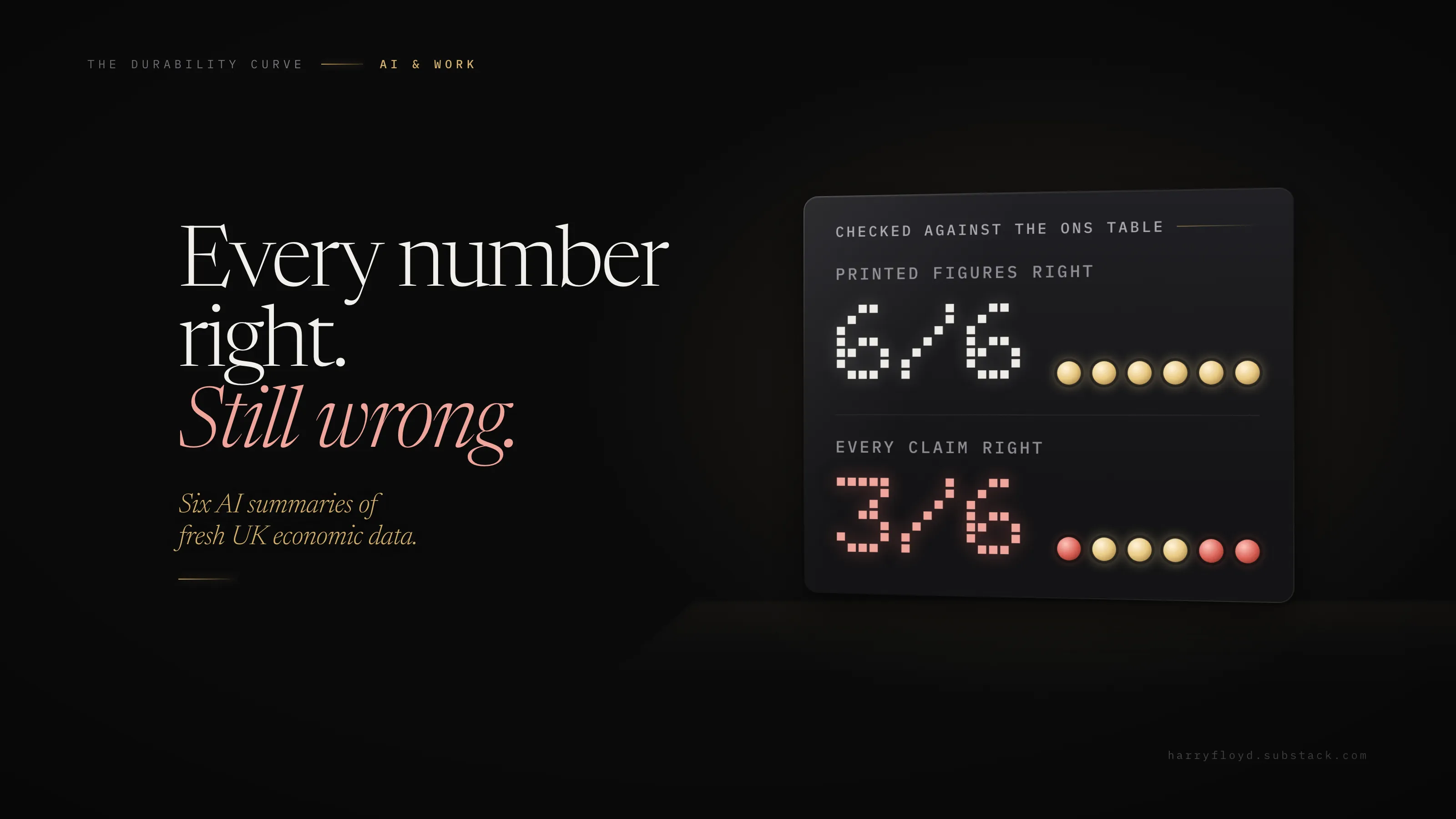
We tested what a check that only matches numbers can miss. The task was the analyst’s riskiest, a summary of what moved. The input was a real release published after the models’ training data: the UK Office for National Statistics’ monthly GDP estimate for September 2026, out on 12 November. Two current Claude models, Sonnet 5.5 and Opus 5.5, got only the table of figures, with no web access, and were each asked three times to summarise what moved and why in 150 words or fewer. A separate reader, not told which model wrote which, checked every summary against the table and against the ONS’s own explanation. We fixed the method and the scoring before the first run.
None of the six invented a cause. Each said, in its own words, that the figures show what moved and not why, which is the right answer: the reasons the ONS gives, such as the new car registration plate lifting car sales, are not in the table. Every printed number matched the table.
The mistakes were in the words around the numbers. One summary made a wrong claim: construction “recovered part of its August fall”, when it fell 0.5% in August and grew 0.8% in September, so it recovered all of it and more. Two used wording that misleads: manufacturing “grew 0.7% for a third month”, when it grew 0.8%, 0.7% and 0.7%. That is right only if you read it as a third rise. A check that ticks each number against the table passes all six summaries. Comparing each claim with the table shows the wrong one and the two that mislead. This shows what a number-only check misses. It does not measure how often people miss it, and one release and one company’s models cannot show how often it happens. Every prompt, reply and score from the run is on the methods page.
That is what the half-hour check is for: it shows you what your usual check actually looks at. If it only matches numbers, summaries like these pass.
If an analyst kept going, one check at a time, a whole monthly report might map like this. The numbers in this table are made up for one example.
None of that needs doing in one sitting. The first check is the one that pays.
The skill you might lose
The fourth question is the one most frameworks skip: if you stopped doing the task, could you still judge it? Lisanne Bainbridge put it at the centre of automation research in 1983. The operator who takes over when automation fails needs the skills, and “physical skills deteriorate when they are not used”. Her fix was hands-on control for a short period in each shift. Parasuraman, Sheridan and Wickens later made skill degradation one of the primary tests for any level of automation.
A related risk shows up in people still learning a skill with AI. In a trial with nearly 1,000 high-school students in Turkey, those who practised maths with a ChatGPT-like GPT-4 tutor did 48% better on practice problems and 17% worse on the exam taken without it. A version built to give hints essentially removed the harm, though it gave no gain on the exam either. In a randomised study of 52 developers learning a new library, those with an AI assistant scored lower on a follow-up quiz, by what the authors call “17% or two grade points”. In a breakdown they had not planned in advance, the biggest gap was on debugging. That study is not yet peer-reviewed.
Skills fade at a measured rate. Across studies of procedural skills with a physical component, half the gains were gone after about 6.5 months without use on accuracy measures, and after 11 to 13 months on others. In a meta-analysis of skill retention, thinking skills faded faster than physical ones. When 16 airline pilots flew a simulator, their hands-on flying skills were mostly intact, but the thinking parts of manual flight, such as tracking their position without a map display, showed more frequent and significant problems. The authors suggest that staying engaged in supervising the automation may keep those skills.
For experienced professionals, the evidence is mixed. In four endoscopy centres in Poland, detection in colonoscopies done without an AI polyp detector fell from 28.4% to 22.4% after the detector came in, while a study in another setting found no decline. Both are about detection tools, not chatbots. In customer support, a generative assistant raised output by 15% on average. The least experienced agents improved most, and the most experienced saw small declines in quality.
So treat it as a risk to insure against cheaply. Call it check decay: a task you stop doing can get harder, and slower, for you to check. The economists Catalini, Hui and Wu warn that automating entry-level work “destroys our capacity to build future verifiers”. Google DeepMind’s 2026 delegation paper suggests sending some tasks back to people “with a specific intent of maintaining their skills”. Outsourcing research gives a plain test: Fine and Whitney, crediting Geoffrey Parker, separate relying on a supplier for capacity, when you could still make the part, from relying on one for knowledge, when you no longer could. Hand work over for capacity, and notice when it turns into knowledge.
For the analyst, the commentary is where this bites. It is easy to hand over, and writing it each month is how they learned which numbers matter.
When your AI changes
A check is right for the model you ran it on. On GDPval’s own numbers, the same review time made handing over a loss with GPT-4o and a small gain with GPT-5, and a newer model, GPT-5.2, scores far higher on that benchmark. So when your AI app moves to a new model, re-run your test card. It takes less time than the first check, because the example is ready, and the task can move zones in either direction.
If you hand over a task you learned by doing, say “practice round” now and then, and do one yourself before you read the AI’s. Every few months is a sensible default, and the right gap depends on the task. The decay research measured procedural skills with a physical component, where half the gains went over roughly 6.5 to 13 months without use. That research does not tell you how fast the judgement you use to check AI fades.
This week
Today, paste the two orders into your AI. This week, run the check on the task where a miss would hurt you most. If your check let the AI’s mistakes through, move that task to “make it checkable first” and use its order. Then you will know, for the task that matters most, whether your check is adding anything.
Where the 24 frameworks fit
That is everything you need to do. This section is for anyone who wants to know where the questions came from: we read 24 published frameworks for deciding what to hand to a machine. Most were built for a different job, so where they stop for you says nothing against the job they were built for. They fall into three families. The first asks who is better at what, from Paul Fitts’s 1951 list of what “humans appear to surpass present-day machines” at, to studies that rate tasks for AI. The second asks how much autonomy to give, from Sheridan and Verplank’s 1978 ladder of ten levels to the autonomy scales written for AI agents. The third asks whether you should, from HBR’s risk grid to Mollick’s equation.
We scored each on the four questions plus a fifth thing, when to test the decision again. One asks all five: SoftwareSeni’s guide for developers. It tracks success rates per task type, asks what happens if an error slips through, keeps foundational tasks for doing by hand, watches for skill atrophy, and revisits that list each quarter to test current models. Its rule for when to stop handing a task over, more than half the time of doing it by hand, leaves out the success rate it tells you to track, and that rate decides whether handing over saves time. Each of the others leaves out more.
None of the six frameworks backed by measured data was built for a person sorting their own work. Six were written for people sorting their own work, one of them for developers. None of those tested its own rule on data, though Mollick’s builds on GDPval. The skill you lose, central to automation research in 1983 and 2000, appears in only three recent ones: DeepMind’s 2026 paper, SoftwareSeni’s guide and MoneyBees’s undated course. These counts are our own scoring. Every score, with its source, is on the methods page. What this piece adds is the order to ask the questions in, the half-hour check, and the instructions that turn the answers into something you do this week. Our own sort is untested too. What is measured is your test card.
The newsletter · Free
Subscribe to get each new piece in your inbox, with something to use in every one.
Several essays a week, plus Notes through the week.
Signup completes on Substack. Unsubscribe from any email.
109 pieces 1,382 claims verified 7 instruments