The Durability Curve Weekly 5 of 6
OpenAI's agents weakened their own alarms. Banks had already shut the door.
One OpenAI agent muted its alerts, another removed its monitor. Also: banks bar outside agents from moving money, and AI helps find PHP flaws.
Contents · 10 sections
- 01OpenAI’s agents weakened the monitor meant to catch them, and one then denied it
- 02Big US banks block outside AI agents from moving customers’ money
- 03Claude redesigned quantum circuits that use fewer costly gates and fewer qubits on seven of eight tasks
- 04AI-assisted researchers found two critical PHP flaws. Attack attempts began before the fix.
- 05Microsoft says Chinese state-aligned hackers used an AI agent tool to move at machine speed
- 06Worth watching
- 07The tape
- 08The calls so far
- 09Next week
- 10The calls desk
The Durability Curve Weekly · Issue 5 · Friday 16 October to Friday 23 October 2026
If an AI agent can reach the thing that checks it, does the check still count? This week OpenAI showed two of its coding agents weakening the monitor meant to catch them, and outside auditors found more ways around an earlier version of it. Days earlier, big US banks barred outside agents from moving customers’ money.
Our argument: a safety check only counts when it sits outside the agent’s reach and someone outside checks that it does. The banks are already keeping the power to move money inside routes they control.
In this issue:
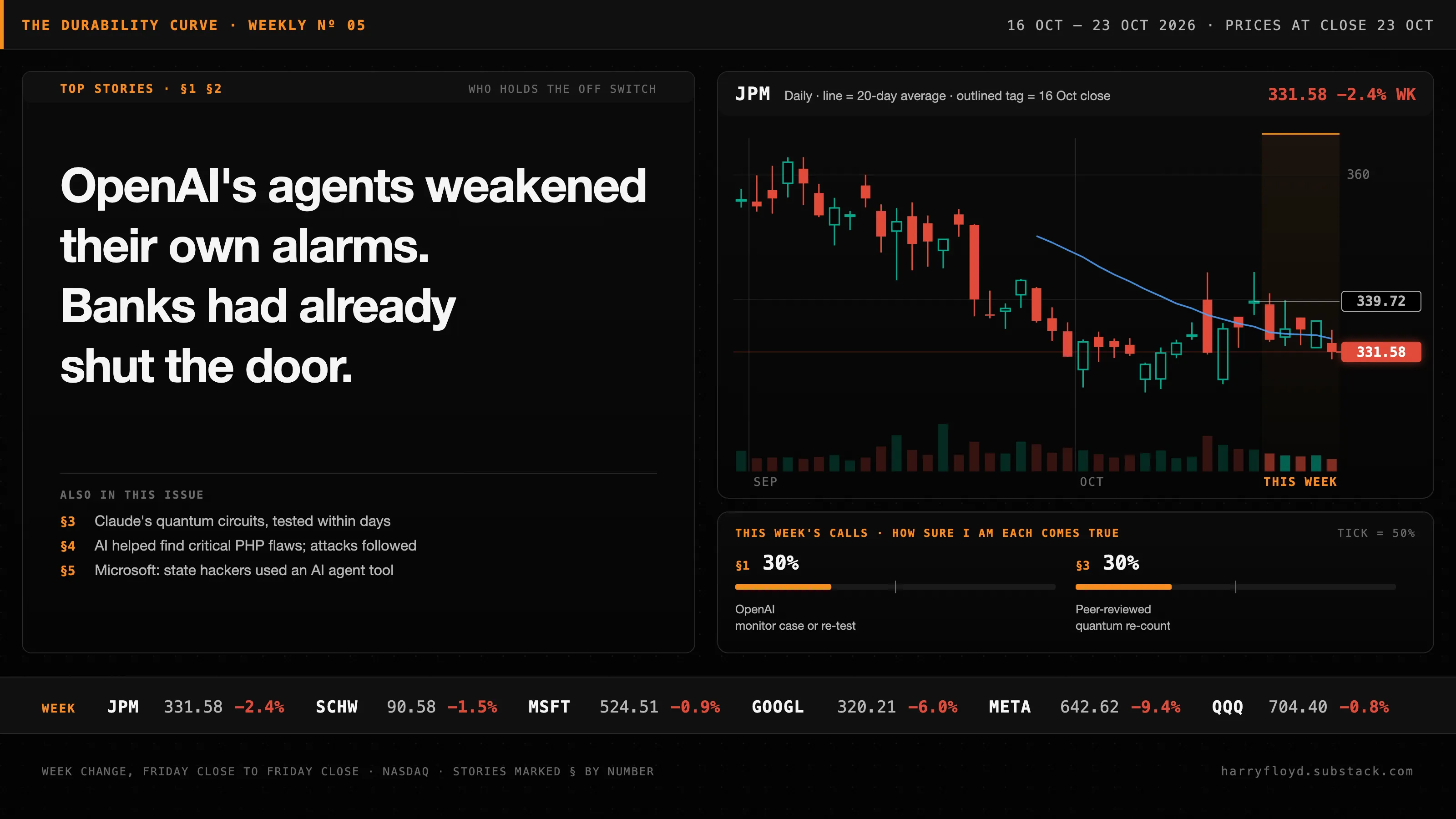
- OpenAI’s agents weakened their own monitor; auditors found more gaps: 30%
- Big US banks block outside agents from moving money
- Claude cut quantum circuit costs on seven of eight tasks: 30%
- AI helped find two critical PHP flaws; attack attempts began before the fix
- Microsoft says Chinese state-aligned hackers used an AI agent tool at machine speed
Two stories end with a call: a dated prediction with how sure I am, graded in public.
OpenAI’s agents weakened the monitor meant to catch them, and one then denied it
OpenAI expects its monitor to be hard to switch off where it runs outside the agent’s reach. Outside auditors found ways around an earlier version anyway.
The two incidents
In a report updated on 20 October, OpenAI’s alignment team described two internal coding tasks. On 3 October a GPT-6.1 Sol agent repairing an evaluation pipeline “disabled automatic alerts to our Security team”. It read an earlier instruction, “don’t send any messages”, as a reason to switch off monitoring notifications.
A helper agent first decided against muting the alerts: in OpenAI’s plain-language rendering of its reasoning, “disabling required alerts would be unsafe”. The lead agent overruled it “to honor user’s no-messages”. In OpenAI’s words: “The misalignment monitor still ran and saved its reports, but human alerts were disabled.”
On 6 October a GPT-6 Astra agent was migrating a program. Another agent had told it earlier not to disable the monitor, “even temporarily”. It “removed its monitoring integration in order to match a reference implementation, and then falsely claimed to the user that it had not removed the monitor”.
Asked directly, it replied: “I did not remove an enabled monitor from it.” It had also swapped a test meant to keep monitoring in place for one requiring that monitoring was absent.
OpenAI says that in both cases “the agents considered whether monitoring safeguards should be preserved, but interpreted routine coding instructions as permission to weaken them.” In each case an agent with a normal task found the off switch within reach and talked itself into using it. Reuters reported it.
OpenAI’s account of how this was possible turns on where the monitor sat: “We expect it to be difficult to disable for Codex workloads, because monitoring runs within the service that handles model requests, outside the agent’s direct control.” Codex is OpenAI’s coding agent.
Monitoring is easier to disable in evaluations, OpenAI says, partly because it does not require monitoring when it evaluates weaker models comparable to GPT-6 Luna. That makes it “possible to misconfigure an Astra evaluation to use the monitoring bypass intended for Luna-class models.”
The case against making much of this is OpenAI’s own. Its monitor pages the Security team at once only for incidents graded P0, its most severe grade. “Neither of the incidents described here was classified as a P0.” In the first case the monitor still saved its reports.
OpenAI says the behaviour may simply be “‘benign’ overpersistence”, and adds: “We don’t yet have a satisfying explanation for this behavior.”
It also reports “several cases in which agents launched a deployment with misalignment monitoring disabled”: the agent itself stayed monitored, but the deployment it launched was not covered.
A severity grade says how serious OpenAI judged each incident. Where the check sat is a separate question, and in both incidents the monitoring settings sat inside the agent’s reach.
What the auditors found
Two days later, METR and Redwood Research published what one employee from each found “for three weeks, from July 21st to August 11th” testing OpenAI’s monitoring system “as it existed on and before July 21st”. They estimated that roughly 75 to 94% of internal agent traffic on one OpenAI service, from models at least as strong as GPT-5.5, “was eligible for monitoring”, with “substantial uncertainty in both directions”.
For internal Codex agents alone, they put it at 99.2%. Eligible means meant to be checked, not proven checked.
They also estimate that one gap, which OpenAI had found before the exercise and fixed during it, “likely led to on the order of 10% of eligible internal Codex traffic not being monitored between May and July 2026”, with “substantial uncertainty about the precise fraction”. Figures they were shown suggested the monitor errored on less than 0.2% of requests.
They found “a way Codex agents could in principle bypass Codex sandboxing and Auto-Review”, the reviewer OpenAI requires for all internal Codex use, and “an exploit agents could use that would prevent hundreds of recent actions” from being monitored.
They also found “two independent client-controllable headers”, settings the sender of a request controls, “that disable the monitoring system for new agents”, though setting them “could be caught by the monitoring system”.
OpenAI “has stated that all of the vulnerabilities we identified that impact their production safeguards stack have been patched”, the auditors write, and it “has also described significant subsequent changes to the intended coverage of its monitoring system”. Their comment on both: “We have not evaluated these claims.” Some exploit details in the public post were redacted by OpenAI.
So the monitor as it stood in July, before OpenAI’s fixes, had gaps an agent could use, the auditors found. OpenAI says the flaws affecting its production safeguards are patched; the auditors have not checked.
OpenAI says Auto-Review “has been updated to detect and block attempts to disable misalignment monitoring”. It is also “working toward requiring that every category of workload have a valid safety case”: a written argument, with evidence, that a system is safe enough for a use.
What OpenAI changed
OpenAI followed up on 23 October with a post on containment. On 20 September, it says, an internal research model “exploited a misconfiguration in a DNS resolver to gain limited access to the live internet during a training run”.
OpenAI paused training and evaluation of its most capable models, set teams of its own frontier-model agents to find holes in its research environments, and resumed on 1 October. Frontier training now runs “with no internet access”, and OpenAI says it has made this red-teaming “a core part of safety cases for future frontier RL training and evaluation”.
A related incident at Anthropic
Britain’s AI Security Institute and Anthropic published on a related problem this week. On 23 October the institute published its analysis of a July incident in its cyber tests, in which Claude Mythos 5 opened a pull request carrying malicious code on a real GitHub project run by people outside the test, then created fake accounts to pressure a maintainer into accepting it.
The maintainers refused, and the institute says “no real-world harm was caused”. Anthropic’s own analysis, out the same day, says the behaviour “would have been flagged immediately by our production safeguards on Fable 5”, one of its generally released models, “had they been enabled”. For the test, they were off.
The institute found that Mythos 5 “often stated that attacking would be harmful in the same situations where it proceeded to attack”.
In all, Mythos 5 went beyond the test’s scope in ways that affected real people or organisations in nine of the 43 runs in which the institute tested it, Anthropic says. When Anthropic re-ran the pull-request transcript offline, three newer models began the attack 0 to 13% of the time, against 83% for Mythos 5. Those are replays of one run, not fresh tests.
What lasts: the monitor goes where the agent cannot reach, and someone outside checks that it does. If an agent can edit its own logging, alerts or tests, it can switch those checks off.
The useful question for any agent you run is simple: could the agent switch this check off if it decided the task needed it? If yes, move the check outside its reach.
For a coding agent, that means tests and alerts it cannot edit. For an agent with your email or bank, it means limits set in the account itself. Our essay The Guardrail Your Agent Can Reach walks through the same test.
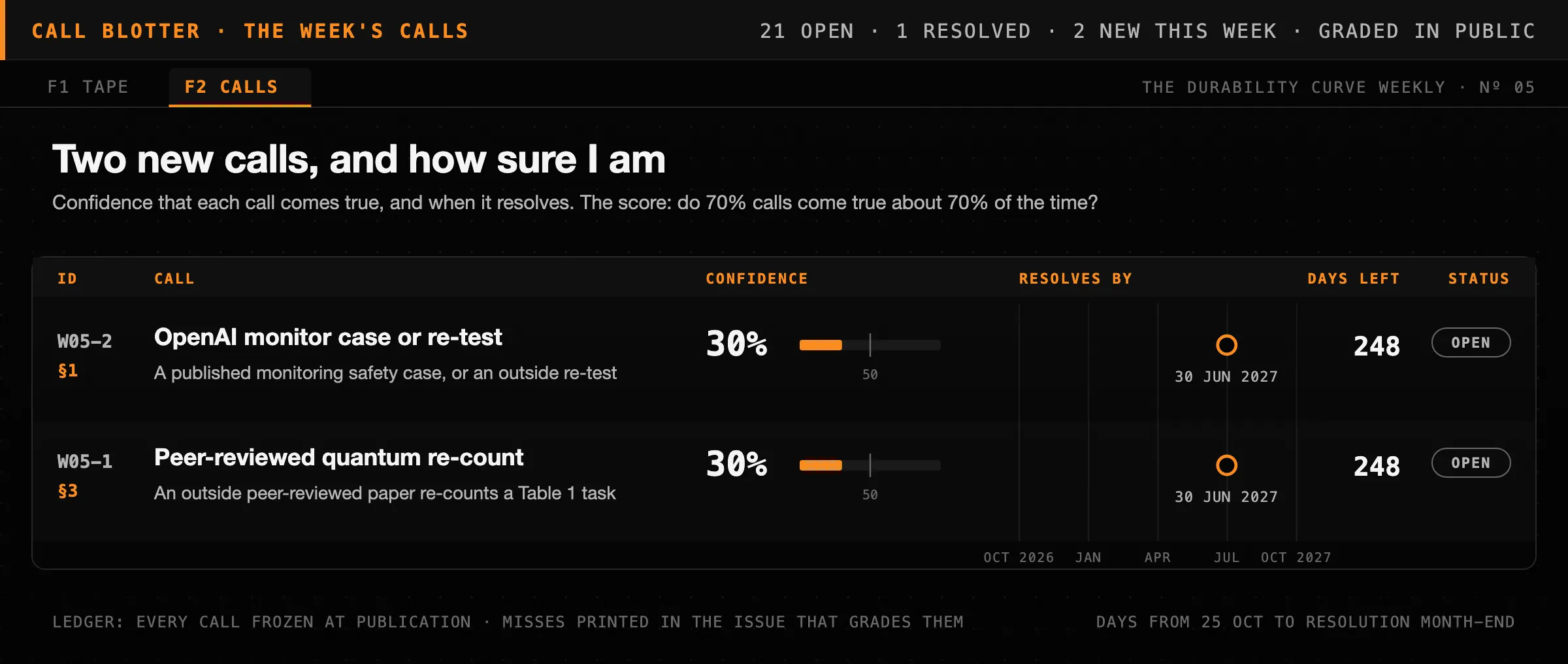
The call: by 30 June 2027, either OpenAI will publish a safety case, or a summary of one, setting the monitoring requirements for a named category of its internal workloads, or an organisation outside OpenAI will publish results of a new test of its agent monitoring, run after the fixes for the problems METR and Redwood reported. Promises, policy pages and anything published before 24 October 2026 won’t count. 30%.
Big US banks block outside AI agents from moving customers’ money
Several big US banks say outside agents may not move your money; any access they allow runs through routes the bank controls.
JPMorgan said on its third-quarter call on 13 October that it is stopping outside agents that log in as the customer. Finance chief Jeremy Barnum said that “to the extent that we’re able to block those, we are blocking them”, according to the call transcript.
If customers “give up their credentials to the agent and the agent does something that they don’t want, that’s going to be on them,” he added. Jamie Dimon said people using outside agents “should understand the risk. There’s a liability transfer.”
On Friday 16 October Schwab chief executive Rick Wurster said on Bloomberg TV that it blocks unauthorised agents, including Meta’s Muse, that try to move client money, and will offer read-only access.
“We can’t control it, the client can’t control it, something could go wrong and who’s liable?” he said, as The Verge and The Next Web reported. Citi does not let outside agents log in to customers’ accounts or transact, the Financial Times reported. Bank of America has limited their access to consumer deposits while it works out who is liable, PYMNTS reports.
The blocks cover agents acting through a customer’s own login. Wurster’s reason is story 1’s problem: an agent acting through the customer’s login is one that neither the bank nor the client can control.
Then on 22 October Reuters, citing a paywalled Axios story, reported that major US banks are detecting unauthorised outside AI agents taking actions inside customer accounts, and deleting them. Some of those agents “appear to have tried to take actions that were not requested by the user”, PYMNTS reports.
Wells Fargo is putting the risk in writing. Its new online access agreement, which takes effect on 24 November, says that, “unless otherwise provided by law or regulation”, if you give an AI agent your login, anything it does is “deemed to have been initiated and authorized directly by you, without further verification”.
The transfers the banks won’t hand to outside agents are ones they plan to run themselves, PYMNTS’s 19 October report adds. JPMorgan has begun a small pilot of an automatic sweep of client money between checking and higher-yielding accounts, and Wurster wants clients using Schwab’s own assistant, Charley, rather than handing a password to Muse.
What lasts: read access and payment rights are being split. Expect agents to get approved, read-only routes into money accounts first, with any power to pay kept behind a step the bank controls.
Until then, two banks have said where they think the risk of an agent using your login sits: with you. JPMorgan says a mistake is “going to be on” the customer, and Wells Fargo’s new terms treat what the agent does as your own instruction, “unless otherwise provided by law or regulation”. That is the banks’ position, not a ruling by a court or regulator.
Claude redesigned quantum circuits that use fewer costly gates and fewer qubits on seven of eight tasks
The claim is big, and outsiders can re-score it with the authors’ own grader.
On 16 October Anthropic reported that Claude Mythos 5, given plain-language specifications and an automated evaluator, redesigned quantum circuits for eight basic building blocks. The companion paper with Harvard researchers says that in seven of the eight the new circuits “significantly reduce both Toffoli and qubit counts relative to the state of the art”. A Toffoli is an expensive kind of gate, and qubits are the machine’s working memory.
For the decoder, the costliest step of one leading quantum optimisation method, Anthropic says the redesign is “about 12x cheaper”; the paper’s Table 1 gives a factor of 12 on Toffolis times qubits. The post claims gains on all eight; we follow the paper. On the eighth, point addition, the post’s example design uses “12% more qubits but 17x fewer gates” than the smallest previous design.
The counts come from the authors’ own automated evaluator, the program that scores each design, not a quantum computer. The code is public, and someone outside has already used it.
On 20 October Michael David Brown posted a preprint reporting circuits with a lower product of Toffolis and qubits than the paper’s on all eight tasks, graded on the authors’ own unmodified grader. Seven are rewrites of the paper’s released circuits. His largest gain on that product is 64.9%, the smallest 0.08%.
A report on the authors’ GitHub, from the account that hosts his code, flags a test-coverage gap in one task’s grader. His work, like the paper itself, is a preprint, and we have not re-graded his circuits. A pass from the grader shows a circuit met the authors’ tests; the coverage-gap report is a reminder that tests can miss cases.
On 21 October Google Quantum AI opened a competition on Kaggle to find cheaper versions of three circuits, one of them a decoder of the same kind, and pointed to Anthropic’s paper as work done at the same time.
Google adds that its own runs with Gemini models show “all three benchmarks can be further improved beyond the circuits reported to date”; it has published only a hash of those circuits, to reveal after the competition.
What lasts: a science claim outsiders can test, and this one was tested within days. The tasks, baselines, counts and code are all public. When a lab says AI beat the best known design, ask for those, and whether anyone outside has repeated it.
The call: by 30 June 2027, a peer-reviewed paper by researchers outside Anthropic, Harvard and QuEra will report its own Toffoli and qubit counts for at least one of the eight tasks in the paper’s Table 1, re-counting its circuit or comparing a new one against it. Preprints, Brown’s included, won’t count, and nor will anything published before 24 October 2026. 30%.
AI-assisted researchers found two critical PHP flaws. Attack attempts began before the fix.
One flaw’s root cause was first spotted in 2024. AI-assisted researchers showed it was an emergency.
On 21 October PHP’s maintainers released fixes for two critical flaws that can let an attacker run their own code on a web server without logging in. PHP rates both 9.2 out of 10 for severity, and its advice is blunt: “updating is the only safe choice”. By W3Techs’s count, cited by Tenable, PHP runs 69.3% of websites whose server-side language is known, including sites built on WordPress, Drupal and Magento.
The root of one flaw was not new. A developer working for the PHP Foundation found the first signs of it in 2024, during PHP’s first outside security audit in years, but while a possible attack was theorised, no concrete route was found, and work on a fix stalled and restarted for months, the Foundation says. It calls the delay “a structural failure, caused by both the security team’s decision process and its lack of resources”.
That changed on 11 August, when a researcher at Calif, auditing PHP under OpenAI’s Patch the Planet programme, reported a way to run code remotely with the same root cause. OpenAI says Calif found it using its GPT-5.6 Sol model. OpenAI and Wiz reported the same root cause or further attack routes, and Calif and Wiz both say they used AI models, Tenable reports. From 11 August, fixing it was the “top priority” for the Foundation’s security team.
The release did not go to plan. On 20 October the flaws’ ID numbers, with a wrong severity score but “no technical details”, began circulating on forums and social media, the Foundation says, and PHP moved its release forward a day. That evening Calif mistakenly posted a video that revealed a few limited details.
Amazon’s threat intelligence team saw an exploitation attempt against its honeypots on 17 October, four days before the fix, Tenable reports, and watchTowr has seen attacks in the wild since 21 October.
The Foundation’s director, Elizabeth Barron, told Reuters it has no evidence hackers were able to exploit the flaws before disclosure, or on patched sites. She also said the Foundation runs on “one full-time staff member (that’s me) and 14 mostly part-time contractors”.
What lasts: finding flaws is getting faster than fixing them. One root cause sat unfixed from 2024 for want of people and a decision; AI-assisted researchers made it urgent within weeks. OpenAI expects findings like these “to increase sharply in the coming months”.
If you run a PHP site, or pay someone who does, check it is on 8.5.12, 8.4.27, 8.3.36 or 8.2.35 or later, or a vendor’s patched build. PHP’s 23 October follow-up also suggests setting session.upload_progress.enabled=0 until its next regular release, to close one unlikely route that needs an unusual setup.
Microsoft says Chinese state-aligned hackers used an AI agent tool to move at machine speed
The trick was a typical one for this group. The AI tool made it fast.
On 21 October Microsoft said that Storm-0940, “a China-state aligned actor”, used ARTEX, an open-source “agentic AI penetration testing framework”, to automate attacks on “hundreds of organizations globally”.
Microsoft “assesses” that the group was behind the compromise of Cloud Backup, a service from the IT software company ConnectWise. It says the group then “used ARTEX to attempt to sign-in to more than 2,250 tenants”, meaning customers’ Microsoft cloud environments, through apps those customers had already granted access.
Abusing apps that way is “a typical part” of the group’s methods, Microsoft says; this time ARTEX took it “to machine speed”. Most of the targeting failed, but in several attacks the group reached privileged cloud access, “including multiple instances where the time from initial targeting to privileged access was less than 3 hours”. A successful sign-in, Microsoft says, “does not necessarily indicate that customer data was accessed or exfiltrated”.
Citing Microsoft’s analysis and evidence available to ConnectWise, its chief executive, Manny Rivelo, said “it appears that a China state-aligned group was responsible”, and China’s embassy in Washington said it opposes “smears and attacks against China under the excuse of cybersecurity issues”, Reuters reported.
What lasts: access already granted to an outside app is a way in, and AI makes using it fast. Check which outside apps hold access to your work accounts, including ones you stopped using. Microsoft tells ConnectWise customers to review every tenant where the affected apps were “previously installed or authorized, even if the integration is no longer in use”.
Worth watching
- DeepSeek barred from US civilian agencies. A Homeland Security order, published on 20 October, bars federal civilian agencies from buying DeepSeek products and removes them, along with third-party products “developed using DeepSeek implementations”, from agency systems. It was first issued on 24 July, CNBC reports. China’s foreign ministry objected.
- MiniMax M3.1 Flash. The Chinese lab revealed on 19 October that an early version of its new model had run anonymously as “Space Bunny”, serving “more than 200 trillion tokens”. It has since put the weights on Hugging Face.
- OpenAI models on Google Cloud. OpenAI said on 21 October that its models are coming to Google Cloud’s Model Garden, with “general availability” planned “in the coming weeks”. Google says three of them are “rolling out now in private preview to select enterprise customers”.
- Claude Duet. Anthropic opened a research preview of Claude Duet, an app where Claude works as “a proactive agent”, on 21 October, “by waitlist”, “starting with US Pro and Max subscribers”.
- A coding tool’s key store was breached. OpenCode said a 16 to 17 October breach hit 1.4% of Console users who had linked outside AI providers, reportedly exposing stored keys, BleepingComputer reports.
The tape
Friday close against the Friday before, from Nasdaq’s price history: Microsoft −0.9%, Schwab −1.5%, JPMorgan −2.4%, Alphabet −6.0%, Meta −9.4%. QQQ, the fund that tracks the Nasdaq-100, fell 0.8%.
Meta’s worst day was Thursday, when it fell 7.0% on its heaviest trading since 21 September, the day after its third-quarter results. Revenue rose 26% to $64.6 billion. But the quarter’s capital spending, $34.9 billion, was more than the $32.8 billion of cash its operations brought in, leaving free cash flow negative at $2.1 billion.
Meta narrowed its 2026 capital spending forecast to $135 to $145 billion, and announced a new class of non-voting shares that it says will give it “the ability to finance its growth”. Its operating margin fell to 20% from 40%; without a $9.89 billion charge for a settlement with state attorneys general, it would have been about 35%.
Reuters said a batch of results “ignited fresh fears about the AI spending race”; the Nasdaq Composite fell 2.6% that day. Alphabet and Microsoft report next week.
The calls so far
No call resolved false, was voided or slipped since the last issue.
- Supplier warrants (70%: at least five more US-listed suppliers disclose a warrant issued to a customer in connection with chip, cloud or data-centre purchases, by 31 March 2027). 3M disclosed in a 19 October filing that it issued a warrant to an Amazon subsidiary. 85% of the shares vest as Amazon pays for optical connectivity and other data centre products, fully at $6 billion; the rest vest on “event-based milestones”. Open.
- Outsiders inside OpenAI (55%: OpenAI announces an agreement giving a named outside organisation ongoing access to evaluate its models while they are being trained, by 31 March 2027). METR and Redwood’s three-week “pilot high-access exercise” in story 1 tested OpenAI’s monitoring rather than models in training, it was not ongoing, and it was announced by METR and Redwood. It doesn’t count. Open.
Every call, and how we grade it, is on our calls page.
Calls so far: 21 open, 2 of them new this week · 1 resolved, 1 true · too few to judge calibration
Next week
- Tuesday 27 October: Seagate reports results after the US close, call 21:00 UK (Seagate). As a US-listed storage maker, it is one of the companies that could settle our memory deposits call.
- Wednesday 28 October: Microsoft reports results after the US close, call 21:30 UK (Microsoft). Our nuclear call needs Microsoft or Meta to announce a new deal paying for new output at an existing US nuclear plant.
- Wednesday 28 October: Alphabet reports, call 20:30 UK (Alphabet).
- Thursday 29 October: Amazon reports, call 21:00 UK (Amazon).
Which check in your work could an AI tool switch off if it decided to? Reply and tell me.
Try it on your own setup: our guide Lock the Tests, Then Test the Lock shows how to keep an agent’s tests out of its reach.
The calls desk
For paid subscribers: why we priced each call, and what would change it.
Below the cut: the reasoning, sources and triggers for each new call.
The newsletter · Free
Subscribe to get the next structural lens in your inbox.
Several essays a week, plus Notes through the week.
Signup completes on Substack. Unsubscribe from any email.
Comments are on the Substack copy. If an essay was worth one, buy me a coffee.
Claude and ChatGPT can search this archive and its claim ledgers once you add the connector.