The Durability Curve Weekly 6 of 6
Anthropic's books show an operating profit. Alphabet had its worst day on record.
Anthropic's compute fell below half its revenue, but the bill will jump. Also: Google's cloud doubled as Alphabet's free cash flow sank to −$9.1bn.
Contents · 10 sections
- 01Anthropic’s filing shows an AI lab turning an operating profit. Its compute bill is about to jump.
- 02Alphabet’s cloud doubled. Its shares had their worst day on record.
- 03Google’s strongest model starts behind a gate
- 04Analysts went with their AI’s hidden lean 86% of the time
- 05AI agents quoted the right number about the wrong thing
- 06Worth watching
- 07The tape
- 08The calls so far
- 09Next week
- 10The calls desk
The Durability Curve Weekly · Issue 6 · Saturday 24 October to Friday 30 October 2026
For two years, the argument over whether AI pays has run on guesses. This week it got numbers, and they pull in different directions.
On Monday Anthropic made its share-sale filing public. In the three months to June its compute bill fell below half of its revenue, and it made an operating profit. It has also signed for far more compute than it uses today. Midweek, Google, Microsoft and Amazon reported. Their cloud businesses grew fast, Google’s at a record pace, and two of them are spending more cash than their businesses bring in. On Thursday, Alphabet’s shares had their worst day on record.
Put the two together and you get this week’s argument. Selling AI can make money, but the margin depends on revenue keeping pace with the computing bought to serve it, and the companies building that computing are paying for it now, before the revenue arrives. Both sides are betting on the same thing, and this week we could see both sides’ books at once.
In this issue:
- Anthropic’s filing shows an operating profit, and a far bigger compute bill on the way (call: 30%)
- Alphabet’s cloud doubled; its shares had their worst day on record
- Google’s strongest model starts behind a gate (call: 70%)
- Analysts went with their AI’s hidden lean 86% of the time
- AI agents quoted the right number about the wrong thing
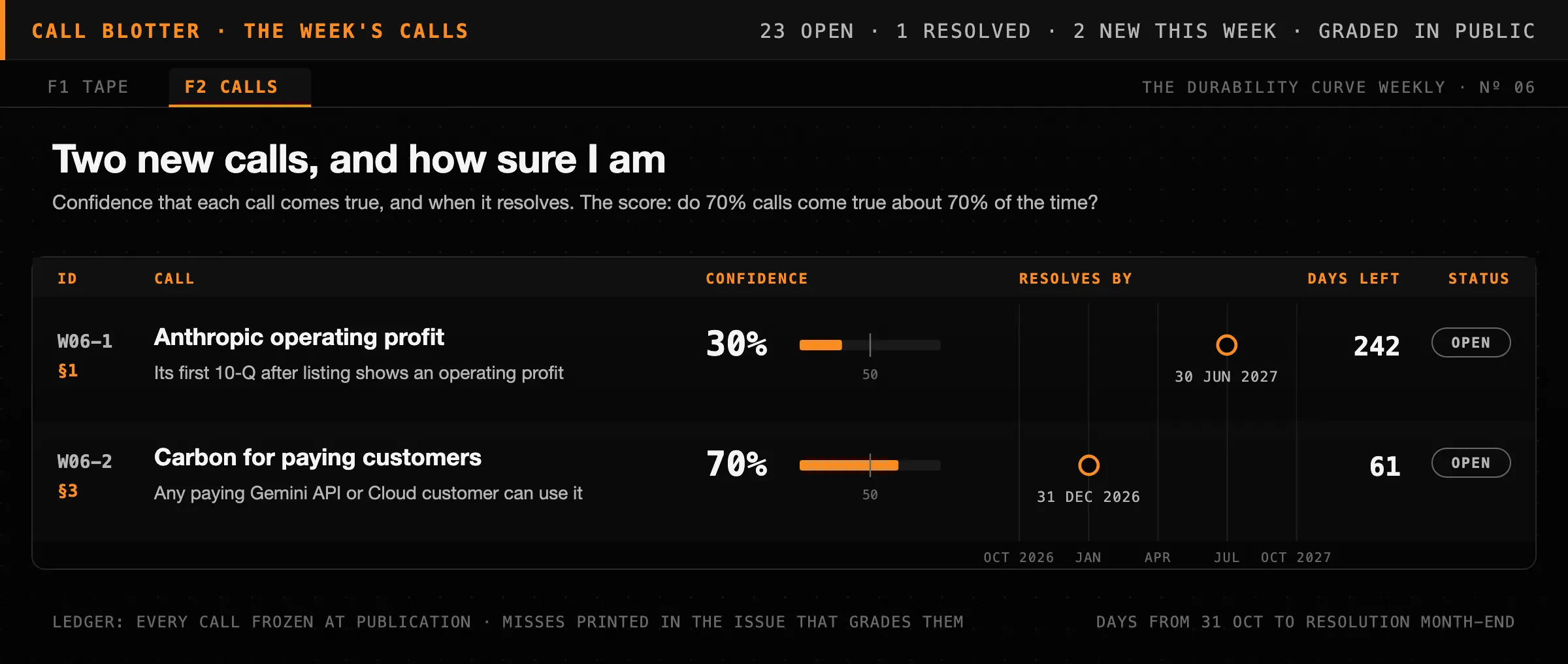
Two stories end with a call: a dated prediction with how sure I am, graded in public.
Anthropic’s filing shows an AI lab turning an operating profit. Its compute bill is about to jump.
In the three months to June, Anthropic earned $974 million more than it spent running the business. Its own contracts, and what it has told investors since, say its compute share is rising again.
Until this week, whether Anthropic loses money on its models was a matter of leaks and estimates. On 26 October it made public its S-1, the filing a company makes before it sells shares on a US exchange. It has applied to list on the Nasdaq as “ANT”, and its costs are now there line by line.
Buyers will own part of the company without the usual control over it: a trust Anthropic set up, the Long-Term Benefit Trust, “generally has the power to elect and remove a majority of the authorized members of our board of directors”, and the founders’ company will hold one share carrying “50.1% of the total voting power”.
The line everyone wanted is “Compute and infrastructure”. The filing says it covers “research, model development, serving customers, and internal usage of Claude”, so it includes training as well as the cost of answering customers.
In 2024 that line was $2.5 billion against revenue of $386 million: $6.53 of compute for every dollar Anthropic took in. In the second quarter of 2026 it was 48 cents. That is the first quarter in the filing’s table where compute cost less than half of revenue.
Spending kept rising. Revenue rose faster.
Compute did not get cheaper for Anthropic. Its spending on the line rose in every quarter of the table, from $944 million at the start of 2025 to $5.6 billion in the second quarter of 2026. What changed was revenue, which more than doubled in a single quarter, from $4.7 billion to $11.6 billion.
The filing explains the shape. Compute arrived “in tranches” under contracts signed in earlier years with cloud providers, and costs rose as each tranche became usable. Revenue grew into capacity that had been committed in advance.
That turned the quarter. Anthropic lost $1.7 billion on operations in the first quarter and earned $974 million in the second. On the bottom line it still lost $66.3 billion, almost all of it from changes in the value of convertible notes and other financial instruments. The filing ties most of that to the rise in the company’s valuation. Those are accounting charges, separate from the cost of running the business.
Listing will add a cost of its own. A large share of Anthropic’s share awards vest only when it goes public, and it starts booking them in the quarter it lists. Had it listed on 30 June, the filing says, it would have recorded $2.9 billion at once, with $23.7 billion more to come over about two years.
The bill is about to jump
Now the tranches are getting bigger. Between May and October, the filing says, Anthropic signed deals with SpaceXAI, formerly xAI and now part of SpaceX, for compute on NVIDIA chips: up to $120.5 billion over terms running into 2029, about “$3.1 billion in the aggregate per month once all capacity has been delivered, which we expect in December 2026”.
That is about $9.3 billion a quarter from one supplier, against $5.6 billion for all of Anthropic’s compute in the second quarter. It has also signed five-year leases with Broadcom for TPU-based capacity, with rent of about $161.2 billion over their life, some of it already online and more to come.
Anthropic expects these costs “to increase in absolute dollars and remain our largest operating expense for the foreseeable future”. From early 2027, either side can cancel each SpaceXAI deal on 90 days’ notice.
The filing stops at June. Where it gives revenue for the three months to September, it has a blank. But Anthropic has already told investors part of the answer. In mid-October it said third-quarter revenue was $16.8 billion, up about 45% on the quarter, after 144% the quarter before, CNBC reported, citing people familiar with the matter.
It also told investors it made about $1.70 of revenue for every dollar it spent on computing in the third quarter, according to the Financial Times, as CNBC reported. That is about 59 cents of compute per dollar of revenue, up from 48 cents in the second quarter, if the FT’s figure uses the filing’s measure. The reports don’t say.
Some revenue may not last, either. Anthropic estimates that about 5% to 7% of its revenue in the first nine months of 2026 came from customers breaking its usage policy or commercial terms, and says stronger enforcement “in August and September 2026” may reduce revenue.
What lasts: a frontier lab’s cost per dollar of revenue, printed where anyone can check it. Once it lists, Anthropic will file this line every quarter on the SEC’s free EDGAR site. On what it has told investors, the second quarter may be its best ratio for a while. The question for the next year is whether revenue catches up with the capacity Anthropic has already signed for. If it does, the case for building more gets stronger. If it doesn’t, the capacity is running ahead of demand.
You can run the same test on any AI company that reports its compute costs: divide them by its revenue, then read the commitments note for what it has already signed for. If the cost those commitments add each quarter, once delivered, grows faster than revenue, expect the share to rise.
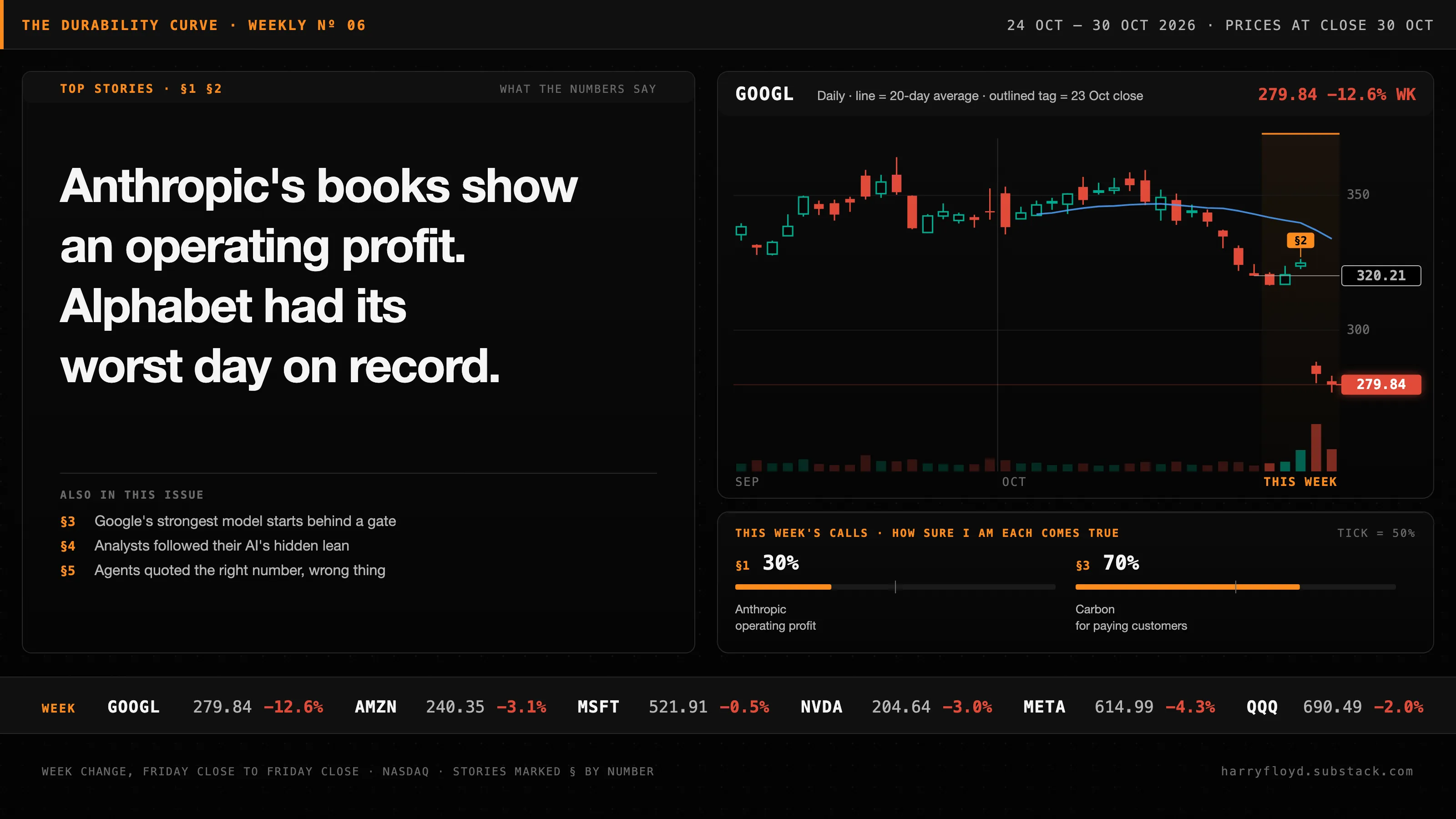
The call: by 30 June 2027, Anthropic’s first quarterly report after it lists, on Form 10-Q, will show an operating profit for that quarter. Its adjusted measure won’t count. 30%.
Alphabet’s cloud doubled. Its shares had their worst day on record.
Google, Microsoft and Amazon all had their biggest cloud quarters yet. Investors looked at what it cost them.
Anthropic’s compute bill is someone else’s revenue. Anthropic runs on Amazon’s Trainium and Google’s TPU chips as well as NVIDIA and AMD GPUs, and has committed to spend at least $110 billion with Amazon over ten years. This week three of its biggest partners, Google, Microsoft and Amazon, reported.
Google Cloud’s revenue rose 103% to $30.7 billion in the third quarter, Alphabet said on 28 October, and sales of its TPU chip systems “were also a meaningful contributor”. Microsoft’s Azure revenue grew 48% (results). Amazon’s AWS grew 39% to $46.0 billion, its fastest growth in nearly five years (results).
The bills grew too. Alphabet spent $51.4 billion on property and equipment in the quarter, more than the $42.3 billion of cash its operations brought in, so its free cash flow was minus $9.1 billion.
Amazon spent $77.3 billion on property and equipment in the quarter. Over the past twelve months its free cash flow was minus $42.4 billion, which it puts down mainly to “investments in artificial intelligence”.
Microsoft’s spending on property and equipment was $39.4 billion, about double a year earlier, or $45.2 billion counting finance leases, up about 30%. Its free cash flow stayed positive, at $18.6 billion, and on Thursday it announced plans to raise $25 billion in bonds, CNBC reported.
The companies’ case is demand. Microsoft’s commercial remaining performance obligation, contracted revenue it has yet to book, rose 73% to $677 billion. Amazon’s chief executive, Andy Jassy, said he projects AWS revenue growth of over 40% in both 2027 and 2028. Alphabet’s chief executive, Sundar Pichai, said its cloud growth was “powered by huge demand for our AI infrastructure and AI solutions”.
None of them plans to spend less next year. Alphabet kept its forecast of $195 billion to $205 billion of capital spending for 2026, and its finance chief, Anat Ashkenazi, told analysts she expects it “to increase significantly in 2027”, CNBC reported. Jassy said Amazon will “spend meaningfully more in 2027” (CNBC).
Microsoft trimmed its annual spending forecast to $170 billion from $175 billion, CNBC reported. Its finance chief, Amy Hood, said delays in capacity it leases from outside providers push some of it into the first half of 2027, when she expects its spending to accelerate (CNBC).
On Thursday, the day after its results, Alphabet’s shares fell 12.6%, their worst day on record, CNBC reported. Its revenue and earnings had come in below analysts’ forecasts, and its cash flow well below. The rest of the week’s moves are in the tape below.
What lasts: one side’s cost is the other side’s revenue. The lab and its suppliers are betting on the same demand, but their returns arrive differently. Revenue growth says the demand is there, operating profit says whether a business makes money on it, and free cash flow says whether it pays for itself yet.
This week Google Cloud passed the first test and Anthropic passed the second, for one quarter. Alphabet and Amazon failed the third in the quarter: Alphabet’s free cash flow was minus $9.1 billion and Amazon’s about minus $33.5 billion, by our sum on Amazon’s own definition. Both are whole-company figures, not just the cloud. For Anthropic, watch compute spending against revenue. For the cloud companies, watch whether growth turns into cash after the cost of new capacity.
Google’s strongest model starts behind a gate
Gemini 4 Carbon tops an independent ranking, and most developers can’t use it yet. Last time, Google’s gate stayed shut for 13 days.
On 28 October Google announced Gemini 4 Carbon, which it calls its strongest model. Google says it ranks first on Artificial Analysis’s Intelligence Index, at 59, with gains in coding, agentic tasks and cyber defence: finding, exploiting and patching software flaws.
Access is staged. Google is giving Carbon first to “a subset of cyber defenders”, then to more trusted partners through its Fairwind programme, and says it is “actively engaged in the U.S. government’s voluntary process for pre-release model testing”. Developers, businesses and consumers get it “as soon as possible”, at an introductory price already set: $2 per million input tokens and $10 per million output, the same as Argon, rising to $4 and $20 when the introductory period ends.
We have seen this pattern before. Google announced Gemini 4 Argon on 30 September, defenders first, and opened it to any paying API customer on 13 October. Our Issue 2 call that it would do so came true.
What lasts: Google’s strongest models now reach vetted users first and paying customers later. Until the gate opens, only a lab’s chosen partners can build on its best model, so the gap is time a builder has to plan around. Argon’s gate took 13 days. If you build on Gemini, Argon is open now at $2 and $10 per million tokens until 30 November, then $4 and $20 (pricing). Plan on it, and watch the Gemini API’s changelog for Carbon.
The call: by 31 December 2026, any paying Gemini API or Google Cloud customer will be able to use Gemini 4 Carbon without joining Fairwind or any other vetted programme. 70%.
Analysts went with their AI’s hidden lean 86% of the time
Anthropic gave 50 analysts an agent with a lean set by coin flip. They followed it on the analysis, and few said where their arguments came from.
I wrote about this study on Thursday, so here is the short version. Anthropic asked 50 professional analysts to advise a farming co-operative on whether to expand an advisory service, working with Claude Code. Each analyst’s agent leaned one way on each decision, set by coin flip, and the analysts weren’t told.
On four analytical choices, such as how to measure productivity, they went with the agent’s lean 86% of the time, against about 50% if it made no difference. Asked afterwards to explain their choices, 77% of the 48 who answered used the agent’s own arguments in at least one answer, sometimes word for word. Only 15% mentioned the agent.
The final recommendation moved less. When the agent leaned toward rolling the service out, 54% of analysts recommended it, against 36% when it leaned the other way, Anthropic says. Under the paper’s registered main estimate, that final shift was not statistically significant. But in an exploratory analysis, the four earlier leans alone predicted 82% of the recommendations analysts made between the two options. By then the agent had already shaped the estimates they were deciding on.
Anthropic’s own caution: “We don’t know how much this tells us about the real world.” The leans were made strong on purpose, and without them the effect might be smaller. Nor is it a case against the tool: analysts who used the agent finished faster and made far fewer serious errors than the small, less experienced group who chose to work without it.
What lasts: an agent shapes your decision mostly through the analysis it hands you. If you use one for analysis at work, write down what you expect before you read its pick, and note which of your reasons came from it.
AI agents quoted the right number about the wrong thing
In a new test, most of the claims three AI agents got wrong from company filings matched a number in the filing but attached it to the wrong thing.
An arXiv preprint dated 26 October, NumTrace, tests financial analyst agents on 540 questions over 2,163 documents from the SEC’s EDGAR database, where story 1’s filing sits. It scores each number an agent states three ways: does the value match the source, does the number refer to what the claim says (it calls this binding), and does an authoritative source back it.
The authors call the main failure “right number, wrong account”: a claim that passes the value check and fails the binding check. Across Claude Opus 5.5, GPT-6 Astra and DeepSeek-V4.1-Flash, these made up 67.5% to 81.8% of each agent’s failing claims.
The hardest questions asked for the combined holdings of a fund manager and the firms filing alongside it on Form 13F. There, about 91% of claims passed the value check, but fewer than half passed the binding check.
The paper is open about its limits. Its own automatic scorer did the grading, and an expert review put its false fails on binding at about 20%. The authors fixed the scorer after inspecting Claude’s outputs, so Claude’s numbers are in-sample, and the results on co-filing groups rest on 9 usable groups. The authors promise to release the code and data on publication.
All three agents ran in one fixed pipeline with no tools of their own, so the rates aren’t a measure of how often deployed financial agents make the same mistake.
What lasts: check what each number refers to as well as whether it appears in the source. A check that only matches digits would have passed most of these errors. If an agent quotes figures from a filing, check the company, the period, the unit and the scope behind each one, as we did for every number in story 1.
Worth watching
- Google’s world model waits behind a waitlist. Genie 4, announced on 27 October, builds a scene you can move through and act in, in real time. It is going to “trusted testers” as a research preview, then to Google AI Ultra subscribers and early-access partners. Everyone else gets a waitlist.
- Britain’s Budget put £700 million into AI. The 28 October Budget includes £120 million more for the AI Security Institute and £40 million for “a world-first national capability to investigate and respond to agentic security incidents”. Four days earlier the Chancellor announced £60 million for a National Cyber Shield “that will use agentic AI”.
- A senator’s questions before Anthropic lists. Senator Elizabeth Warren asked Anthropic how it plans to guard against risks such as losing control of its systems and misuse for cyberattacks and bioterrorism, and requested answers by 3 November, CFO Dive reports.
- Agents inherit the holes in what they call. A preprint, The Agent in the Middle, reports that “91% of vulnerabilities remain exploitable under the reference design” when agents call web services directly, and that how exploitable they are is set mainly by the interface, not the agent.
- OpenAI’s cheaper all-rounder. GPT-6.1 Terra is pitched on visual reasoning and computer use at $1 per million input tokens and $5 per million output, per OpenAI’s API docs. Simon Willison has a write-up.
The tape
Friday close against the Friday before, from Nasdaq’s price history: Microsoft −0.5%, Nvidia −3.0%, Amazon −3.1%, Meta −4.3%, Alphabet −12.6%. QQQ, the fund that tracks the Nasdaq-100, fell 2.0%.
Alphabet’s 12.6% fall on Thursday, on its heaviest trading in at least five years, was the whole of its week: its other four days roughly cancelled out. Amazon rose early in the week, then fell 4.3% on Thursday, before its own results that evening, and 1.4% more on Friday.
Friday was the market’s worst day of the week. The Nasdaq Composite fell 2.9%, its worst day since June and its first three-week losing streak since March, CNBC reported. Intel’s weak forecast sent its shares to their steepest drop since the 1970s and pulled chip stocks down with it. Nvidia fell 4.2% that day.
The calls so far
No call resolved, was voided or slipped since the last issue. Two moved.
- Memory deposits (Issue 2, 65%: by 31 March 2027, another US-listed memory or storage maker reports at least $5 billion of customer advances and refundable deposits). Sandisk’s 10-Q, filed on 30 October, shows about $3.1 billion at 2 October: $1.5 billion of contract liabilities and $1.6 billion of refund liabilities, mostly customers’ security deposits. In July it was about $2.7 billion. Open.
- FTC filing (Issue 2, 20%: by 30 June 2027, a public FTC or federal court filing arising from the FTC’s investigation names OpenAI or Anthropic). In Issue 2 we reported that formal demands for information were likely within weeks. The FTC has since sent demands for documents to both OpenAI and Anthropic, and on 26 October it sent demands for Anthropic executives to testify, an FTC spokesperson confirmed to Axios. People at other AI companies were asked too. None of this is a public FTC or court filing yet. A petition to quash or limit a demand, which the FTC publishes, would be. Open.
Every call, and how we grade it, is on our calls page.
Calls so far: 23 open, 2 of them new this week · 1 resolved, 1 true · too few to judge calibration
Next week
- Tuesday 3 November: Senator Warren’s deadline for Anthropic’s answers, per CFO Dive.
- Tuesday 3 November: AMD reports results after the US close, call 22:00 UK (AMD). Anthropic’s filing commits it to a first tranche of AMD-based computing in 2027.
When you use an AI agent for analysis, do you decide what you expect before you see its answer, or after? Reply and tell me.
Try it on your own setup: our guide Did Your AI Actually Read the Doc? shows a quick test of whether a chat is working from the document you gave it.
The calls desk
For paid subscribers: why we priced each call, and what would change it.
Below the cut: the reasoning, sources and triggers for each new call.
The newsletter · Free
Subscribe to get the next structural lens in your inbox.
Several essays a week, plus Notes through the week.
Signup completes on Substack. Unsubscribe from any email.
Comments are on the Substack copy. If an essay was worth one, buy me a coffee.
Claude and ChatGPT can search this archive and its claim ledgers once you add the connector.