The Brief 5 of 5
What Did They Have to Check or Redo?
An AI-drafted update, summary or email can cost the person who gets it time you do not see. Ask them one question, then change one thing.
An AI-drafted update, summary or email can cost the person who gets it time you do not see. Ask them one question, then change one thing.
Your AI drafted the weekly update in three minutes. You read it through, it looked right, and you sent it.
What happens next happens on someone else’s desk. They may trace a figure back to its source, put back the context the summary dropped, or read it twice to find what you need from them. None of that counts as time you spent, so none of it counts against the time AI saved you.
The sender sees the saving, and the recipient sees the repair.
Researchers at BetterUp Labs and Stanford’s Social Media Lab have a name for work like this: workslop, AI-generated work that looks finished but lacks the substance to move the task forward. In their 2025 survey of 1,150 US desk workers, 40 per cent said they had received it in the past month. Those who had received it put their own estimate at nearly two hours per incident, and half of them said they now saw the sender as less capable. Thirty-two per cent were less likely to want to work with that person again.
So ask the person who received yours.
Pick one handoff you send every week: a status update, a research summary, a client email, a meeting recap. Send it the way you normally would. Once the recipient has used it, ask:
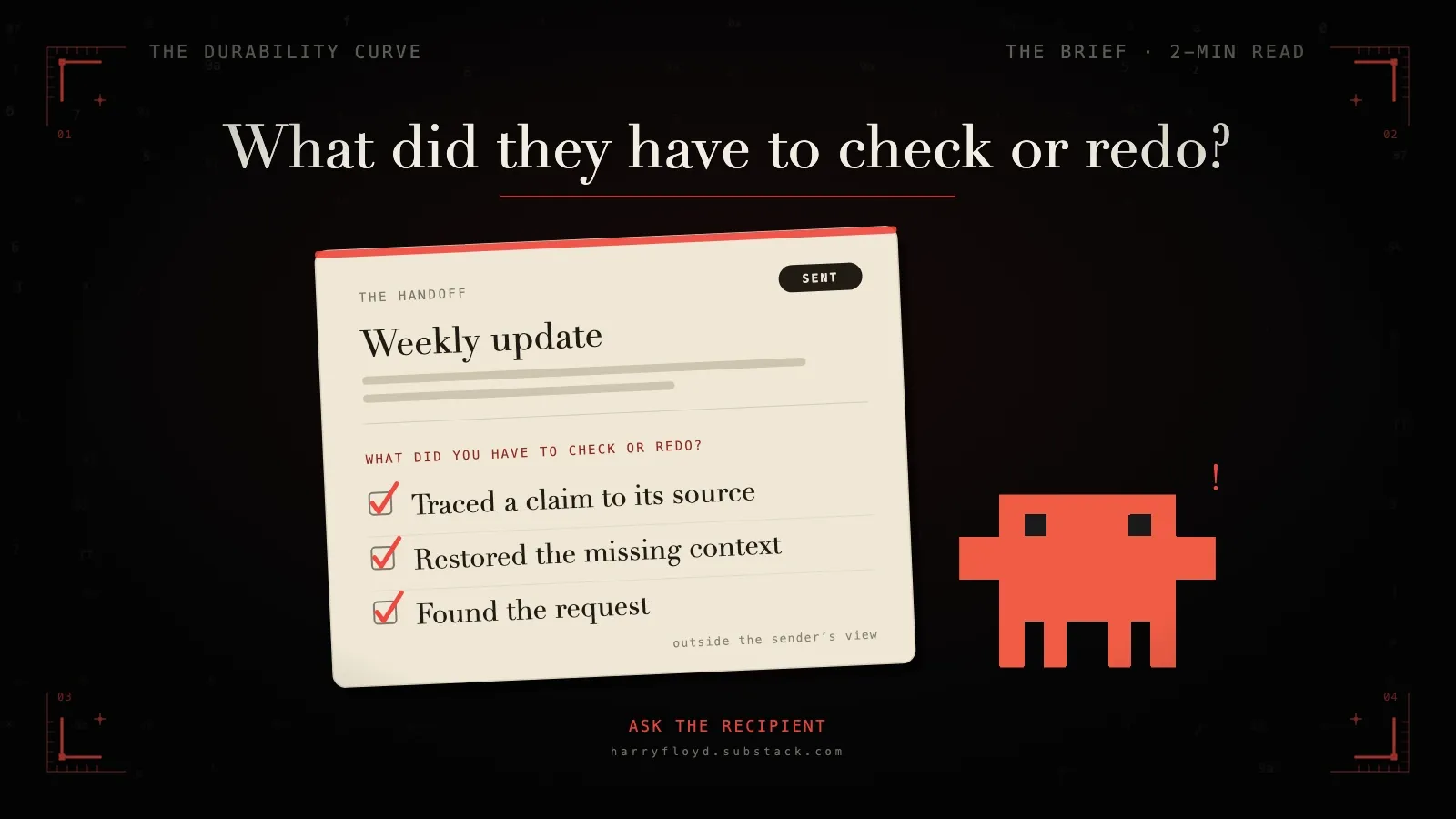
What did you have to check or redo?
The exact words matter. Ask whether it was useful and you invite a polite yes. Ask how much time it saved and you are back on your own side of the handoff. Ask what they had to check or redo, and the honest answer is a list, or “nothing”.
Take the first thing they name and fix it next time. If they reopened your sources, put the source beside each claim. If they hunted for the request, put it in the first line. Then ask again after the next handoff. You want that list to get shorter each time, until there is nothing on it.
The output does not have to be wrong for this to matter. A correct summary can still leave out what the decision turns on. A well-written email can still bury the request. A polished update can still leave nobody sure who owns the next step. The person who received it can tell you which of those happened.
For the wider question of turning faster output into trustworthy work, read AI Made You Faster. It Did Not Make You Safer.
Comments are on the Substack copy. If an essay was worth one, buy me a coffee.
It rests on Law IV, Instruments Over Theory, one of the laws this publication tests against the evidence.
Claude and ChatGPT can search this archive and its claim ledgers once you add the connector.