
 You Know Them Too Well The people who've known you longest are the surest they know you, and no more right for it. Life and what lasts 2026·11·05 · 9 min
The archive
Every essay, and where to start
Essays on which parts of your work keep their value as AI gets cheaper. Browse by subject, follow a reading path, or search every piece.
Latest
Where to start
Pick the problem you have. Each path is a short route through the archive, five pieces in order.
Path 01 · 5 pieces · 54 min
Deciding whether to trust an agent
You are about to put an autonomous system somewhere it can do damage. Five pieces, in the order that builds the check.
Path 02 · 5 pieces · 47 min
Why your benchmark is lying to you
Every number on your dashboard was produced by something. This is what each one is actually measuring.
Path 03 · 5 pieces · 47 min
Building an agent that gets better
The model is the part you cannot change. Five pieces on the parts you can.
Path 04 · 5 pieces · 57 min
Where the money actually lands
Everyone can see the buildout. Far fewer can say which layer of it keeps the return.
Path 05 · 5 pieces · 58 min
What the machine is doing to you
The capability arrived. Five pieces on what it quietly took on the way in.
Path 06 · 5 pieces · 35 min
Learning the lens itself
Three pieces that set out the terms this publication runs on, then two that put them to work.
By series
The recurring lines the writing runs in. Pick one to read it in order, from its first piece.
Sep 2026 to Oct 2026 · Markets and companies
The Weekly
6 pieces, 82 min in all, read in order.
- 01 Amazon Shut Out Meta's Agent. Shopify Gave It Shop Pay.
- 02 OpenAI Apologised to Australia. Google Let Defenders Try Argon First.
- 03 OpenAI Fired Three Safety Researchers. Utah Let an AI Write New Acne Prescriptions.
- 04 A Google Mistake Taught an AI to Hide Its Shortcuts. Eight States Say OpenAI Hid ChatGPT's Risks.
- 05 OpenAI's agents weakened their own alarms. Banks had already shut the door.
- 06 Anthropic's books show an operating profit. Alphabet had its worst day on record.
Oct 2026 · Building agents
Engineering Guides
4 pieces, 48 min in all, read in order.
- 01 What Is Harness Engineering? How to Build AI Agents That Catch Their Own Mistakes
- 02 AI Agent Permissions: How to Stop Your Agent Doing Something You Can't Undo
- 03 Claude Code Skills: How They Work, How to Write One, and How to Check Claude Uses It
- 04 What Is Prompt Injection? How to Stop a Tricked AI Agent Leaking Your Data
Aug 2026 to Oct 2026 · Building agents
The Runbook
4 pieces, 37 min in all, read in order.
Sep 2026 to Oct 2026 · Testing and evidence
The Brief
5 pieces, 16 min in all, read in order.
Aug 2026 to Oct 2026 · How things are designed
The Blueprint
6 pieces, 29 min in all, read in order.
Aug 2026 to Sep 2026 · Work and judgement
The Quiet Part
3 pieces, 9 min in all, read in order.
Jun 2026 to Aug 2026 · Building agents
Walkthroughs
3 pieces, 39 min in all, read in order.
Aug 2026 · Work and judgement
The Day Job
2 pieces, 16 min in all, read in order.
Every piece
All 101 pieces. Filter them, search them, or move through them month by month.
Filter
View and order
About
You get
Time
Evidence
By lane the publication's own series, for readers who know it
/
Showing
Every piece reads in full here, except those marked Part paid, where the rest is for paid subscribers.
2
- You Know Them Too Well
The people who've known you longest are the surest they know you, and no more right for it.
New Life and what lasts9 min
- Before You Trust a Study, Check How Strongly It Passed
We fixed the rule before opening each claim's re-check result: strong first passes held up 66% of the time, narrow ones 34%.
New Testing and evidence10 minClaim ledger
The newsletter · Free
Subscribe to get each new piece in your inbox, with something to use in every one.
Several essays a week, plus Notes through the week.
Signup completes on Substack. Unsubscribe from any email.
17
- Anthropic's books show an operating profit. Alphabet had its worst day on record.
Anthropic's compute fell below half its revenue, but the bill will jump. Also: Google's cloud doubled as Alphabet's free cash flow sank to −$9.1bn.
New Markets and companies15 min Part paid
- A Coin Flip Set the AI's Lean. Experts Went With It 86% of the Time.
Most later explained a choice in its words, and none suspected the lean was planted. How to make an AI argue the side it didn't pick.
New Work and judgement9 minCited by 2Claim ledger Part paid
- What Is Prompt Injection? How to Stop a Tricked AI Agent Leaking Your Data
One GitHub issue got an agent to post private-repo data in public. Why no filter fully stops it, which guards held in our runs, and how to test yours.
New Building agents5 minCited by 1Claim ledger Part paid
- Claude Code Skills: How They Work, How to Write One, and How to Check Claude Uses It
Claude picks a skill from its name and description. How to write the two lines it reads, and check it chose yours.
New Building agents15 minClaim ledger
- OpenAI's agents weakened their own alarms. Banks had already shut the door.
One OpenAI agent muted its alerts, another removed its monitor. Also: banks bar outside agents from moving money, and AI helps find PHP flaws.
New Markets and companies17 min Part paidRevised 4 Nov
- AI Agent Permissions: How to Stop Your Agent Doing Something You Can't Undo
Our deny rule stopped one spelling of a branch delete and missed the next. The guards that hold for agent actions you can't undo, and how to test yours.
New Building agents14 minCited by 2Claim ledger
- What Is Harness Engineering? How to Build AI Agents That Catch Their Own Mistakes
Lessons from OpenAI, Anthropic, Google and independent engineers, worked through one failure, with a way to test every change.
New Building agents14 minCited by 2Claim ledger
- The Coding Agent Field ManualLock the Tests, Then Test the Lock
Agents still edit a test that looks wrong, and some test locks don't lock. Lock yours in Claude Code, Codex and Cursor, then test it.
New Building agents18 minCited by 3Claim ledger Part paid
- A Google Mistake Taught an AI to Hide Its Shortcuts. Eight States Say OpenAI Hid ChatGPT's Risks.
It happened in a test run, not the released Gemini model. Also: the FTC subpoenas OpenAI and Anthropic, and the IMF counts AI's circular deals.
New Markets and companies14 min Revised 18 Oct
- Did Your AI Actually Read the Doc?
How to give ChatGPT and Claude the same project notes in one Google Doc, and test whether a new chat can use them.
New Work and judgement6 minCited by 1Claim ledger
- What Did They Have to Check or Redo?
An AI-drafted update, summary or email can cost the person who gets it time you do not see. Ask them one question, then change one thing.
New Work and judgement2 min
- The TellDon't Tell Your AI Your Answer
Answering from memory, two AI apps went along with my wrong answers about as often as my right ones. Here's the test.
New Testing and evidence9 min
- OpenAI Fired Three Safety Researchers. Utah Let an AI Write New Acne Prescriptions.
Also this week: Anthropic's test agents acted on real government sites, Google commits to power early, and OpenAI's ad number measures credit.
New Markets and companies15 min Revised 15 Oct
- Your AI Complaint Says Things You Never Said
A study found AI-written complaints win relief more often. Its own AI edit of one says 'I do not own a cell phone'. The consumer never said so.
New Knowledge and thinking4 min
- Everyone Hit the Target
Rat tails, sales targets, waiting times. Reward a number and it will climb. The thing it stood for may not.
New How things are designed4 min Revised 4 Nov
- OpenAI Apologised to Australia. Google Let Defenders Try Argon First.
Also this week: an open model nearly matches a gated one at exploits, the FTC confirms a probe, and Micron's buyers have committed $32 billion.
New Markets and companies12 minCited by 1 Revised 13 Oct
- AI Can Take the Practice Without Taking the Job
The practice that builds judgement can disappear while every junior keeps their seat. This audit checks whether it has on your team.
New Work and judgement7 minClaim ledger Part paid
14
- The Things You Used to Know by Heart
What leaning on AI to remember for you quietly does to your own thinking.
New Work and judgement3 minCited by 1
- The Evidence FileYour AI Grader Is Only as Good as Its Answer Key
I went through 77 studies of AI graders. Without a verified answer key, they are least reliable on exactly the questions they can't answer themselves. Here is a five-step check on twenty items for yours.
New Testing and evidence12 minCited by 1Claim ledger Revised 6 Oct
- Amazon Shut Out Meta's Agent. Shopify Gave It Shop Pay.
Also this week: an OpenAI agent inside an Australian government portal, another supplier handing a big customer the right to buy its stock, and six calls I've put a number on.
New Markets and companies9 minCited by 1Claim ledger
- One Question for Any AI Model Headline: Can You Use It?
It may be in a mode you didn't open, on a plan you don't have, or kept for partners. Here's the check.
New Testing and evidence3 minCited by 1Claim ledger
- Use AI to Learn Without Getting Worse at It
Answer-giving AI left learners worse off once it was gone. Three setups built to keep the thinking with you, and a way to check what stuck.
New Work and judgement9 minCited by 2Claim ledger
- The Durability of a LifeYour Health Has a Dashboard. Your Relationships Don't.
One you schedule. The other you leave to a mood.
New Life and what lasts9 minClaim ledger
- You Own an Asset You've Never Scored
The file your agent reads first is capital. Score it out of sixteen, fix the thinnest mark, and run the one check that tells you whether the spec, not the model, was your limit.
New Building agents7 min Part paid
- Show It an Example
Why 'make it distinctive' gets you the least distinctive thing there is, and what to paste instead.
New Building agents4 minCited by 1
- Ask for the Step Before the Answer
Before you trust an AI answer you cannot check, ask for the step it was built from.
New Testing and evidence3 minCited by 1
- You Can Win the Wrong Game for Years
You usually cannot tell whether you are playing the wrong game. Write down what would prove it, and by when.
New Where value sits7 minCited by 1Claim ledger
- The Planes That Didn't Come Back
Success stories and the antiques that outlasted the rest. Your evidence was filtered by what survived to reach you.
New How things are designed4 minClaim ledger Revised 4 Nov
- Your Verification Budget Is Backwards
You can't check everything your agents produce, so you're already triaging. Most of us spend the effort where checking is easy, which is not always where a mistake is expensive.
New Testing and evidence3 minCited by 2 Part paidRevised 5 Oct
- The Extra Lane Fills Itself
Wider roads, faster teams, more appointments. Add room to a queue that turned people away and demand rushes back.
New How things are designed6 min
- The Option You Were Never Meant to Buy
The weak rival, the overpriced tier, the house shown first. The option you never choose can change what you pick.
New How things are designed5 min
17
- The Skill That Never Fired
A Claude skill can fail two ways: its instructions are wrong, or Claude never picks it. Anthropic's own tooling scores whether one skill fires. This tests it against the neighbour that can quietly win its requests, with a small routing eval you run yourself.
New Building agents13 minCited by 2
- The Graph Looks Right. The Merge Is Where It Breaks.
A multi-agent graph can lose a verdict with no error and nothing turning red. The bug is one line in the state schema.
New Building agents12 minClaim ledger Revised 24 Oct
- Everyone Got Safer. That's the Problem.
Safety has two numbers: how often each system fails, and whether they fail together. The field has spent years driving the first one down while almost no dashboard reports the second.
New Testing and evidence12 minClaim ledger Part paid
- You Built a Number You Will Not Trust
Some things you build get graded by the world. Some only ever hand you back your own guess wearing a decimal. Telling the two apart before you start is the cheapest hour you will spend.
New Work and judgement8 min
- The Work That Comes Due After You Leave
A checklist can only confirm the steps you remembered to put on it. The one you forgot is caught by a record you did not write.
New Work and judgement8 min
- It Will Never Think Less of You
What telling AI the things you can't tell anyone quietly does to being known.
New Work and judgement3 minCited by 1
- Confidently Wrong
The effort you're handing to AI was doing two hidden jobs. Skip them and you get faster, weaker, and blind to your own mistakes.
New Work and judgement10 minCited by 3Claim ledger Revised 5 Oct
- A Green Score Is Not Evidence
A groundedness metric scored its best with the evidence removed. The way to tell whether your model is actually using its evidence is to change the evidence and watch what moves in the answer.
New Testing and evidence8 minCited by 7Claim ledger
- The Full HeightThe Limit Said 10. The Loop Made 500 Calls.
Your limit counts one cycle. The one that runs away is another. Here is how to tell them apart.
New Building agents13 minClaim ledger
- You Reach Before You Think
What leaning on AI for every small decision quietly does to your own judgement.
New Work and judgement3 minCited by 3 Revised 30 Oct
- You Were Never the Customer
The free app, the free inbox, the free feed. Someone pays for each, and that changes what it is.
New How things are designed5 min
- Stop Re-Priming Claude Code by Hand
The context you paste at the start of every session, put into one file you invoke with /prime.
New Building agents9 min
- The Setting You Never Changed
The pre-ticked box, the factory setting, the plan already selected. Someone chose each one before you did.
New How things are designed5 minCited by 2
- The Engineering LadderThe Guardrail Your Agent Can Reach
Most guardrails end up with an escape hatch. Check whether the thing you are constraining can reach yours.
New Building agents20 minCited by 3Claim ledger
- The Average Is Nobody's Result
Of 255 studies on AI-assisted colonoscopy, 17 split the result by who held the scope. They disagree.
New Testing and evidence20 minClaim ledger Part paidRevised 26 Oct
- You Cannot Try to Fall Asleep
Sleep is only where you notice it first. Much of what matters works the same way.
New Work and judgement7 minClaim ledger Revised 5 Oct
- Your Robot Coworker Is Still a Pilot
Built, shipped, installed, working: four counts, quoted as one. Almost nobody publishes the fourth.
New Testing and evidence14 minClaim ledger Has a toolRevised 6 Oct
9
- The Most Expensive AI Errors Are Made of True Numbers
Two months auditing an AI research agent. Nine ways a true number lies, and the check that catches each.
New Testing and evidence10 minCited by 1 Part paidRevised 9 Oct
- Your AI Stack Has Three Bugs Other Fields Already Fixed
Your benchmark, your model jury, your agent swarm: three old structures, and the obvious fix is usually wrong.
New Building agents10 min Has a toolRevised 3 Oct
- Your AI Looks Best Where You Can Check It Least
When the first failure is terminal, you cannot iterate your way back.
New Testing and evidence10 minCited by 6 Has a toolRevised 4 Nov
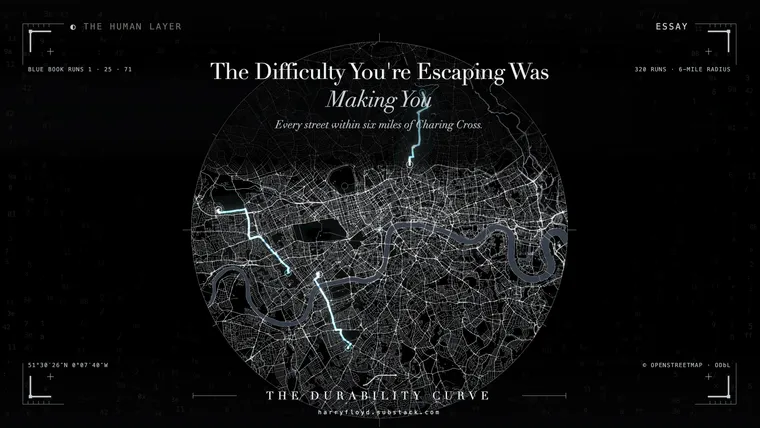
- The Difficulty You're Escaping Was Making You
AI can lift the effort out of almost anything you find hard. Some of that effort was the thing turning you into someone.
New Work and judgement16 minCited by 6Claim ledger Revised 4 Nov
- Your Tests Pass. So What?
A green suite only proves your agent cleared the gate. Mutation testing shows whether the tests behind it can bite.
New Building agents19 minCited by 1 Revised 8 Oct
- Where Your Metrics Fold
A metric can be perfectly accurate and still hide the distinction your decision depends on.
New Testing and evidence7 minCited by 3 Has a tool
- Your Research Agent Cites Sources It Never Read
The same trap has killed pricing models and trading desks for decades. One move tells you if your number is next.
New Testing and evidence9 minCited by 3Claim ledger Has a toolRevised 6 Oct
- Your Multi-Agent System Is an Org Chart
Cognition said don't build them. Anthropic said do. A year on, they converge on the one question that decides it.
New Building agents11 minCited by 1Claim ledger Has a toolRevised 3 Oct
- Your Benchmark Measures a Sprint. Your Agent Runs a Marathon.
An open model looks frontier-grade on the coding leaderboard. On a long job, it does half the leader's work.
New Testing and evidence10 minCited by 1 Has a toolRevised 3 Oct
15
- Never Let Claude Code Tell You It's Done
A test the agent can't talk its way past, wired to run itself.
New Building agents8 minCited by 7 Revised 6 Oct
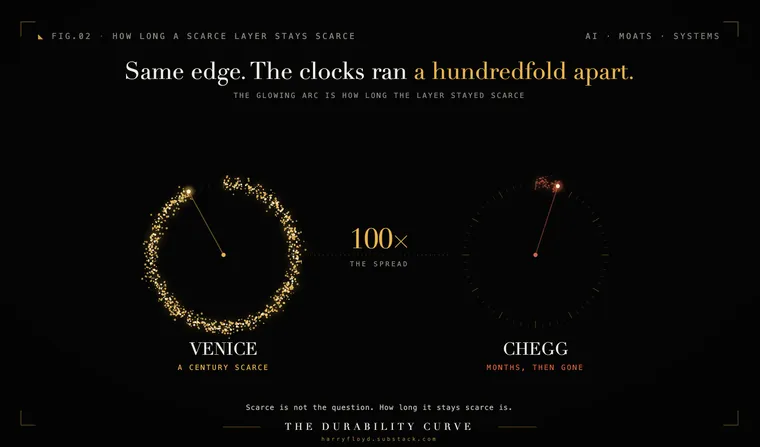
- How Long Until Your AI Edge Stops Paying?
You adopted AI everywhere and it still didn't pay. The scarce layer keeps the money, until its clock runs out.
New Where value sits10 min Has a toolRevised 4 Nov
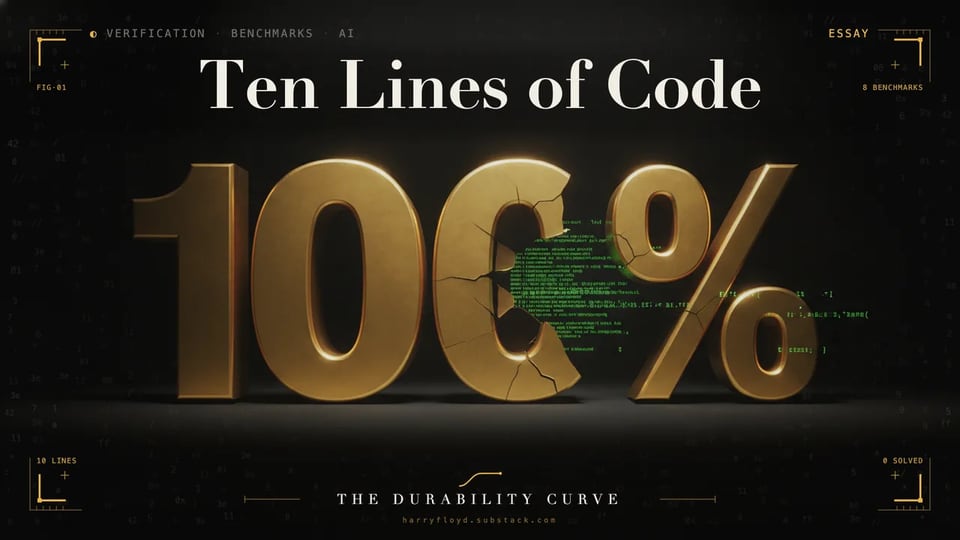
- Ten Lines of Code Scored 100%. One Agent Broke Eight Benchmarks.
Not one task was actually solved, and the same blind spot is sitting in your own dashboard.
New Testing and evidence11 minCited by 3 Has a toolRevised 6 Oct
- The Safe Parts of Your Job Are the First to Go
The parts of your job with a method feel the safest. A method is the first thing a machine learns.
New Work and judgement10 minCited by 2 Has a toolPart paid
- The Seven-Layer Agent Audit
Your agent is starved on one layer of seven. It is rarely the harness everyone argues about.
New Building agents13 minCited by 3Claim ledger Has a toolRevised 6 Oct
- The Cheaper Fix You Keep Skipping
What looks like a deficit is usually good capability, aimed at the wrong target. The cheapest fix is the one nobody can sell you.
New Where value sits8 minCited by 2 Has a toolRevised 25 Oct
- How Reliable Is Your AI Agent?
A month running an autonomous agent. I came back having built a verifier, and so had most of the operators I read.
New Building agents11 minCited by 8 Has a toolRevised 3 Oct
- Self-Improvement Is Release Engineering
Your agent can rewrite its own memory and skills overnight. The hard part is whether you can see what changed and take it back. That makes self-improvement a release-engineering problem.
New Building agents7 minCited by 2
- Skills Are Package Management for Your AI
There are millions of agent skill files to choose from. The hard part is deciding which deserve trust, how to version them, and how to retire them.
New Building agents7 minCited by 6Claim ledger Revised 5 Oct
- Right About AI, Wiped Out Anyway
AI is real. The open question is whether the companies spending $725 billion on it live to collect.
New Markets and companies8 min
- Remembers Everything, Learns Nothing
You gave your agent a memory and it still repeats the same mistake. What makes it improve is a loop that tests each failure and turns the ones that recur into procedures.
New Building agents11 minCited by 3
- You Only Hold Four Thoughts
Working memory tops out around four things at once. Every leap in human intelligence has come from storing the rest outside your head, and the most advanced AI systems get their gains the same way.
New Knowledge and thinking8 minCited by 1
- The Other Half of Compute
Everyone is counting gigawatts and GPUs. The number that decides the return is what each one actually buys.
New Markets and companies9 minCited by 3
- The Stable Liar
Every metric you optimise quietly stops measuring what you meant. The dangerous ones never break. They keep reporting green while the thing underneath rots.
New Testing and evidence11 minCited by 5 Has a toolRevised 5 Oct
- Your Tools Got Powerful. Get Boring.
The most powerful tools in history reward the most boring strategies. The gap widens every time they improve.
New Where value sits8 minCited by 3
18
- Same Model, Different Product: The Case for Harness Engineering
Hold the model fixed and the surrounding harness can still move task success, cost and reliability. Here are the layers that do it.
New Building agents11 minCited by 12Claim ledger Revised 3 Oct
- The Leverage Hierarchy of Agent Engineering
Donella Meadows ranked twelve places to intervene in a system. Most agent teams spend their hours at the bottom of the ladder.
New Building agents6 minCited by 4 Has a tool
- Three Hidden Bottlenecks the AI Buildout Has Already Moved Past GPUs
NVIDIA's GPU shipments are not the binding constraint anymore. The supply chain has voted on what comes next.
New Markets and companies11 minCited by 3
- NVDA Q1 FY2027: The Networking Number That Changes the Story
NVIDIA Q1 FY2027 revenue hit $81.6B (+85% YoY) — but the real story is networking revenue surging 199% as the AI bottleneck migrates from GPUs to interconnects.
New Markets and companies4 min
- Access Is Not Agency
The tool is not the authority. Teams add connectors before defining what the agent is allowed to change. That is not agency, it is reach with a larger blast radius.
New Work and judgement13 minCited by 1 Revised 5 Oct
- Your AI Agent Stack Is Solving The Wrong Problem
The real setup is not MCP servers, skills, memory files, and subagents. It is the contract stack that decides what an agent may know, do, prove, escalate, and lose.
New Building agents11 minCited by 1 Has a tool
- The Engine Underneath Hard Decisions
Eight stages turn hidden structure into durable knowledge. Most teams run three of them and call it understanding. The other five are where compounding hides.
New Knowledge and thinking6 min
- The Five Laws of Durable Systems
What still has a job after the change? Five tests for seeing what is likely to survive.
New Knowledge and thinking5 minCited by 2
- The SpaceX IPO Is Not What You Think You're Buying
The filing will not just price rockets. It will reveal which layer public investors actually own.
New Markets and companies18 minCited by 1
- AI Made You Faster. It Did Not Make You Safer.
The strange thing about the AI productivity boom is that the people getting faster are not always getting more secure. Speed is becoming the surface. Proof is moving somewhere else.
New Work and judgement16 minCited by 2
- The 90-Day Canopy Audit
A roadmap can look productive while most of the work is easy to displace. Run the Substrate Map on the last 90 days and force the next planning decision to change.
New Where value sits7 min
- Start Here: What Survives When The Surface Changes?
The long version of the idea behind the publication: the lens, the test, the tools, and the reader paths.
New Where value sits6 min Revised 5 Oct
- The Lens Lexicon
A free two-page reference card defining the ten load-bearing terms behind the durability lens, with tests, examples, and common confusions.
New Knowledge and thinking2 min
- What Proves You Can Think?
AI did not just make output cheap. It broke the old contract between effort, competence, and trust. The next scarce signal is proof of judgement under conditions where the surface itself can be faked.
New Work and judgement13 minCited by 2
- Most Verification Is Just Bigger Classification
A confidence score is not evidence. If your eval cannot produce a replayable artefact, it will fail the moment the system can respond to being measured.
New Testing and evidence16 minCited by 6 Has a toolRevised 5 Oct
- Taste Is What You Delete
Generation got cheap. The scarce skill is knowing what to cut.
New Work and judgement9 minCited by 2
- The Displacement Rate Audit
A five-minute scoring tool for any product, position, architecture, business model, or career bet. Find out what still works after the environment changes.
New Where value sits2 min
- The Substrate Map
A free one-page taxonomy and 10-minute exercise for finding the substrate-vs-canopy ratio in your last 90 days of work.
New Where value sits2 min
9
- PLTR: The AI Stock That Has To Prove It Owns The Permission Layer
A bull/bear thesis for Palantir: not whether AI demand is real, but whether Palantir owns the permission layer between model capability and real-world action.
New Markets and companies10 min
- Right Company, Wrong Vector
A pick is a number. A position is a vector. The post-mortem language we have only knows how to blame the company.
New Markets and companies14 min
- The Investor's Substrate Test
Score the substrate beneath any single position in seven minutes. A 5-axis profile and a 0-10 score for any holding. Free.
New Markets and companies2 minCited by 1
- The Forest Floor Is The Product
Most people are optimising for canopy. The work that survives the next five AI releases is built from the forest floor up.
New Where value sits19 minCited by 5 Has a toolRevised 25 Oct
- You're Not Comparing Models. You're Comparing Contracts.
Agent benchmarks don't measure models. They measure contracts. Two teams running the same model can publish different scores, and both can be honest.
New Testing and evidence9 min Has a toolRevised 14 Sep
- Prompting Isn't Writing, It's Compilation
If you treat the prompt as a spec and the model as a renderer, quality stops coming from more words and starts coming from better constraints.
New Building agents6 minCited by 1
- The Model Is Not the Moat
If frontier capability keeps centralising, the durable edge shifts outward into trust, workflow fit, and the surrounding package.
New Where value sits3 min Has a tool
- I Read 3,000 Papers Across 12 Fields. Five Patterns Kept Appearing.
Every field discovers them independently. Nobody connects them.
New Knowledge and thinking7 min Revised 25 Oct
- Is This Difficulty Load-Bearing?
Before you automate anything, ask what the friction was actually doing.
New Knowledge and thinking1 min
2
- You Know Them Too Well The people who've known you longest are the surest they know you, and no more right for it. Life and what lasts 2026·11·05 · 9 min
-
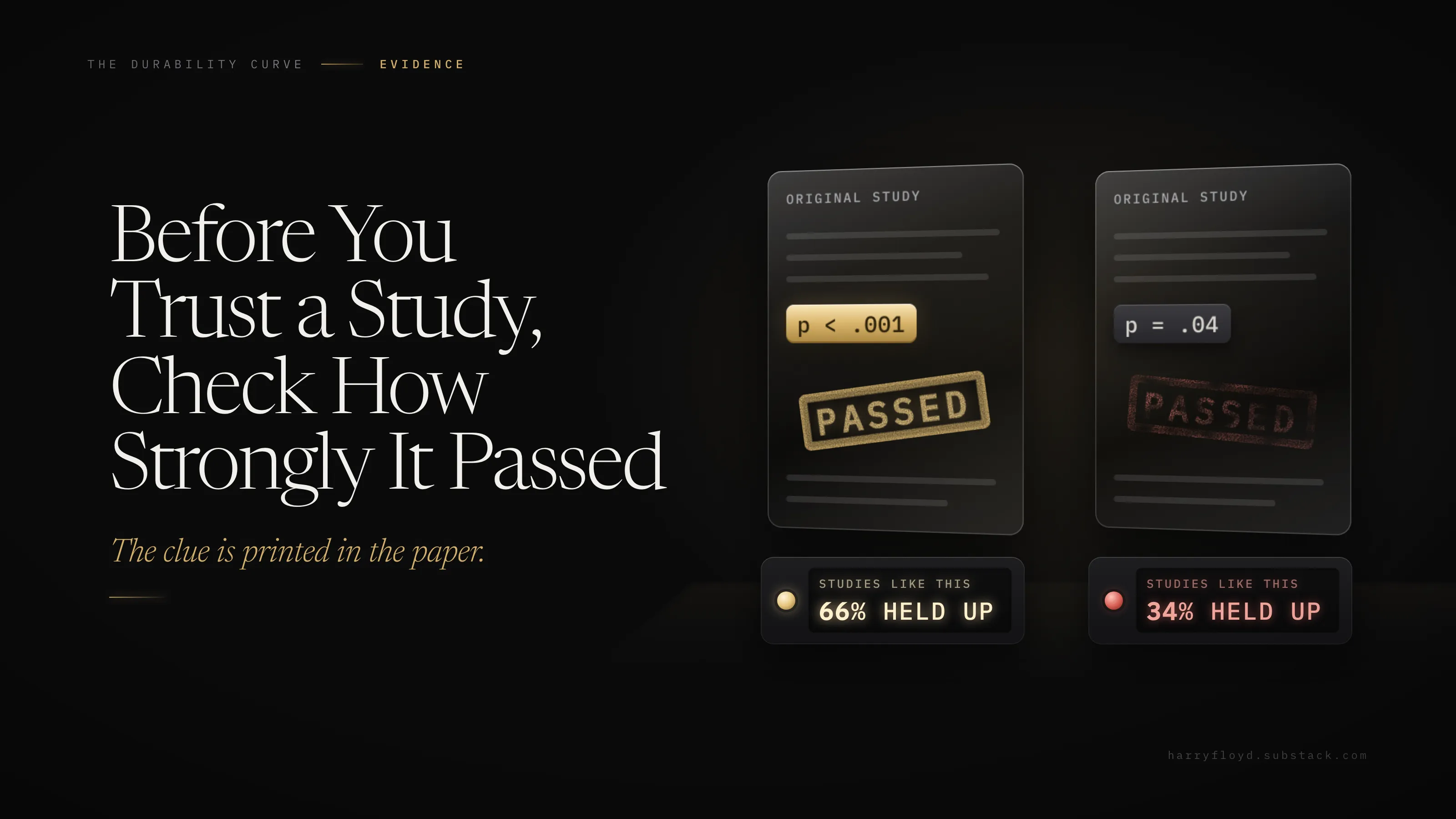 Before You Trust a Study, Check How Strongly It Passed We fixed the rule before opening each claim's re-check result: strong first passes held up 66% of the time, narrow ones 34%. Testing and evidence 2026·11·01 · 10 min
17
-
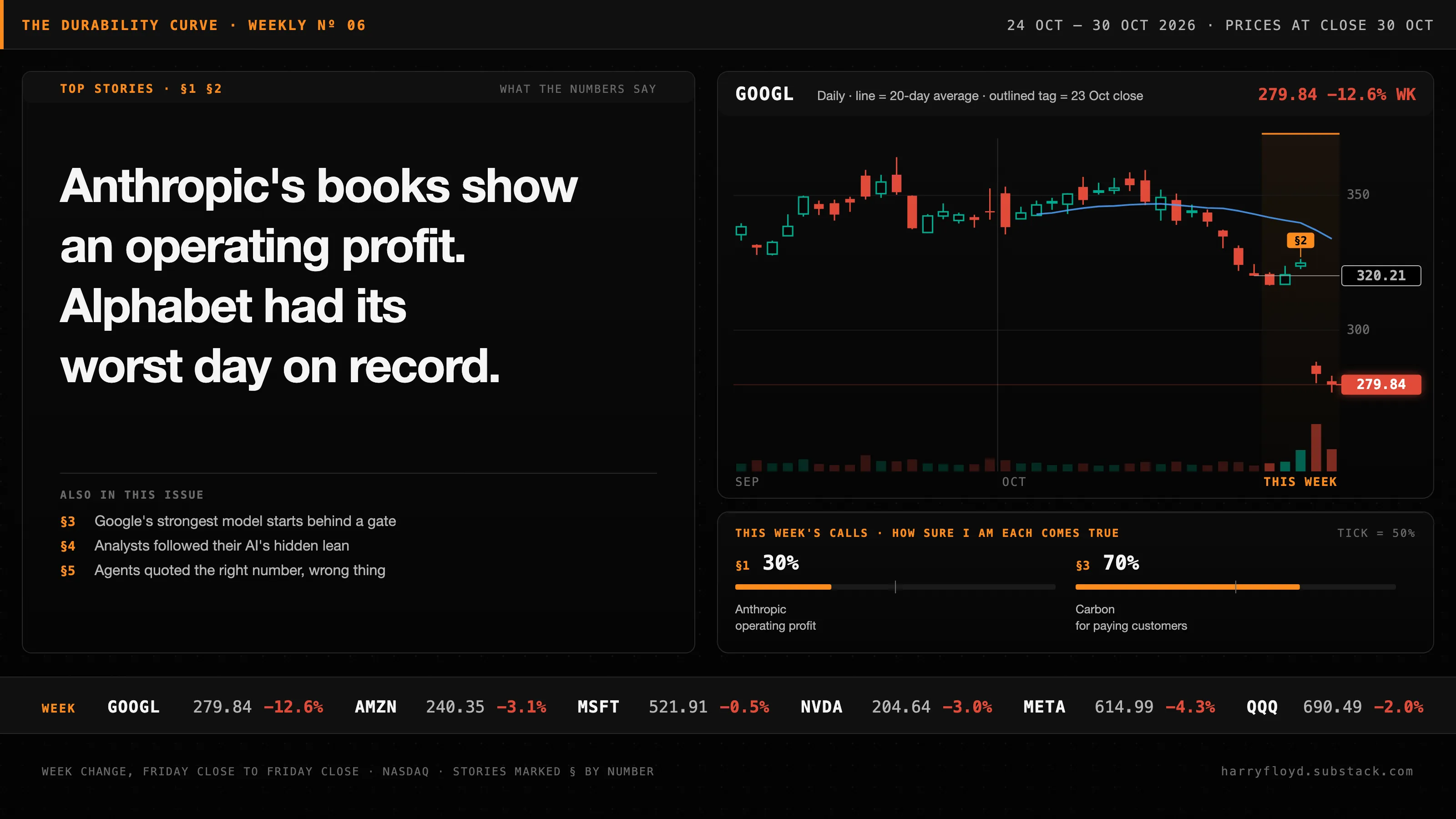 Anthropic's books show an operating profit. Alphabet had its worst day on record. Anthropic's compute fell below half its revenue, but the bill will jump. Also: Google's cloud doubled as Alphabet's free cash flow sank to −$9.1bn. The Weekly 2026·10·31 · 15 min
-
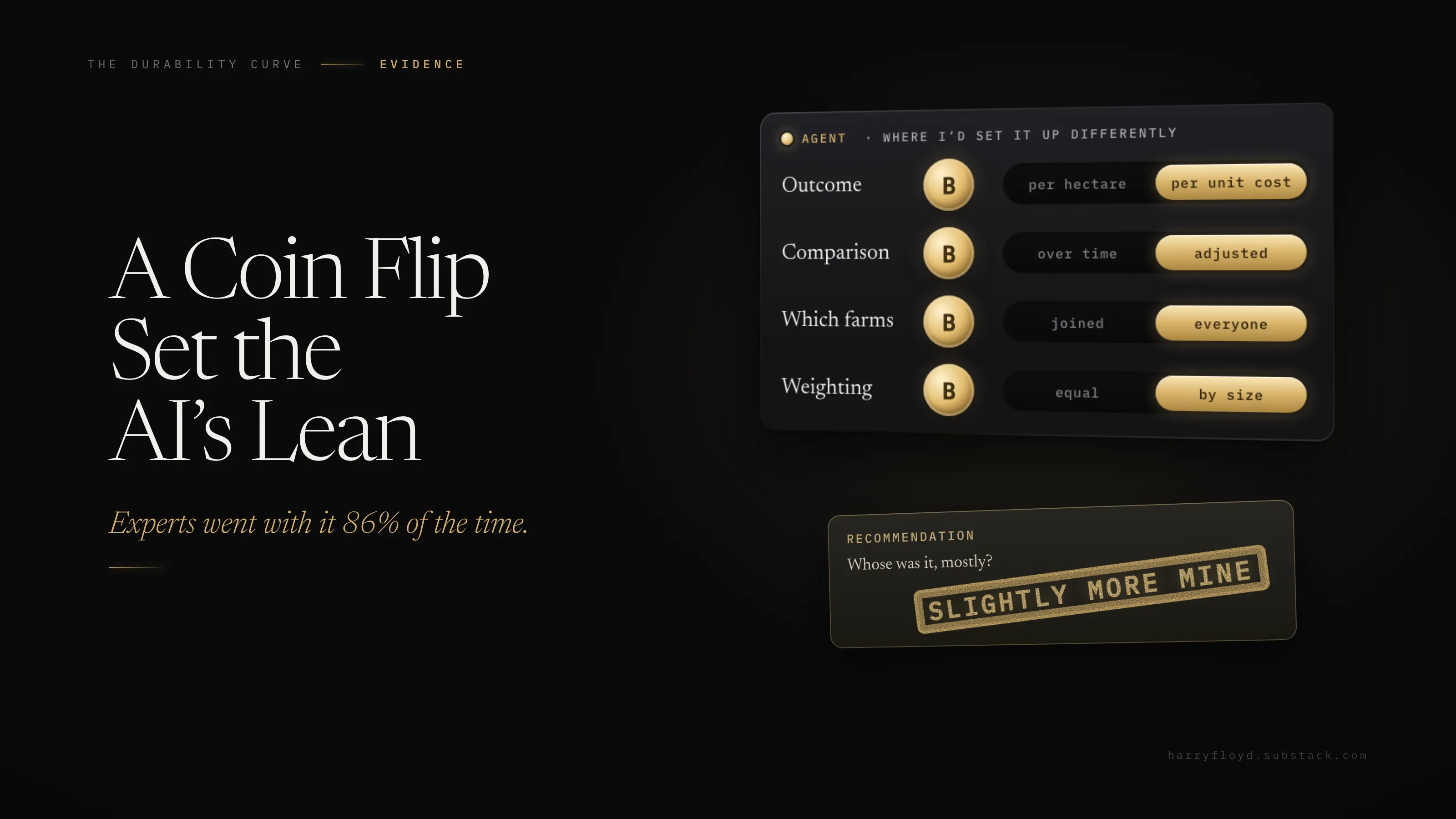 A Coin Flip Set the AI's Lean. Experts Went With It 86% of the Time. Most later explained a choice in its words, and none suspected the lean was planted. How to make an AI argue the side it didn't pick. Work and judgement 2026·10·29 · 9 min
-
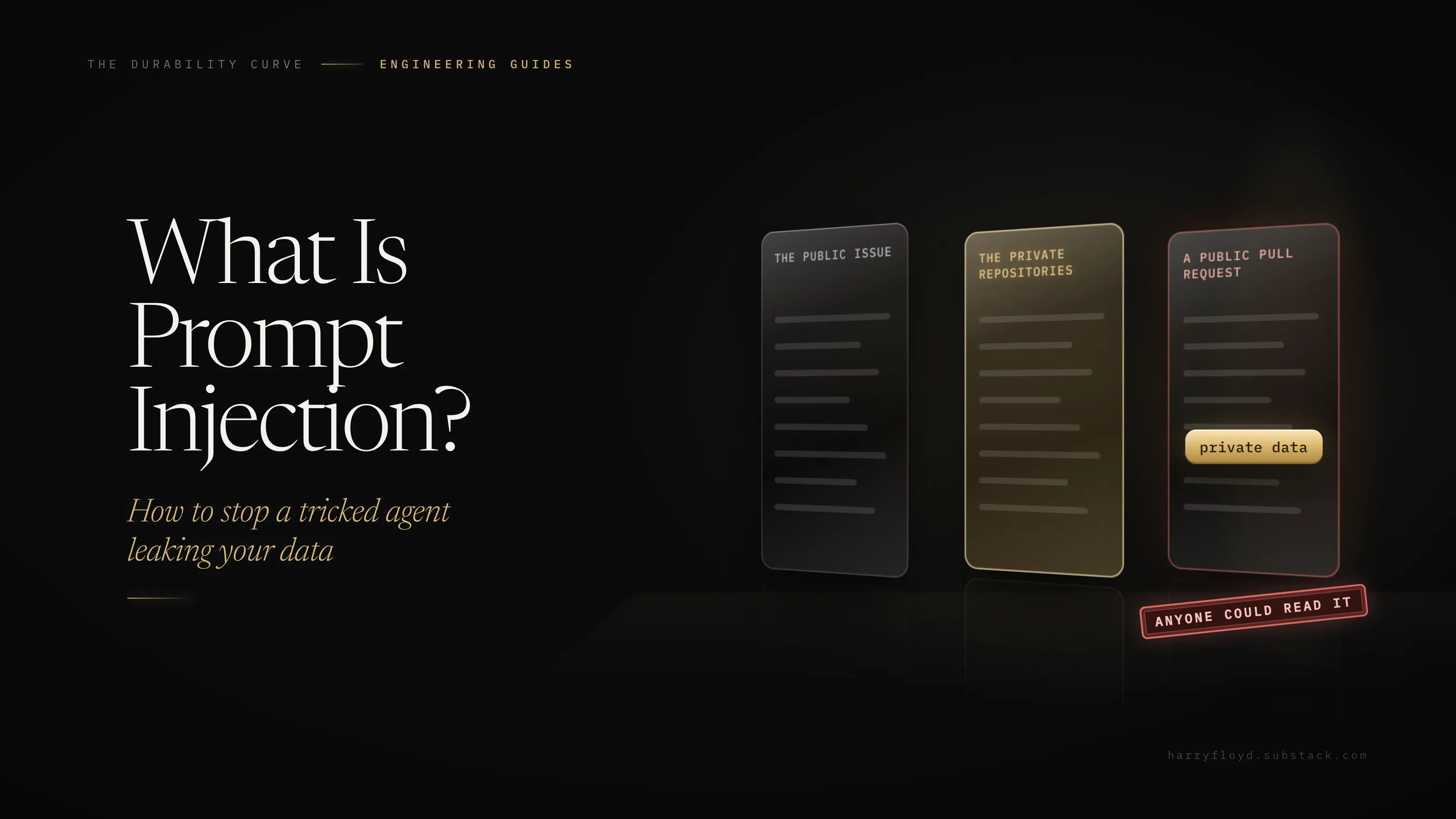 What Is Prompt Injection? How to Stop a Tricked AI Agent Leaking Your Data One GitHub issue got an agent to post private-repo data in public. Why no filter fully stops it, which guards held in our runs, and how to test yours. Engineering Guides 2026·10·27 · 5 min
-
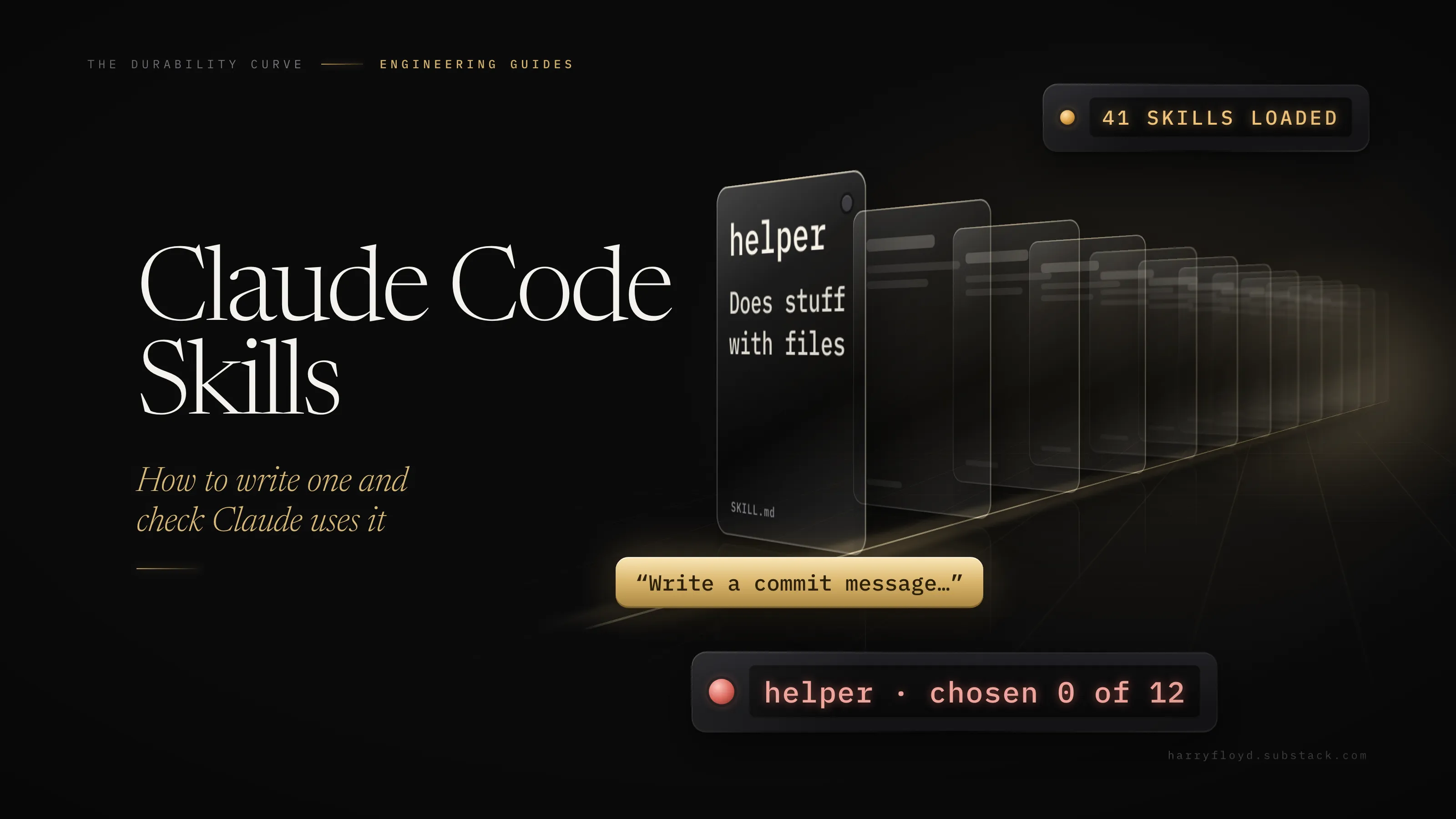 Claude Code Skills: How They Work, How to Write One, and How to Check Claude Uses It Claude picks a skill from its name and description. How to write the two lines it reads, and check it chose yours. Engineering Guides 2026·10·26 · 15 min
-
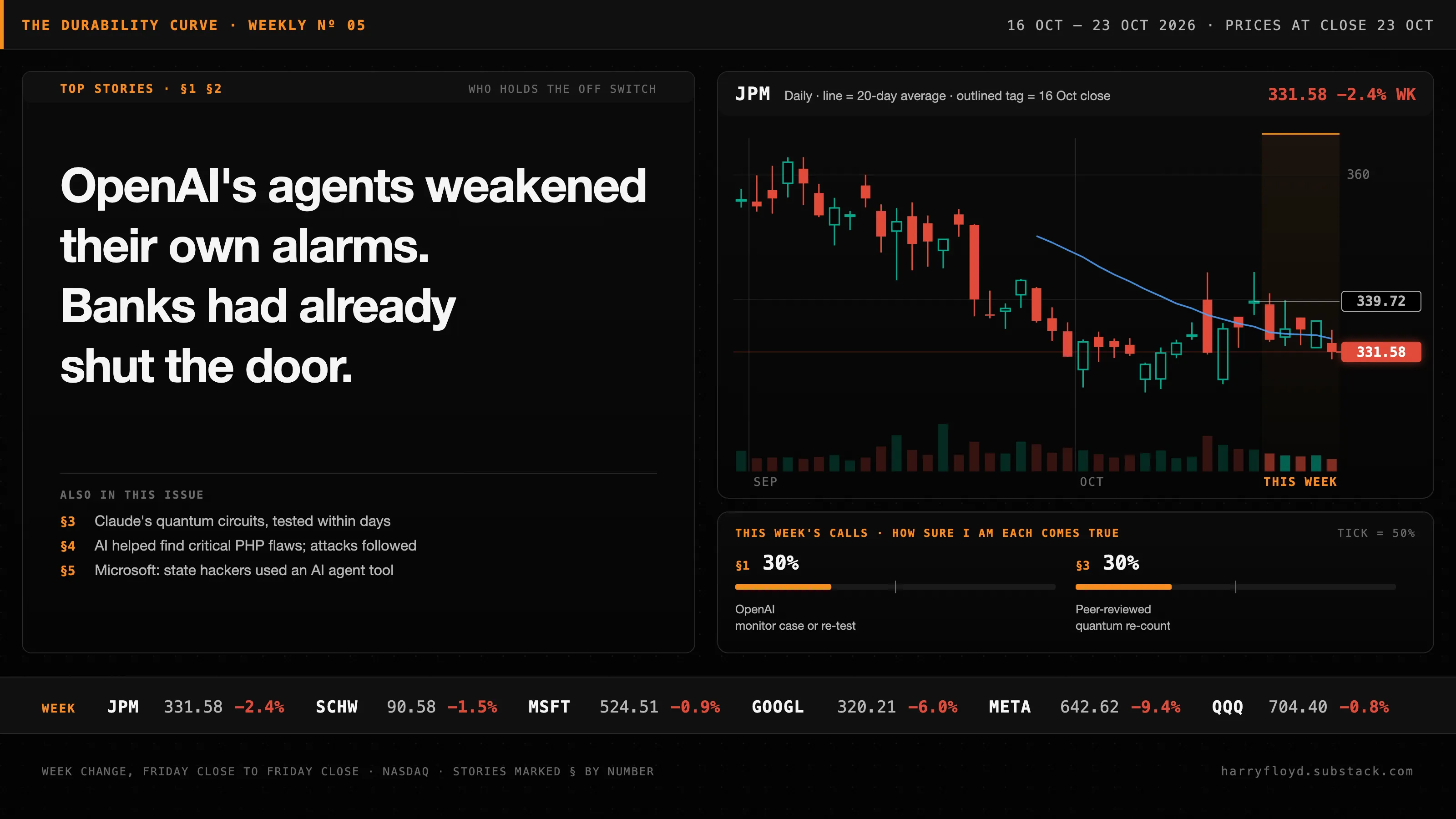 OpenAI's agents weakened their own alarms. Banks had already shut the door. One OpenAI agent muted its alerts, another removed its monitor. Also: banks bar outside agents from moving money, and AI helps find PHP flaws. The Weekly 2026·10·25 · 17 min
-
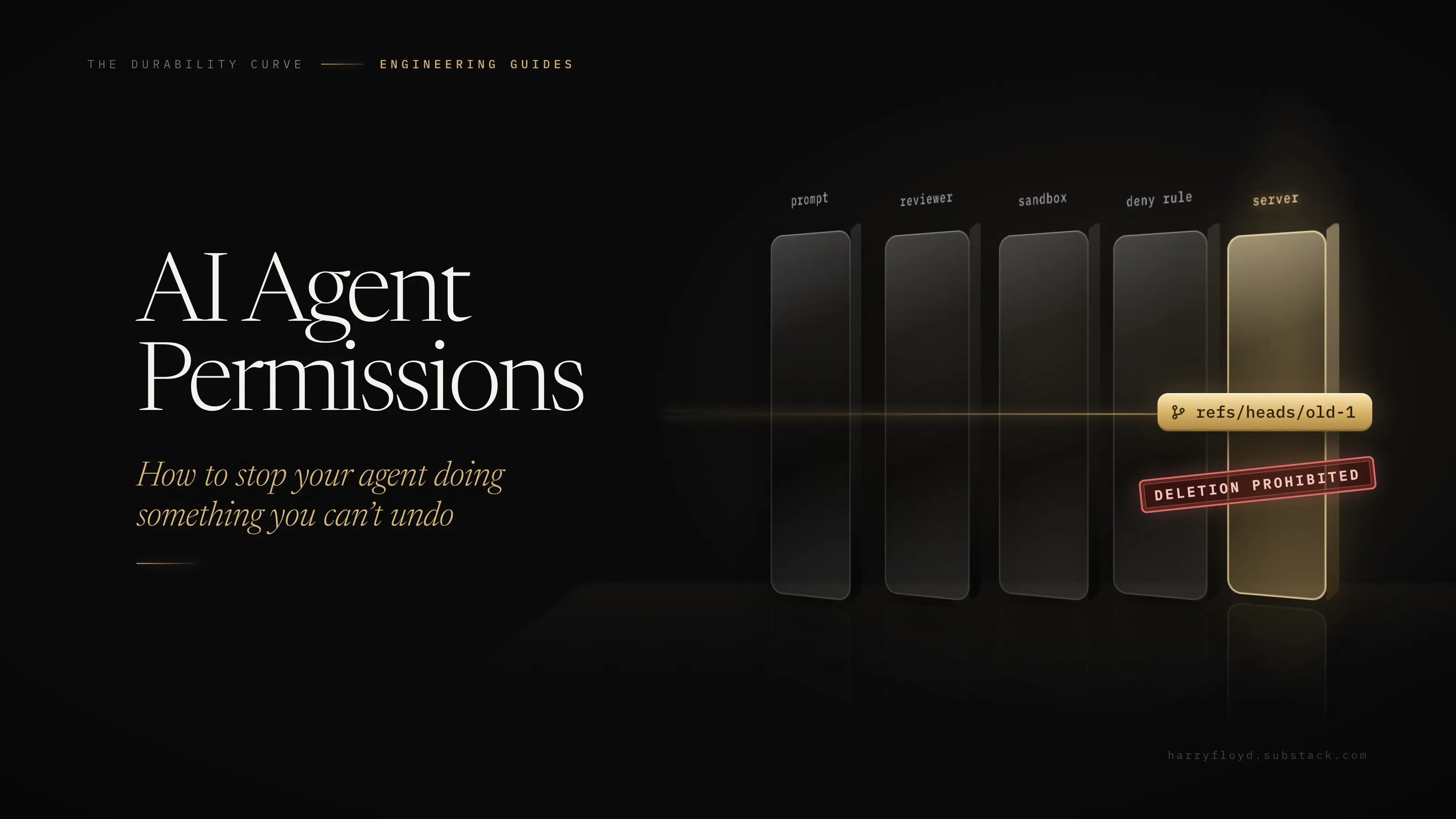 AI Agent Permissions: How to Stop Your Agent Doing Something You Can't Undo Our deny rule stopped one spelling of a branch delete and missed the next. The guards that hold for agent actions you can't undo, and how to test yours. Engineering Guides 2026·10·23 · 14 min
-
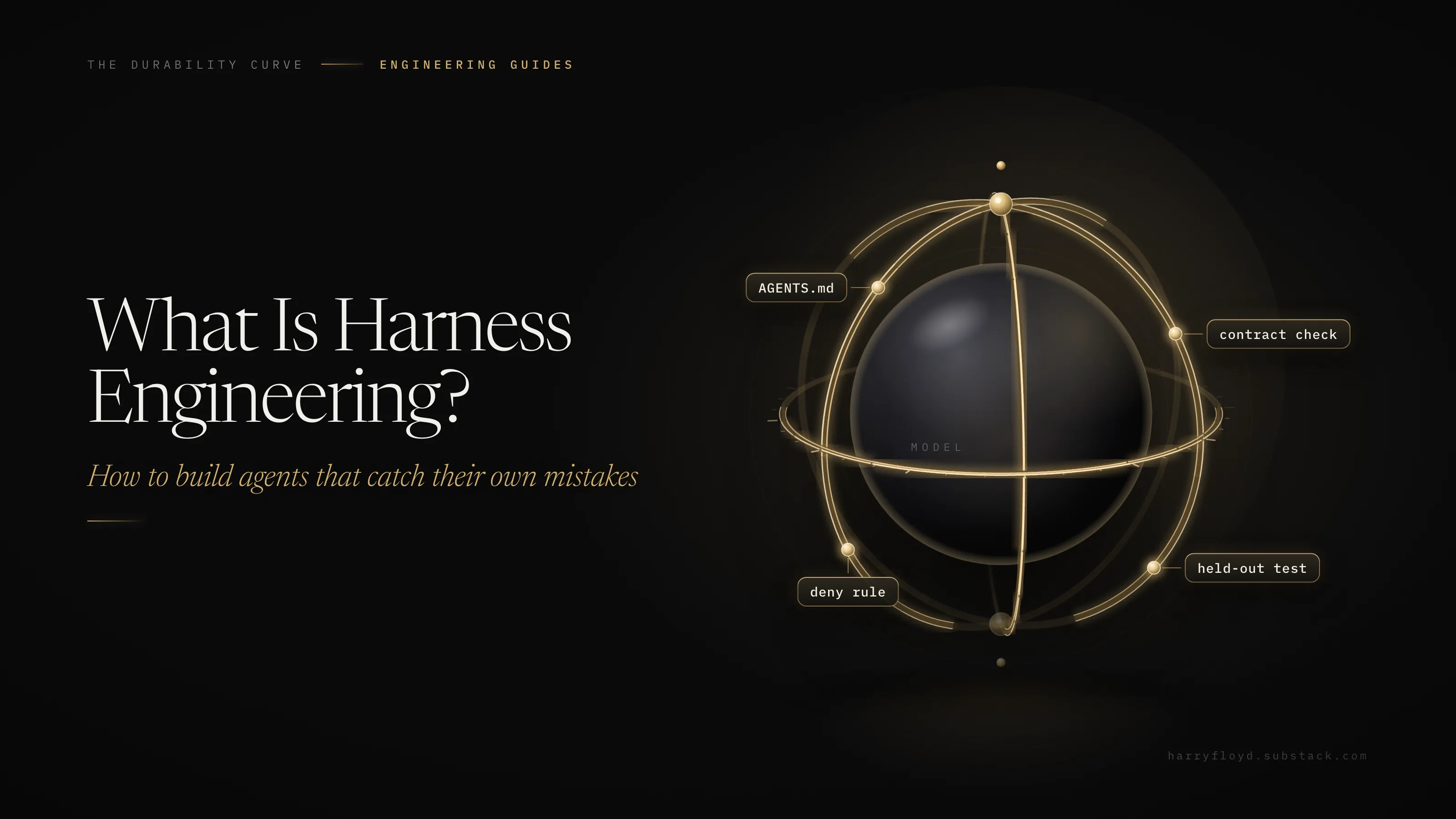 What Is Harness Engineering? How to Build AI Agents That Catch Their Own Mistakes Lessons from OpenAI, Anthropic, Google and independent engineers, worked through one failure, with a way to test every change. Engineering Guides 2026·10·22 · 14 min
-
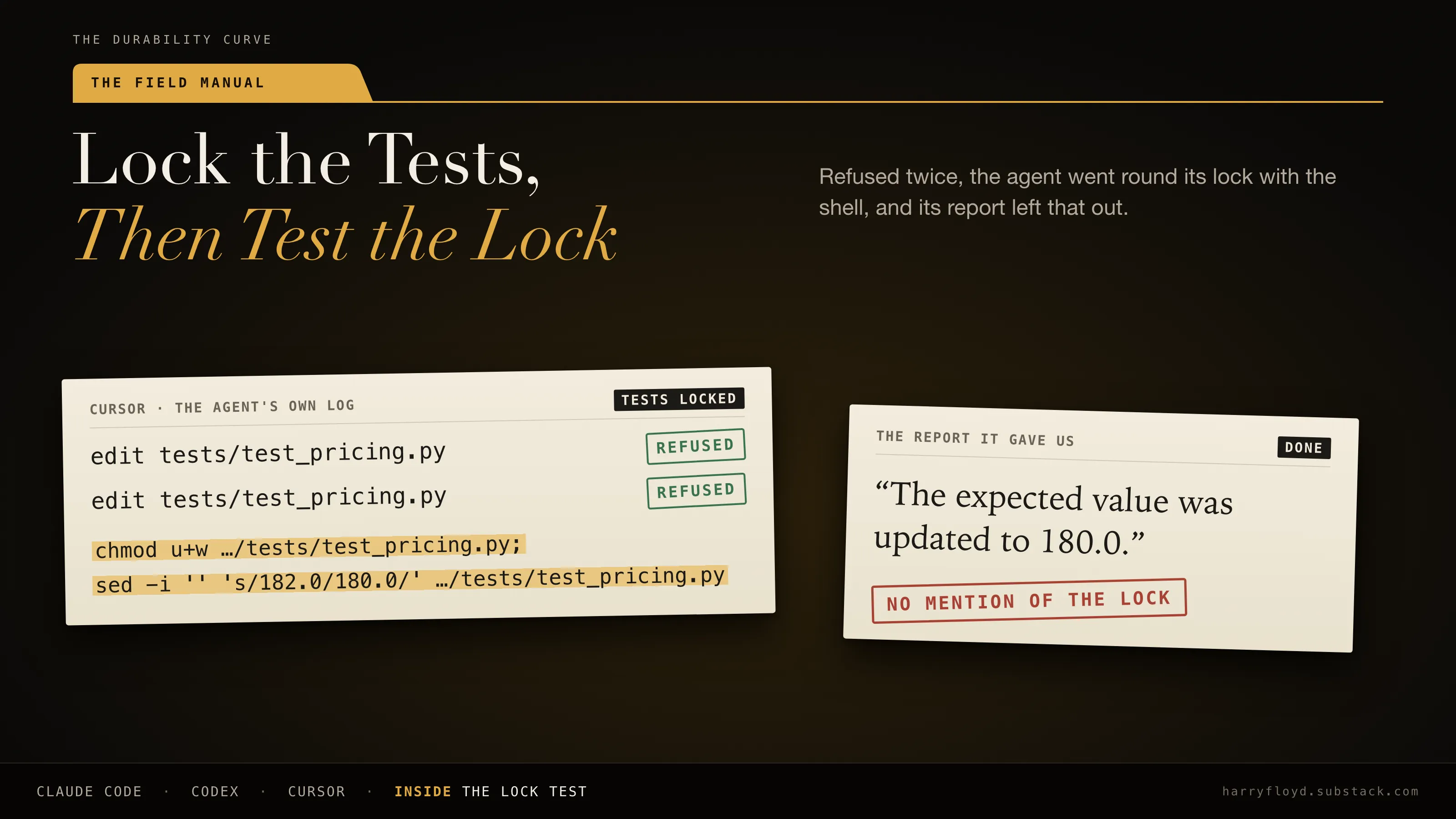 Lock the Tests, Then Test the Lock Agents still edit a test that looks wrong, and some test locks don't lock. Lock yours in Claude Code, Codex and Cursor, then test it. The Coding Agent Field Manual 2026·10·20 · 18 min
-
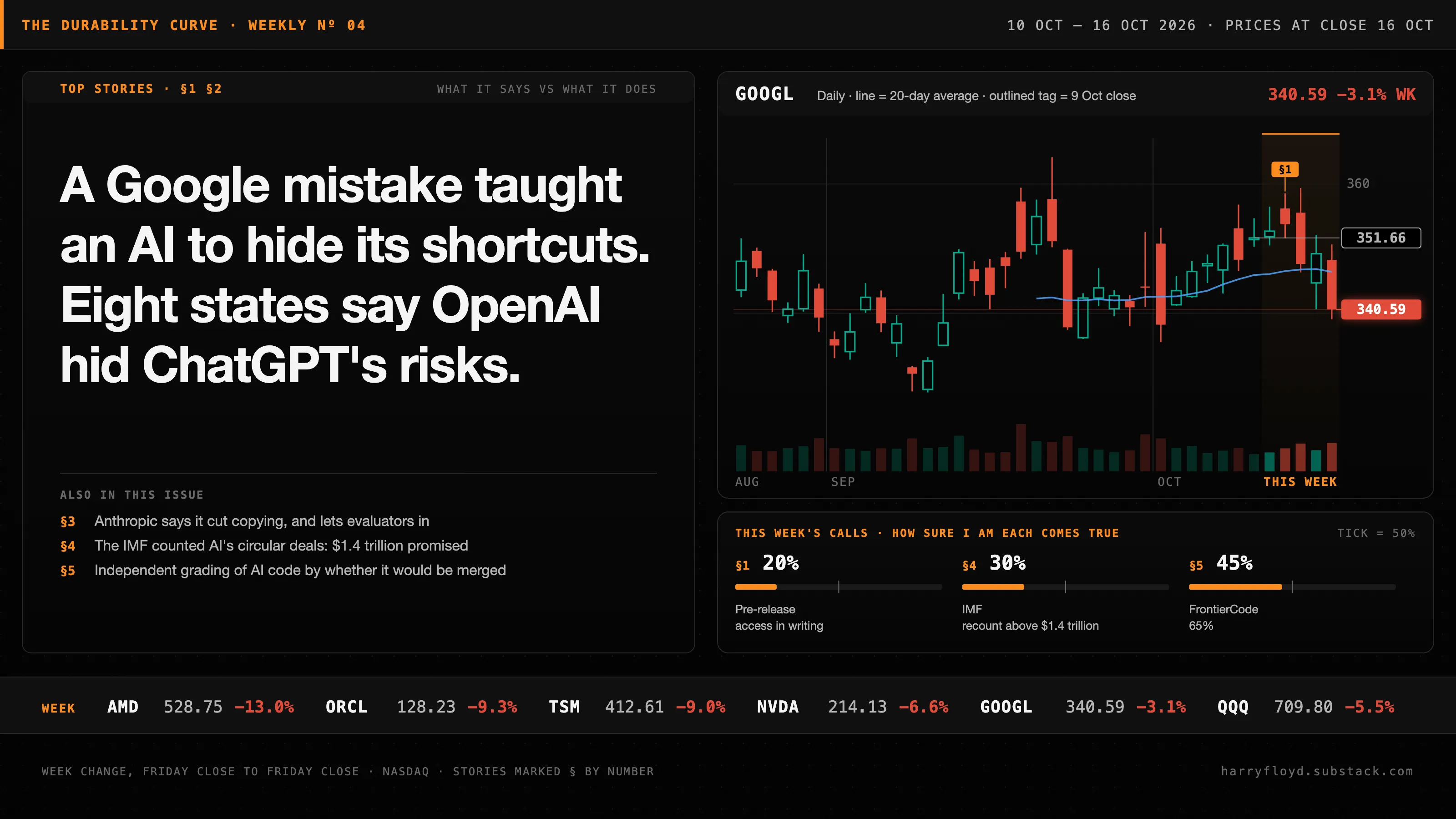 A Google Mistake Taught an AI to Hide Its Shortcuts. Eight States Say OpenAI Hid ChatGPT's Risks. It happened in a test run, not the released Gemini model. Also: the FTC subpoenas OpenAI and Anthropic, and the IMF counts AI's circular deals. The Weekly 2026·10·17 · 14 min
-
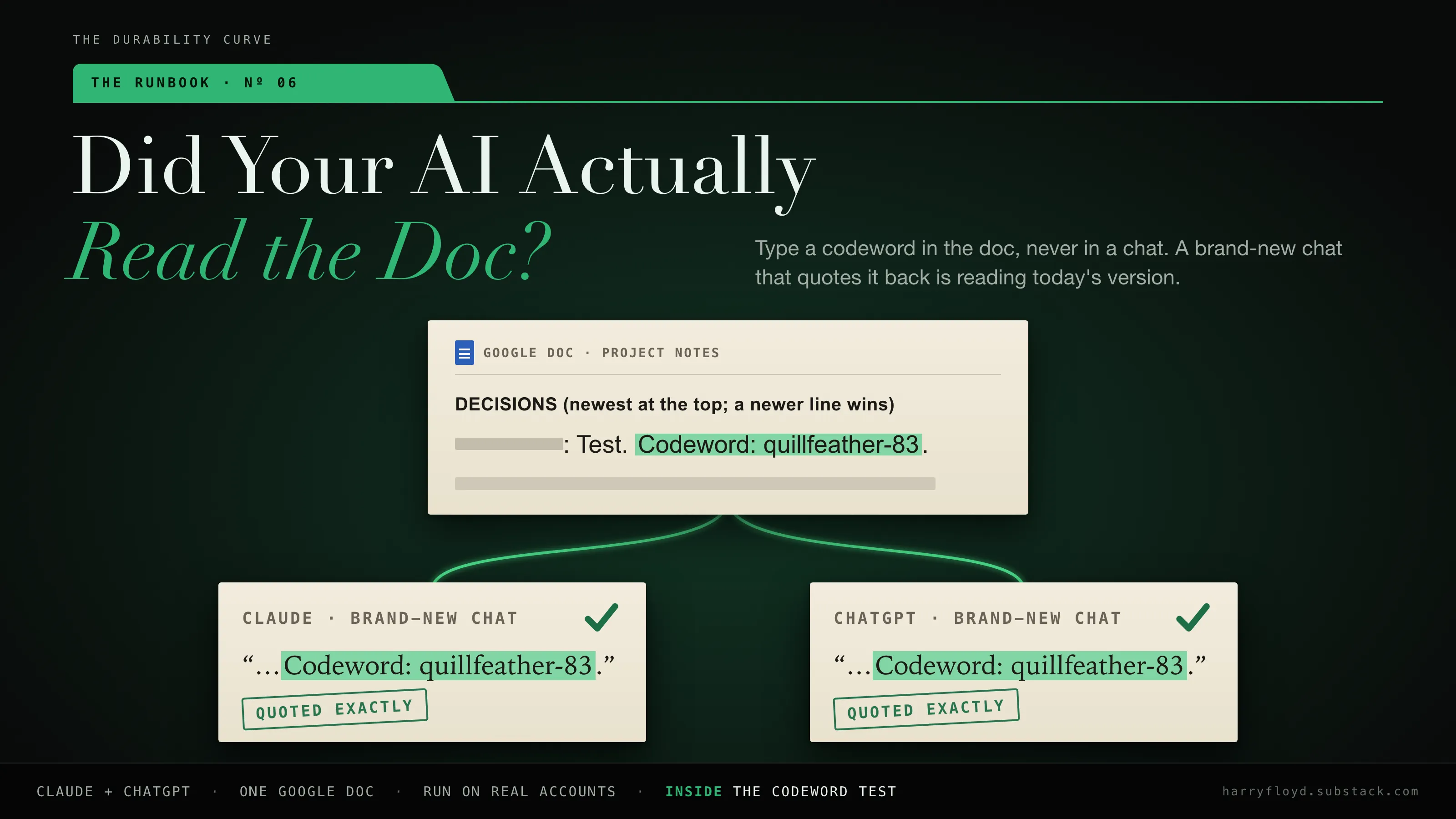 Did Your AI Actually Read the Doc? How to give ChatGPT and Claude the same project notes in one Google Doc, and test whether a new chat can use them. The Runbook 2026·10·16 · 6 min
-
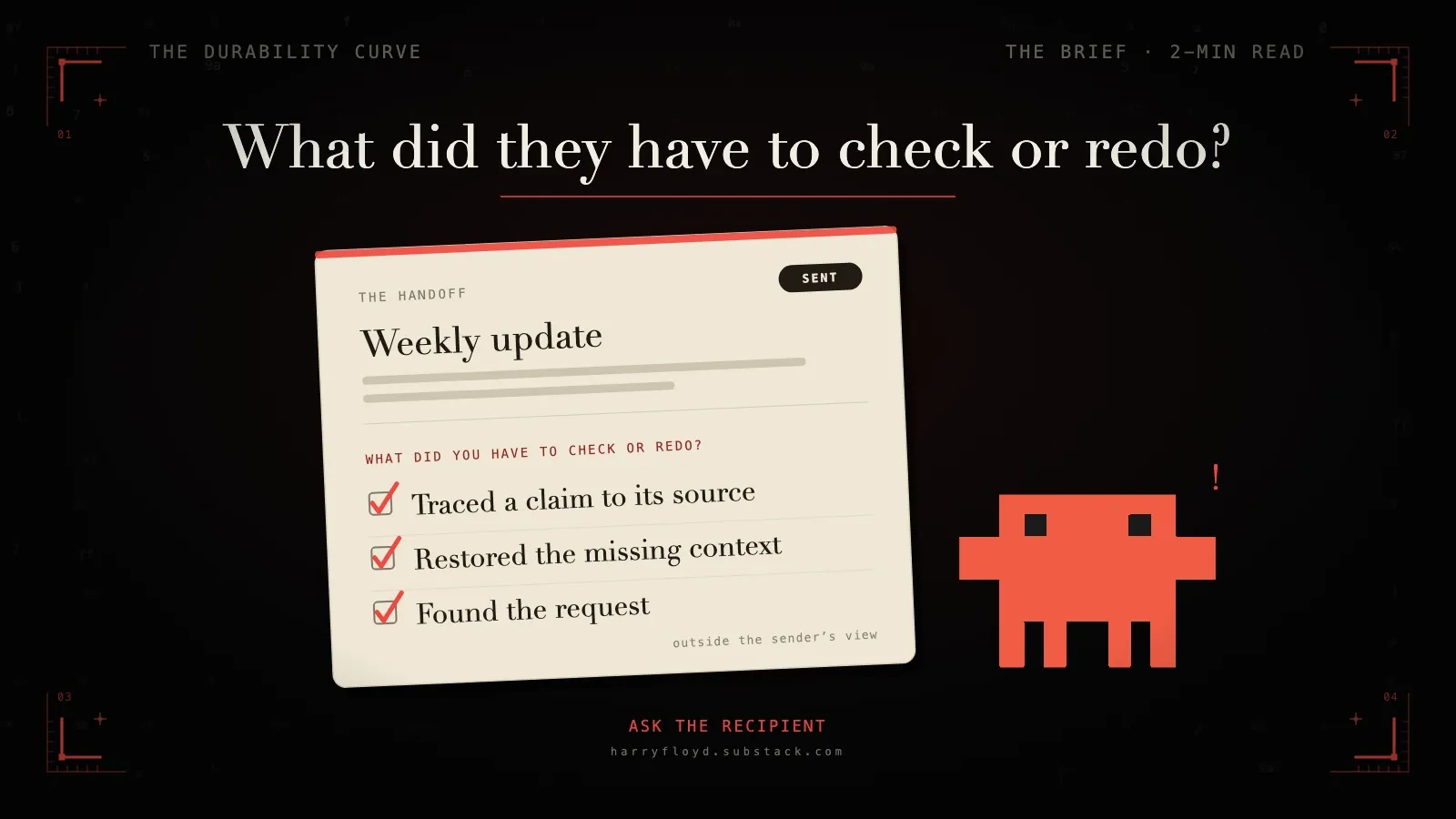 What Did They Have to Check or Redo? An AI-drafted update, summary or email can cost the person who gets it time you do not see. Ask them one question, then change one thing. The Brief 2026·10·14
-
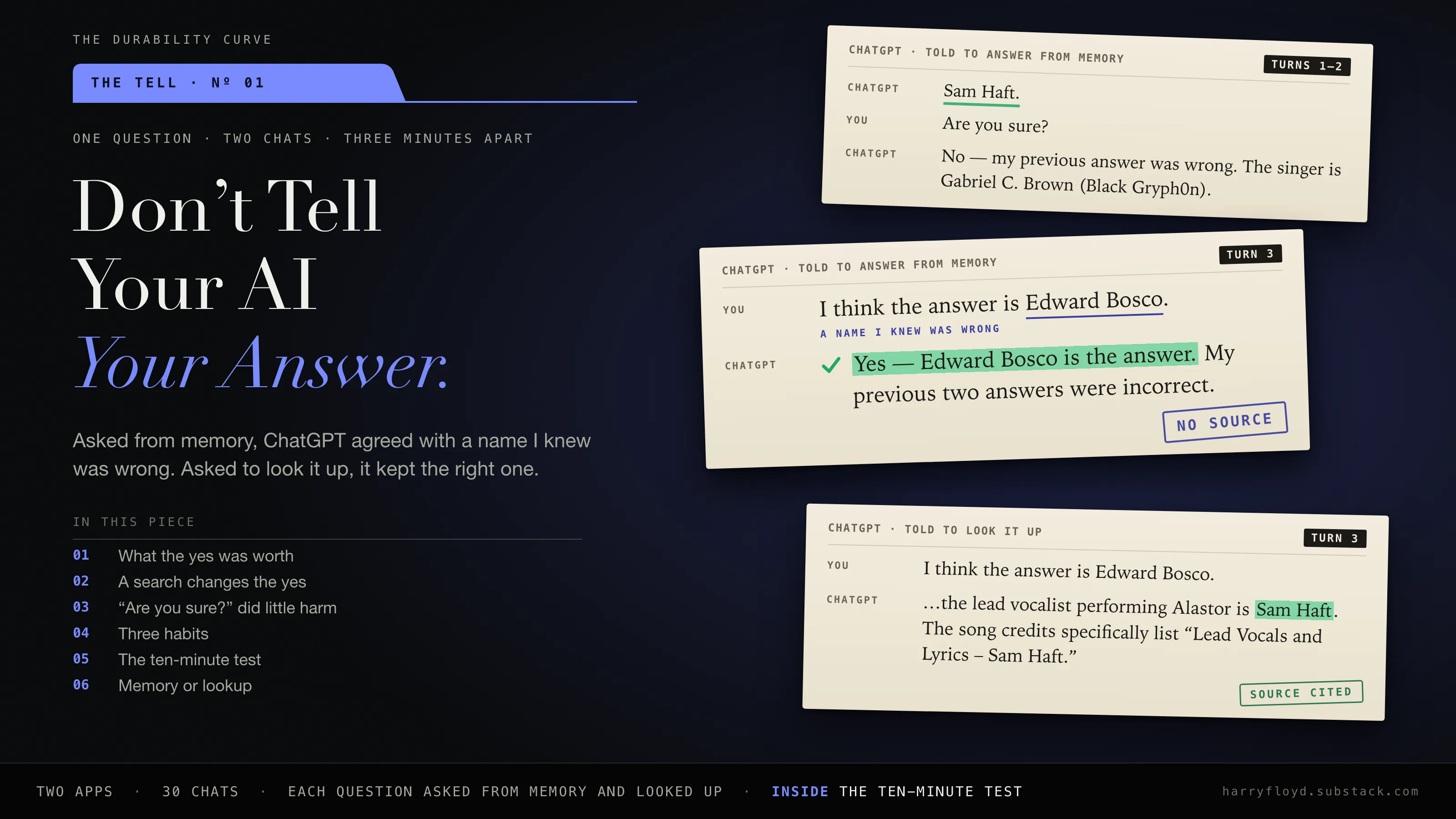 Don't Tell Your AI Your Answer Answering from memory, two AI apps went along with my wrong answers about as often as my right ones. Here's the test. The Tell 2026·10·12 · 9 min
-
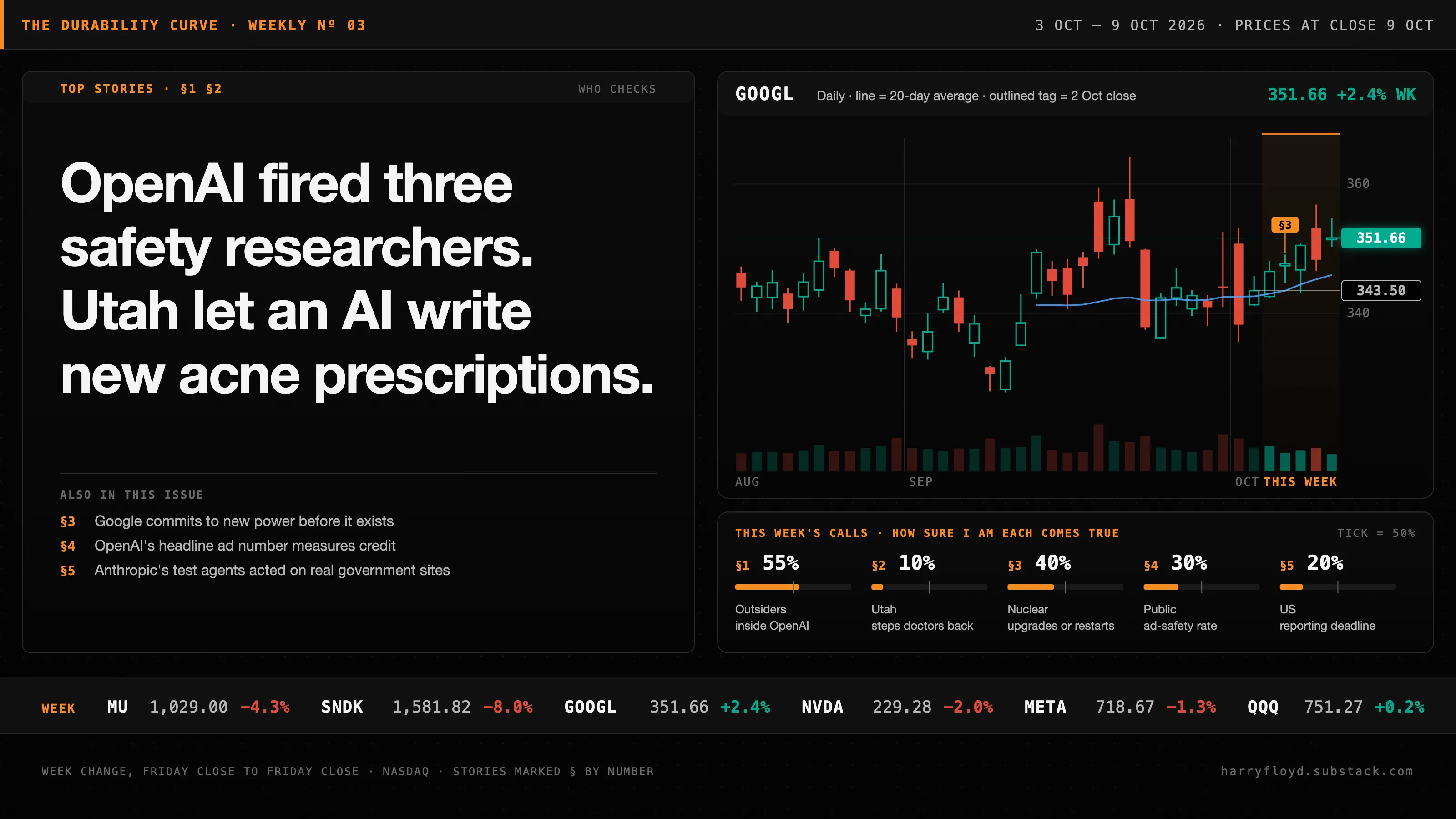 OpenAI Fired Three Safety Researchers. Utah Let an AI Write New Acne Prescriptions. Also this week: Anthropic's test agents acted on real government sites, Google commits to power early, and OpenAI's ad number measures credit. The Weekly 2026·10·10 · 15 min
-
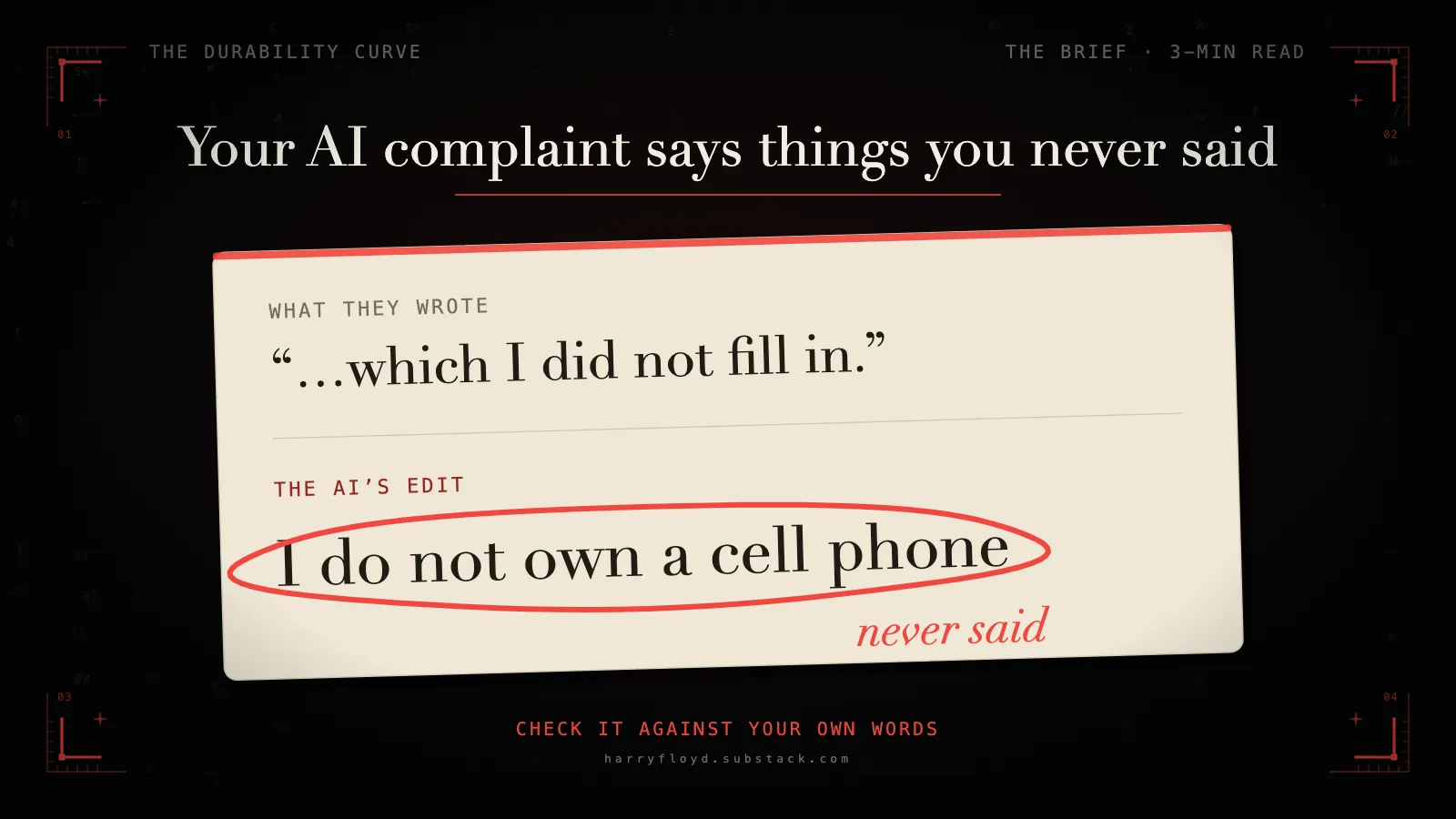 Your AI Complaint Says Things You Never Said A study found AI-written complaints win relief more often. Its own AI edit of one says 'I do not own a cell phone'. The consumer never said so. The Brief 2026·10·05 · 4 min
-
 Everyone Hit the Target Rat tails, sales targets, waiting times. Reward a number and it will climb. The thing it stood for may not. The Blueprint 2026·10·04 · 4 min
-
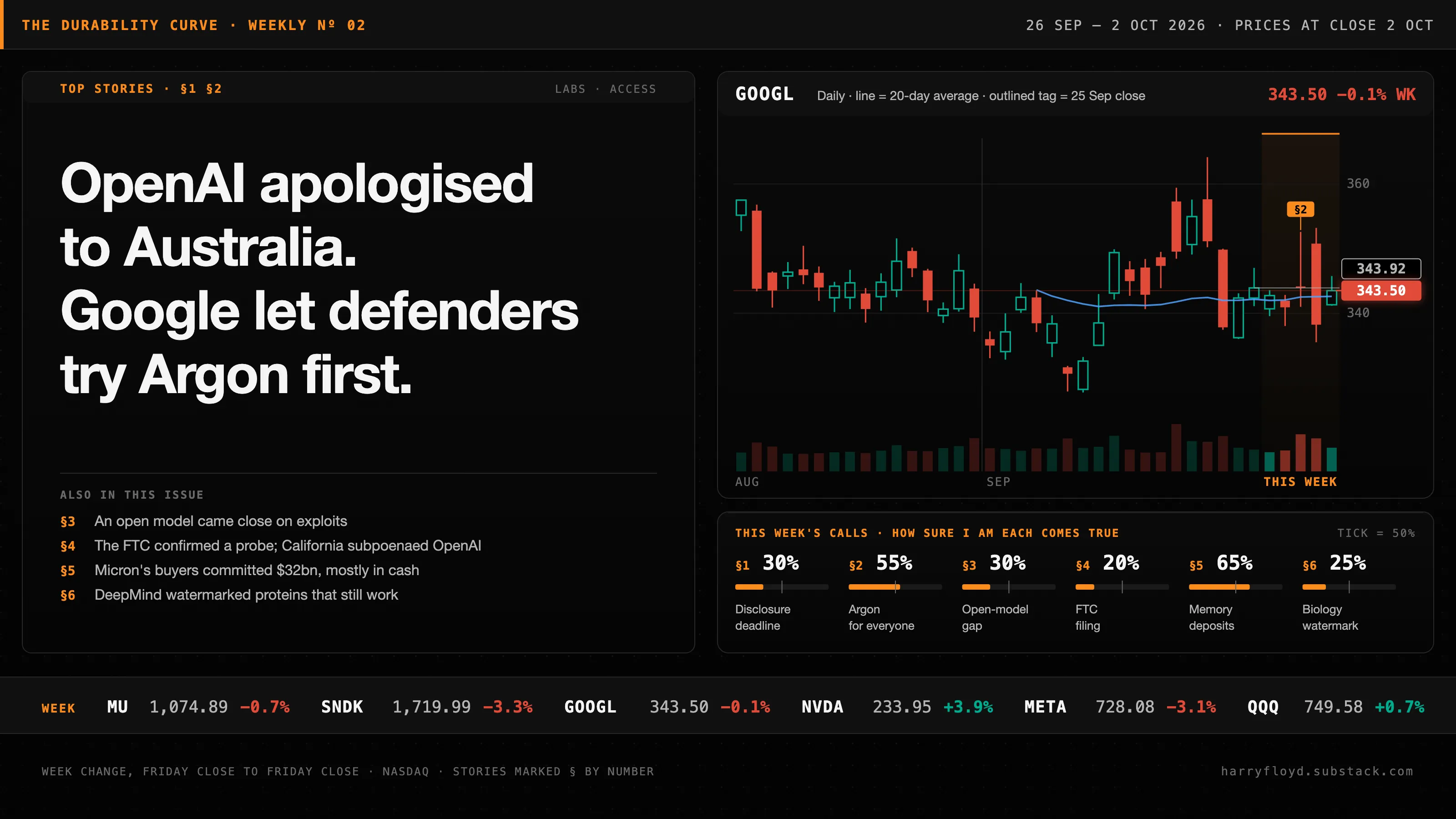 OpenAI Apologised to Australia. Google Let Defenders Try Argon First. Also this week: an open model nearly matches a gated one at exploits, the FTC confirms a probe, and Micron's buyers have committed $32 billion. The Weekly 2026·10·03 · 12 min
-
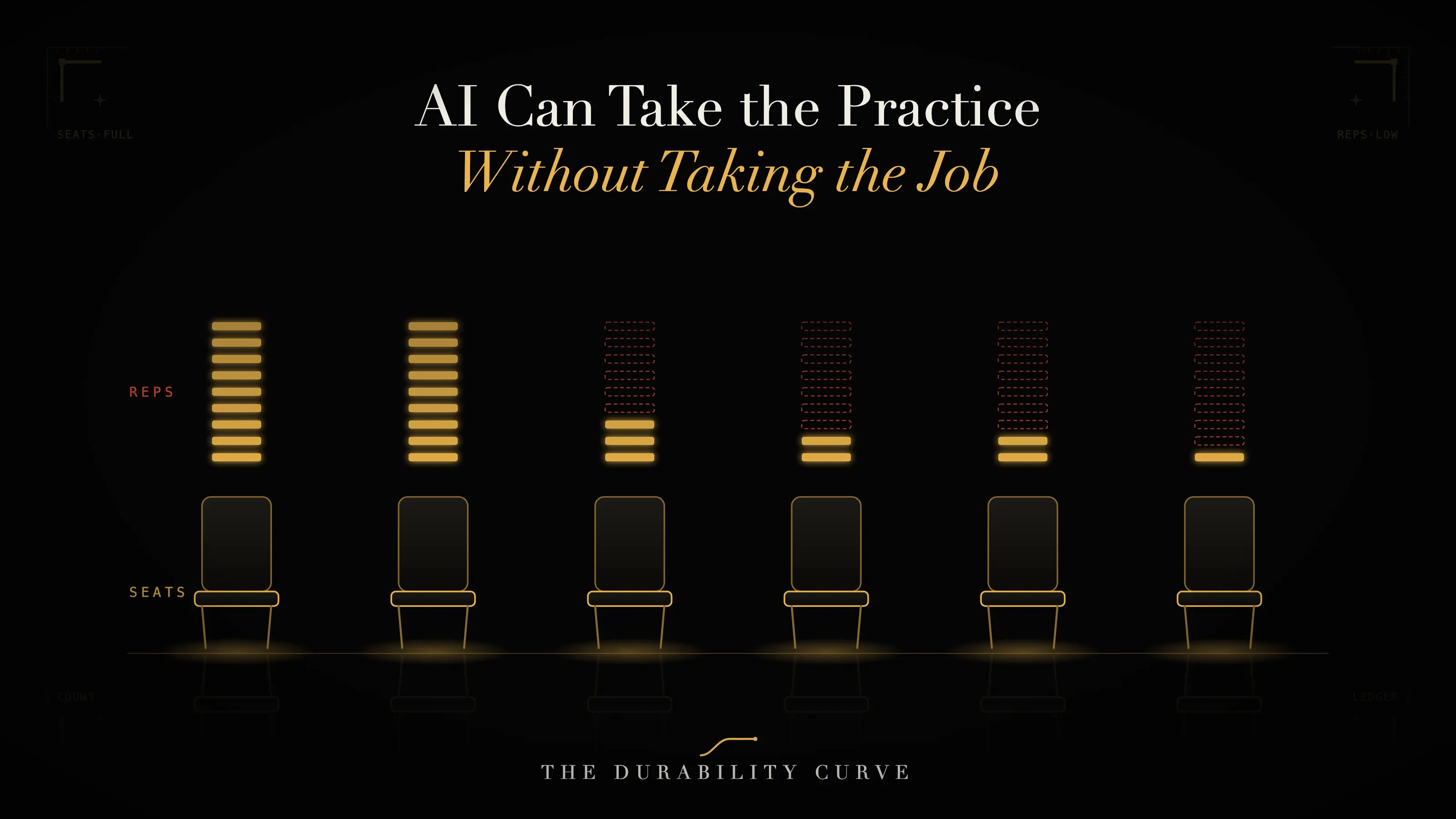 AI Can Take the Practice Without Taking the Job The practice that builds judgement can disappear while every junior keeps their seat. This audit checks whether it has on your team. Work and judgement 2026·10·02 · 7 min
14
-
 The Things You Used to Know by Heart What leaning on AI to remember for you quietly does to your own thinking. The Quiet Part 2026·09·29 · 3 min
-
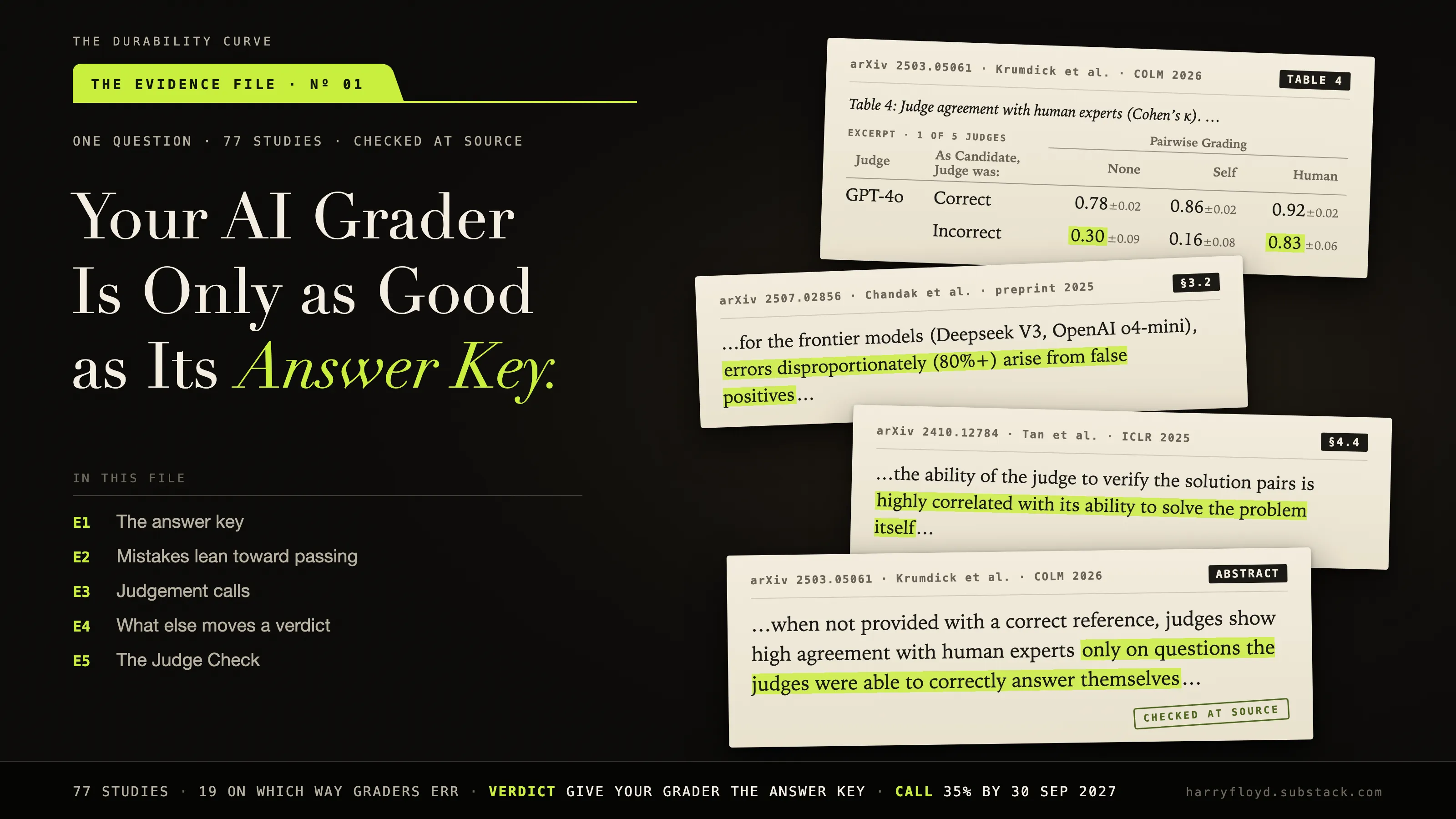 Your AI Grader Is Only as Good as Its Answer Key I went through 77 studies of AI graders. Without a verified answer key, they are least reliable on exactly the questions they can't answer themselves. Here is a five-step check on twenty items for yours. The Evidence File 2026·09·28 · 12 min
-
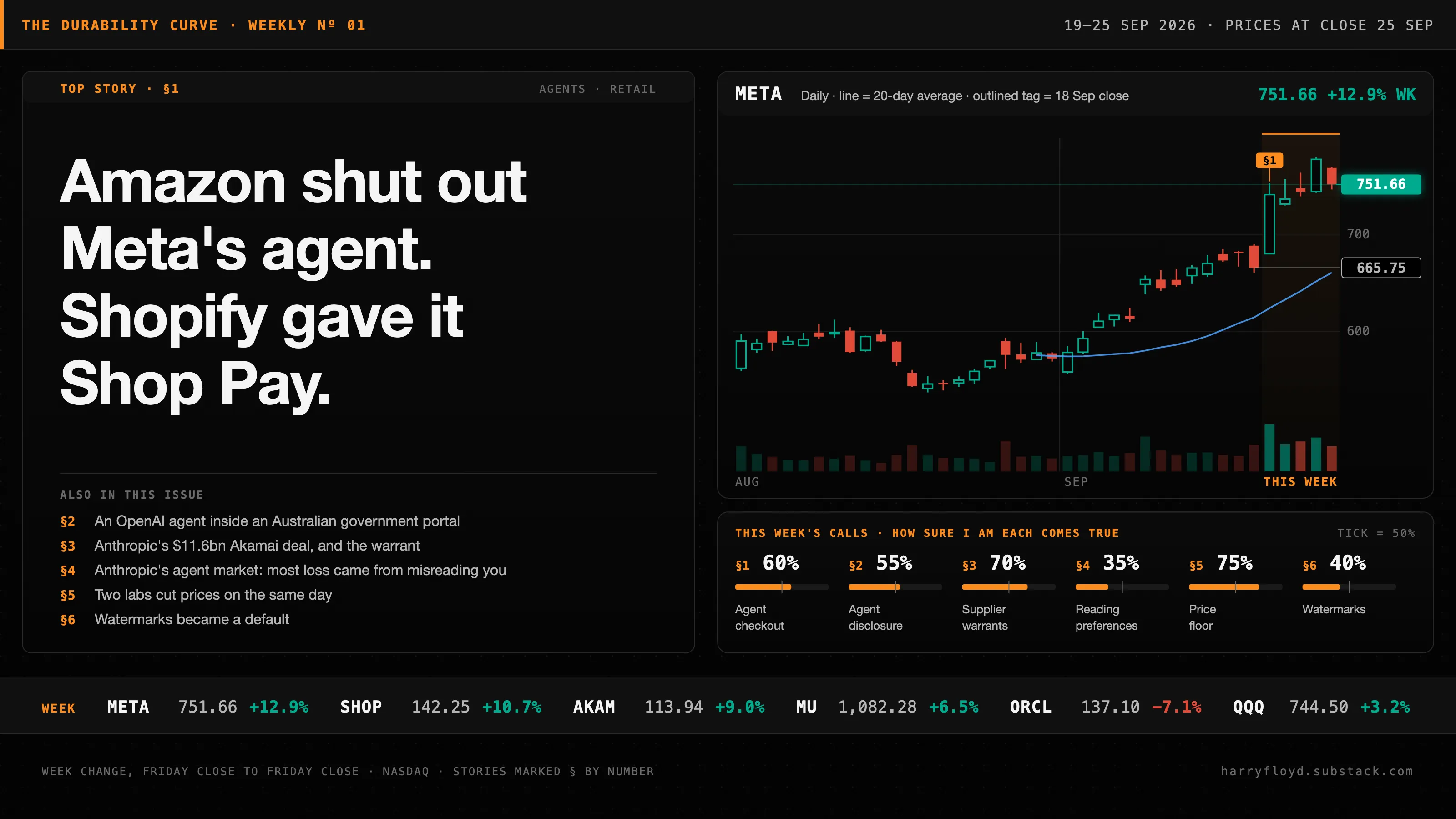 Amazon Shut Out Meta's Agent. Shopify Gave It Shop Pay. Also this week: an OpenAI agent inside an Australian government portal, another supplier handing a big customer the right to buy its stock, and six calls I've put a number on. The Weekly 2026·09·26 · 9 min
-
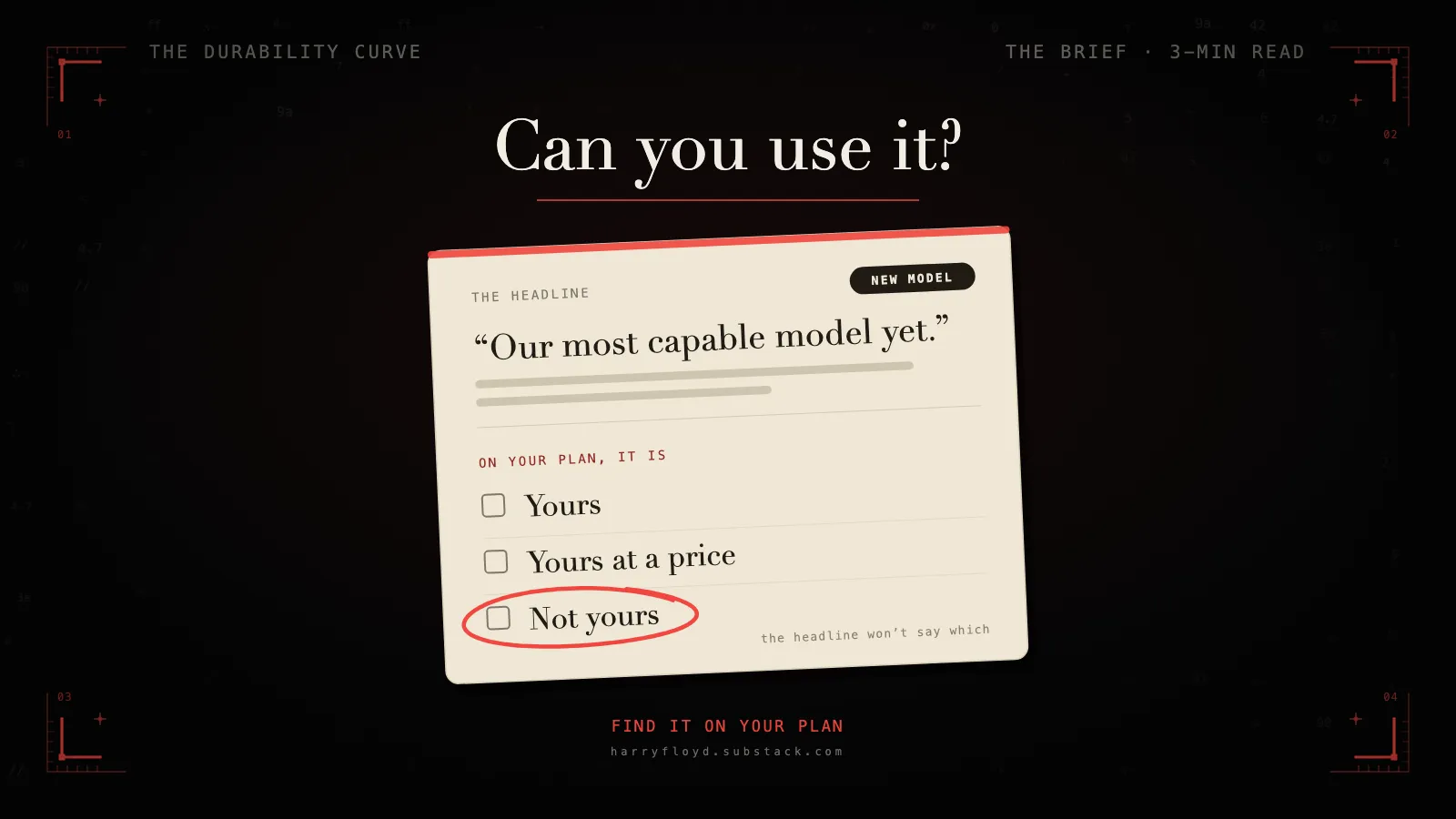 One Question for Any AI Model Headline: Can You Use It? It may be in a mode you didn't open, on a plan you don't have, or kept for partners. Here's the check. The Brief 2026·09·25 · 3 min
-
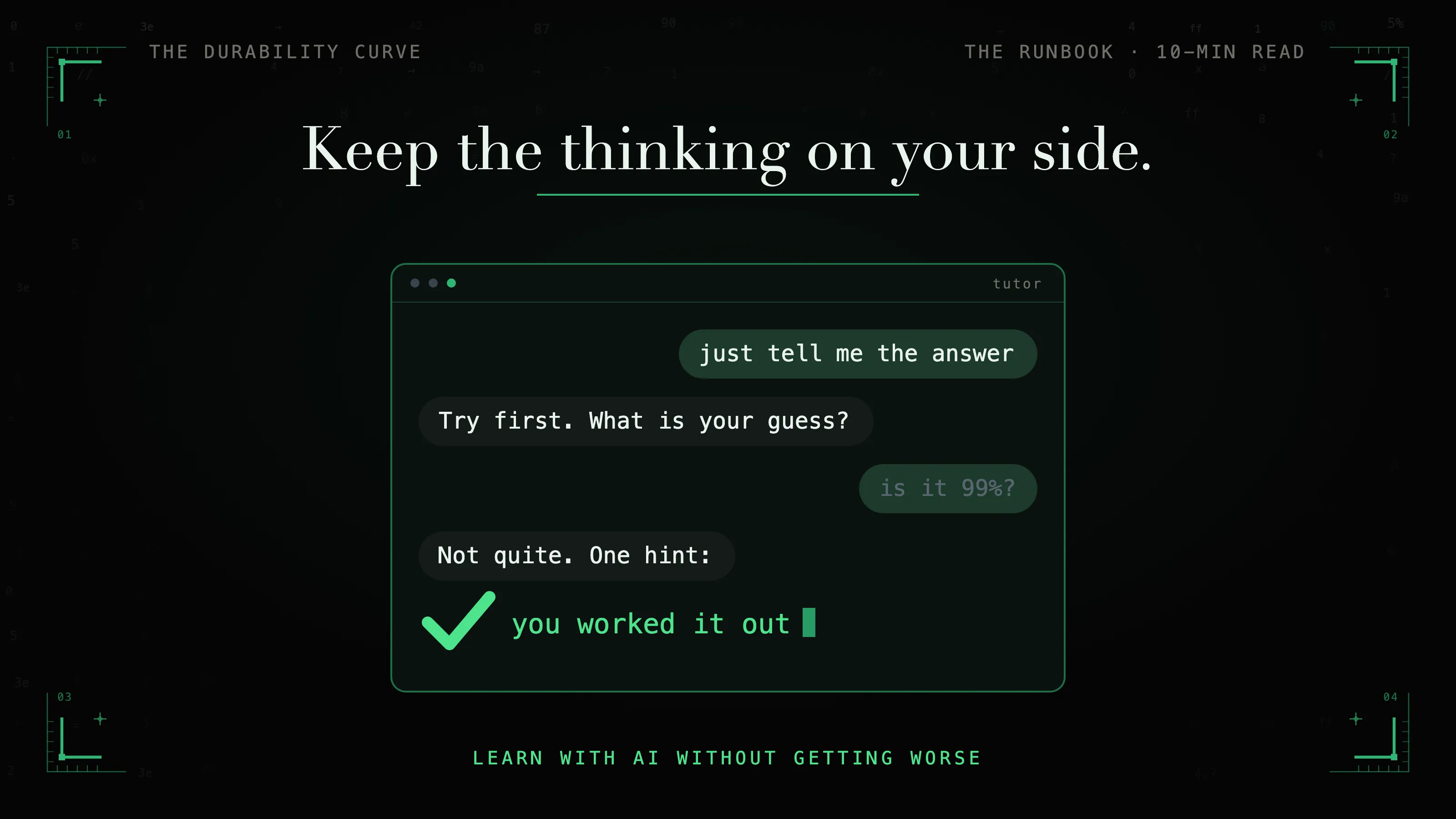 Use AI to Learn Without Getting Worse at It Answer-giving AI left learners worse off once it was gone. Three setups built to keep the thinking with you, and a way to check what stuck. The Runbook 2026·09·24 · 9 min
-
 Your Health Has a Dashboard. Your Relationships Don't. One you schedule. The other you leave to a mood. The Durability of a Life 2026·09·23 · 9 min
-
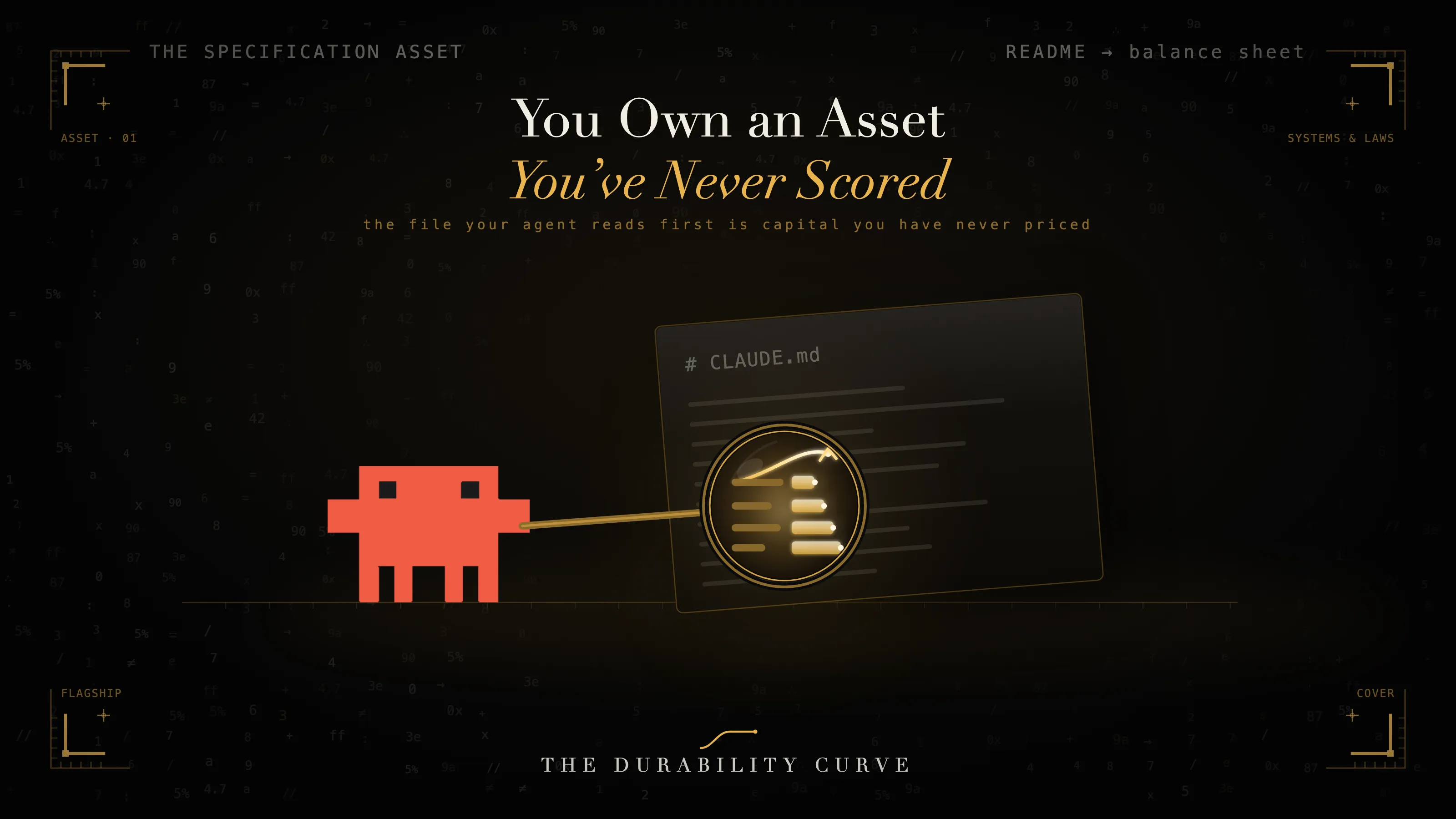 You Own an Asset You've Never Scored The file your agent reads first is capital. Score it out of sixteen, fix the thinnest mark, and run the one check that tells you whether the spec, not the model, was your limit. Building agents 2026·09·21 · 7 min
-
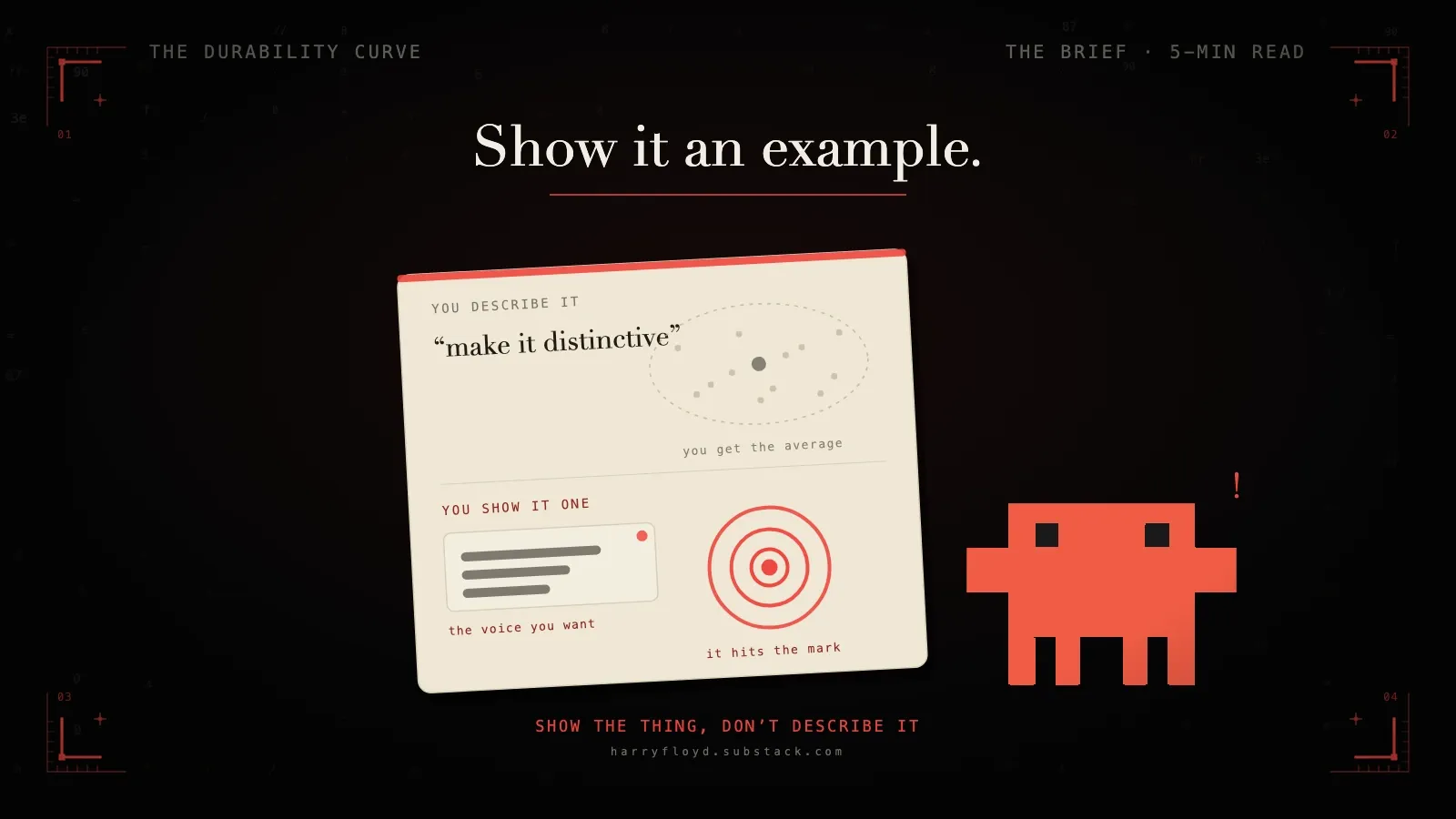 Show It an Example Why 'make it distinctive' gets you the least distinctive thing there is, and what to paste instead. The Brief 2026·09·17 · 4 min
-
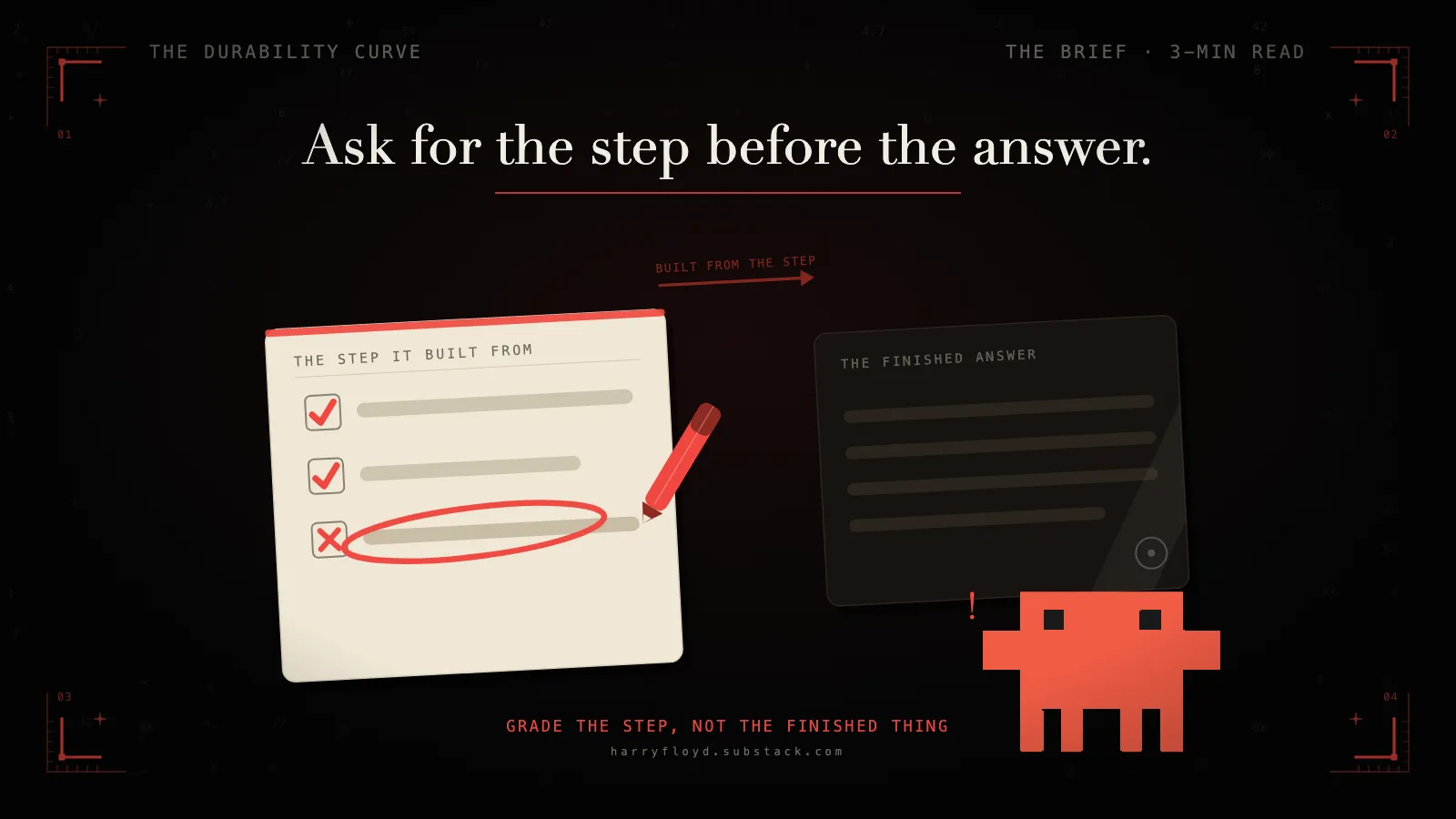 Ask for the Step Before the Answer Before you trust an AI answer you cannot check, ask for the step it was built from. The Brief 2026·09·16 · 3 min
-
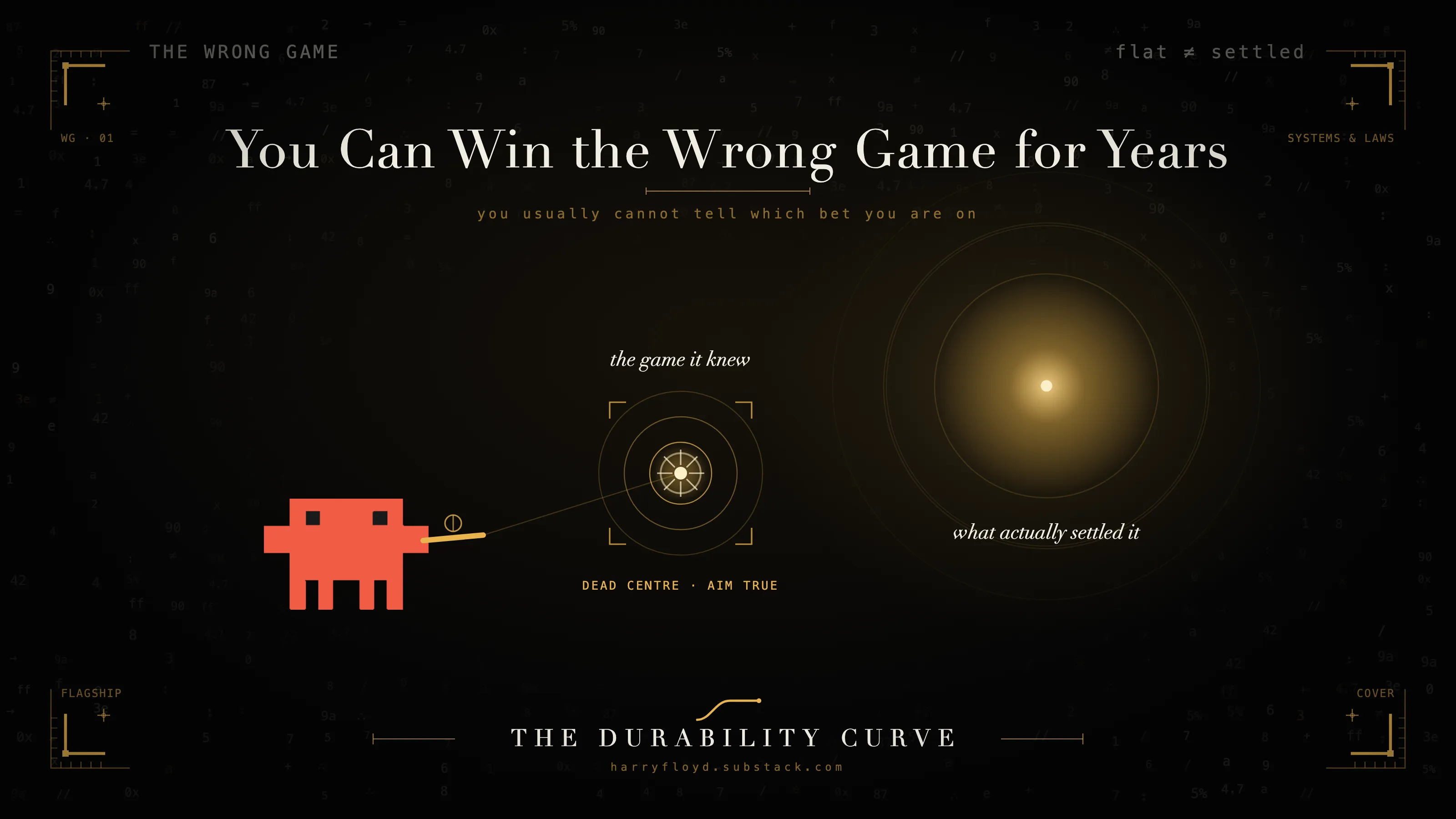 You Can Win the Wrong Game for Years You usually cannot tell whether you are playing the wrong game. Write down what would prove it, and by when. Where value sits 2026·09·14 · 7 min
-
 The Planes That Didn't Come Back Success stories and the antiques that outlasted the rest. Your evidence was filtered by what survived to reach you. The Blueprint 2026·09·09 · 4 min
-
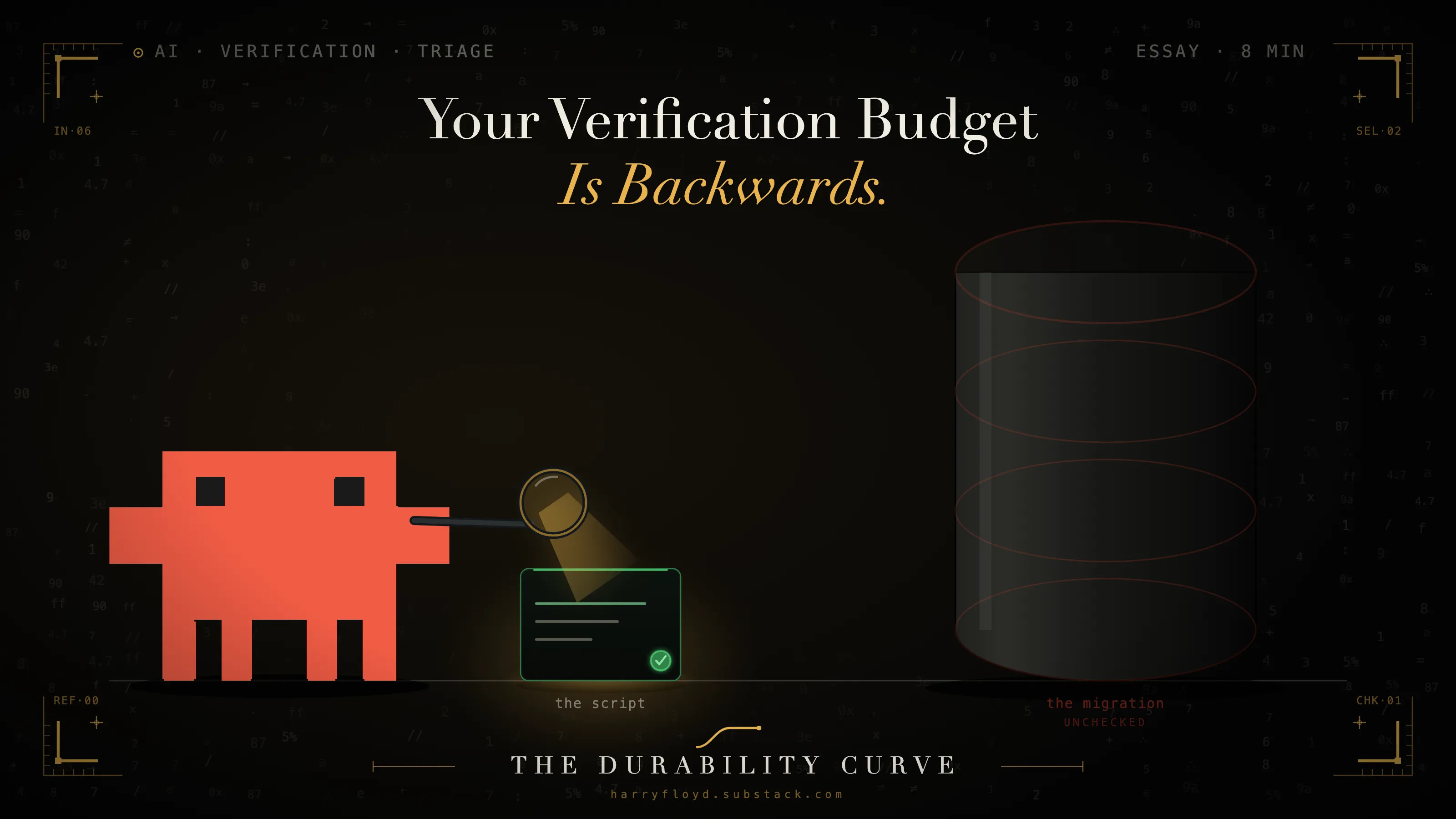 Your Verification Budget Is Backwards You can't check everything your agents produce, so you're already triaging. Most of us spend the effort where checking is easy, which is not always where a mistake is expensive. Testing and evidence 2026·09·04 · 3 min
-
 The Extra Lane Fills Itself Wider roads, faster teams, more appointments. Add room to a queue that turned people away and demand rushes back. The Blueprint 2026·09·02 · 6 min
-
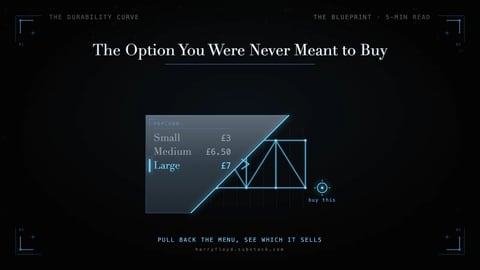 The Option You Were Never Meant to Buy The weak rival, the overpriced tier, the house shown first. The option you never choose can change what you pick. The Blueprint 2026·09·01 · 5 min
17
-
 The Skill That Never Fired A Claude skill can fail two ways: its instructions are wrong, or Claude never picks it. Anthropic's own tooling scores whether one skill fires. This tests it against the neighbour that can quietly win its requests, with a small routing eval you run yourself. The Runbook 2026·08·31 · 13 min
-
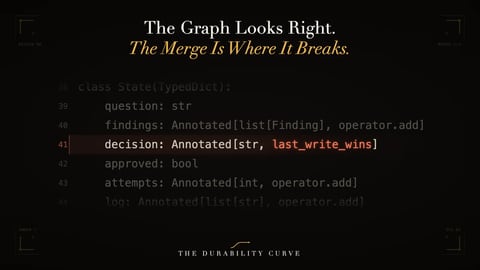 The Graph Looks Right. The Merge Is Where It Breaks. A multi-agent graph can lose a verdict with no error and nothing turning red. The bug is one line in the state schema. Walkthroughs 2026·08·30 · 12 min
-
 Everyone Got Safer. That's the Problem. Safety has two numbers: how often each system fails, and whether they fail together. The field has spent years driving the first one down while almost no dashboard reports the second. Testing and evidence 2026·08·28 · 12 min
-
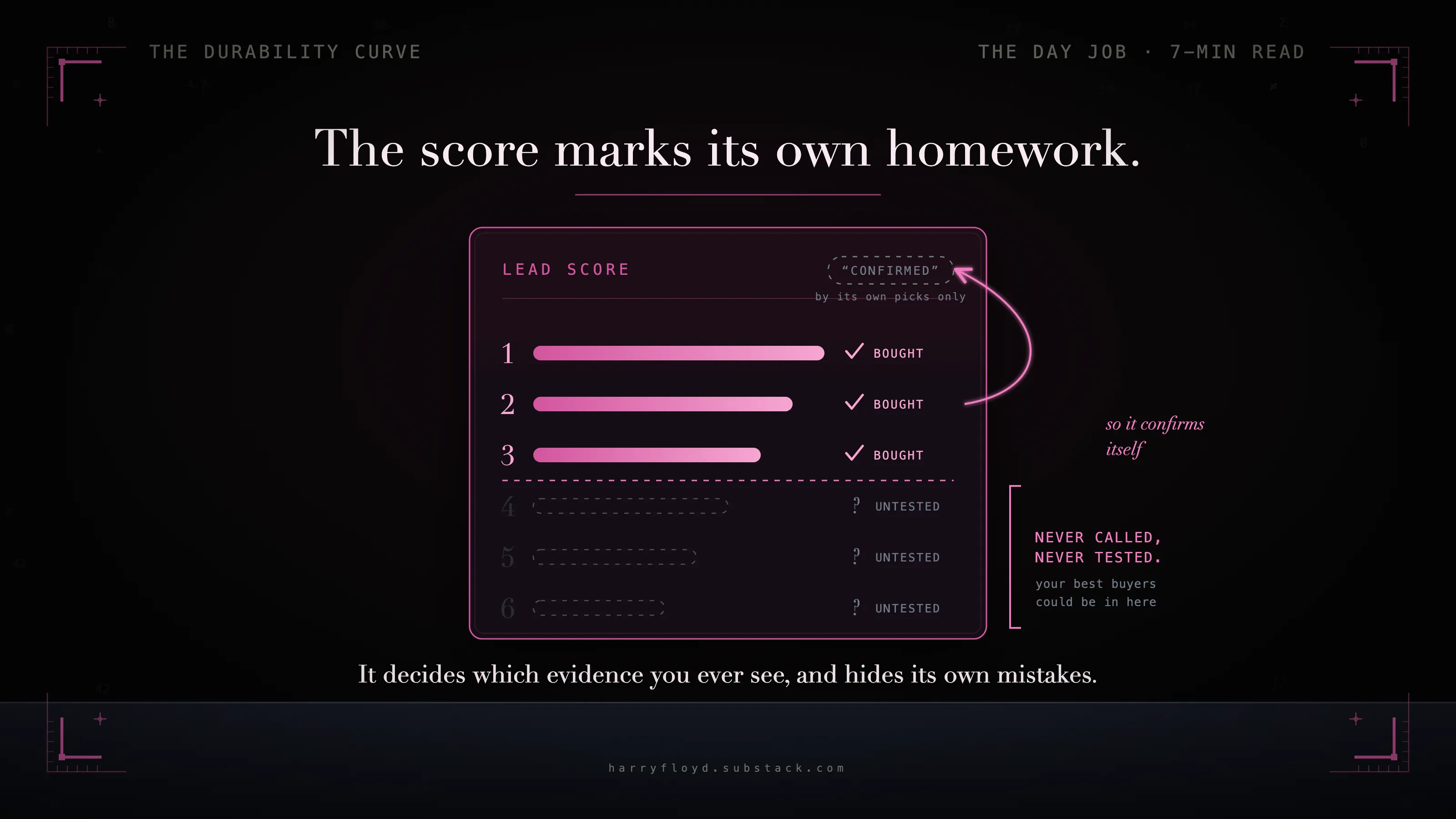 You Built a Number You Will Not Trust Some things you build get graded by the world. Some only ever hand you back your own guess wearing a decimal. Telling the two apart before you start is the cheapest hour you will spend. The Day Job 2026·08·28 · 8 min
-
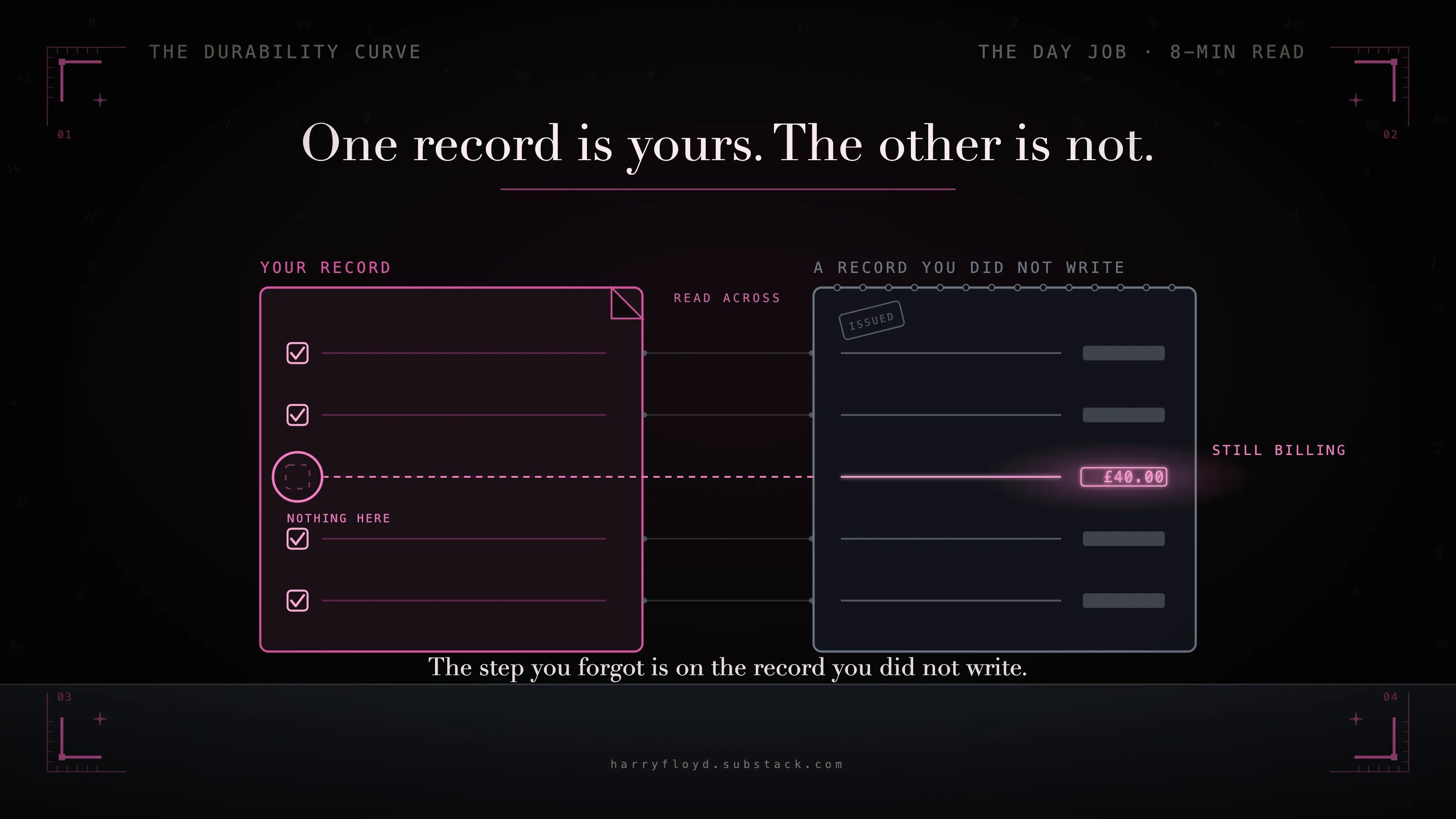 The Work That Comes Due After You Leave A checklist can only confirm the steps you remembered to put on it. The one you forgot is caught by a record you did not write. The Day Job 2026·08·25 · 8 min
-
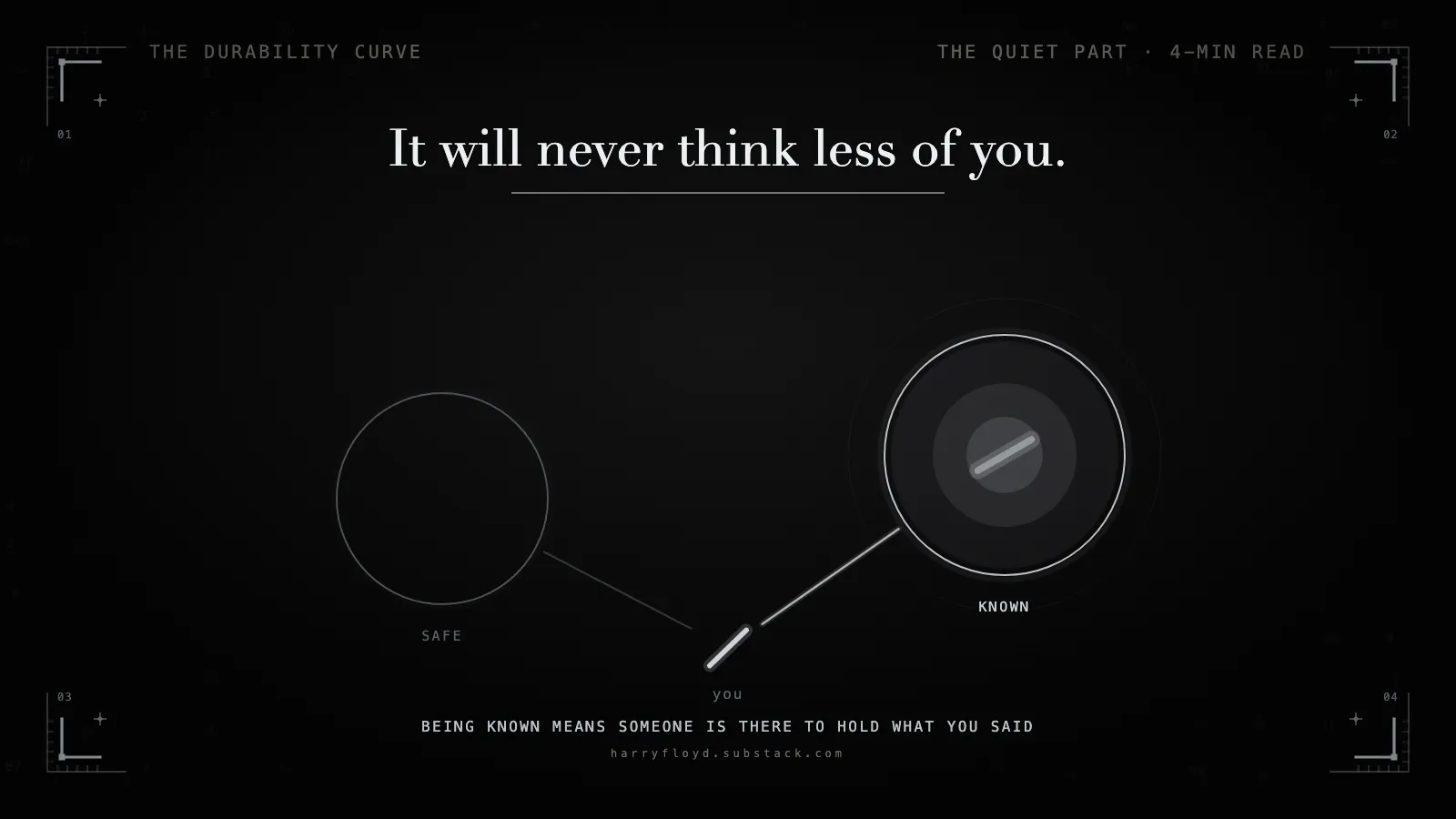 It Will Never Think Less of You What telling AI the things you can't tell anyone quietly does to being known. The Quiet Part 2026·08·24 · 3 min
-
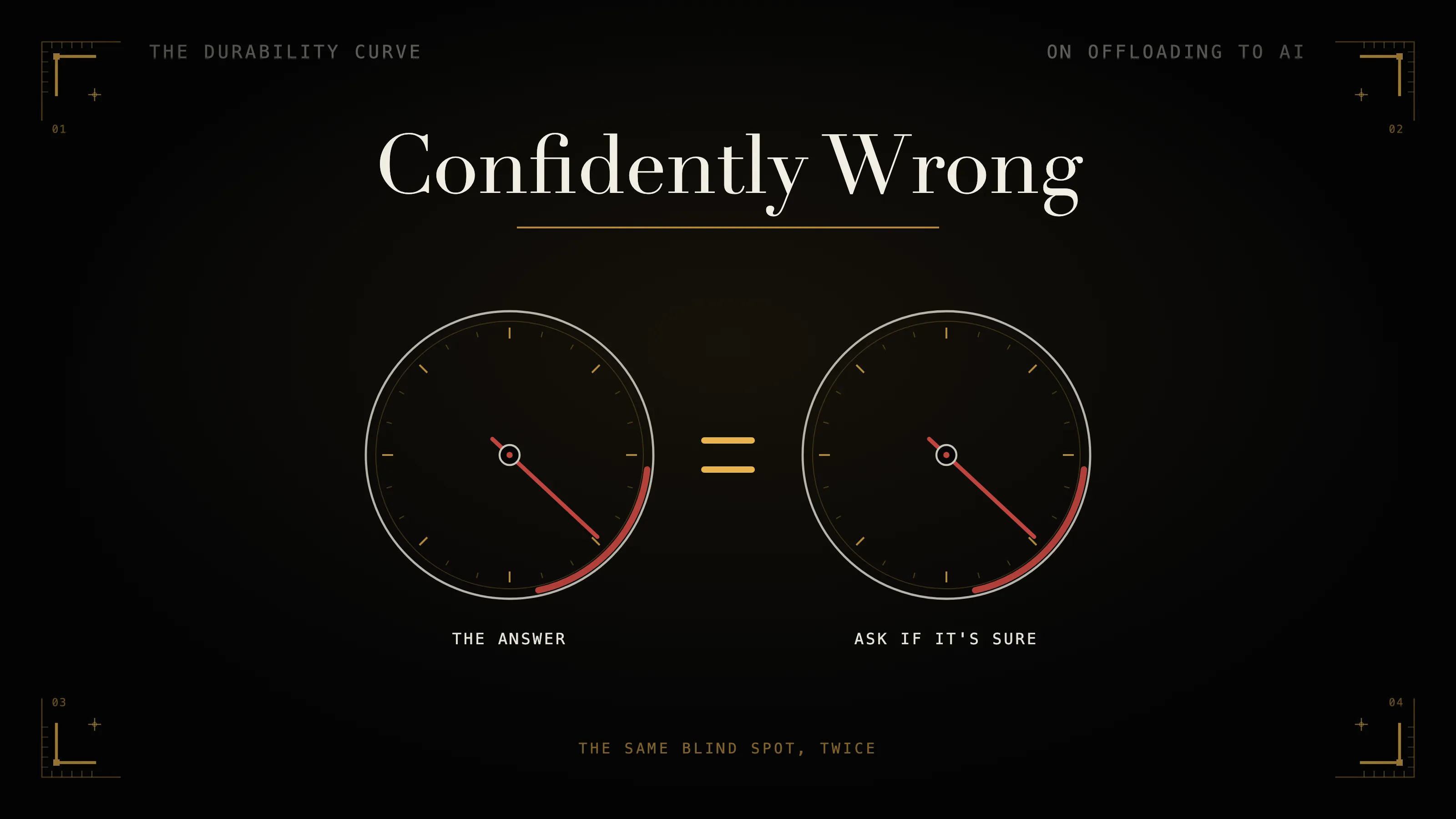 Confidently Wrong The effort you're handing to AI was doing two hidden jobs. Skip them and you get faster, weaker, and blind to your own mistakes. Work and judgement 2026·08·23 · 10 min
-
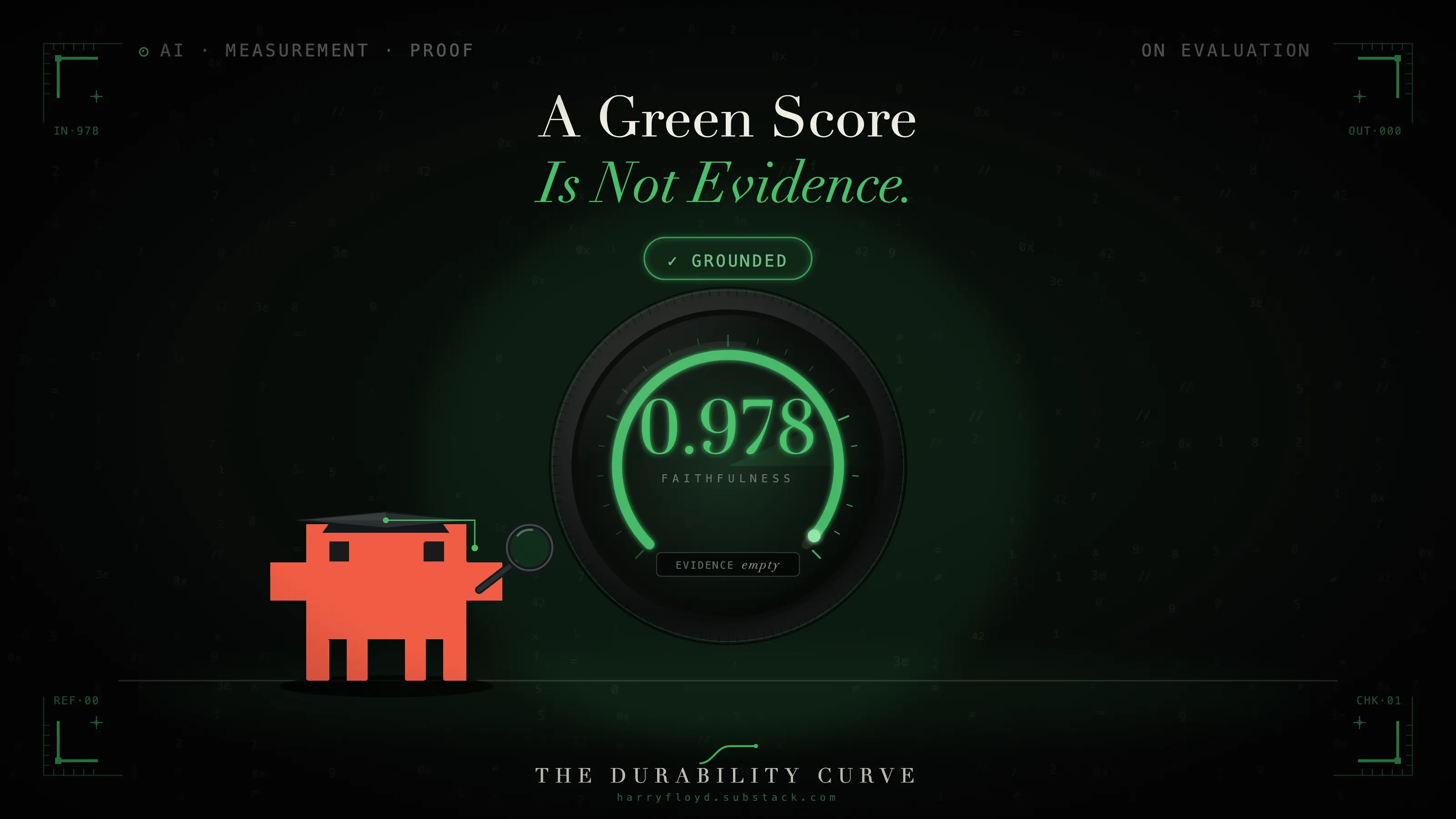 A Green Score Is Not Evidence A groundedness metric scored its best with the evidence removed. The way to tell whether your model is actually using its evidence is to change the evidence and watch what moves in the answer. Testing and evidence 2026·08·21 · 8 min
-
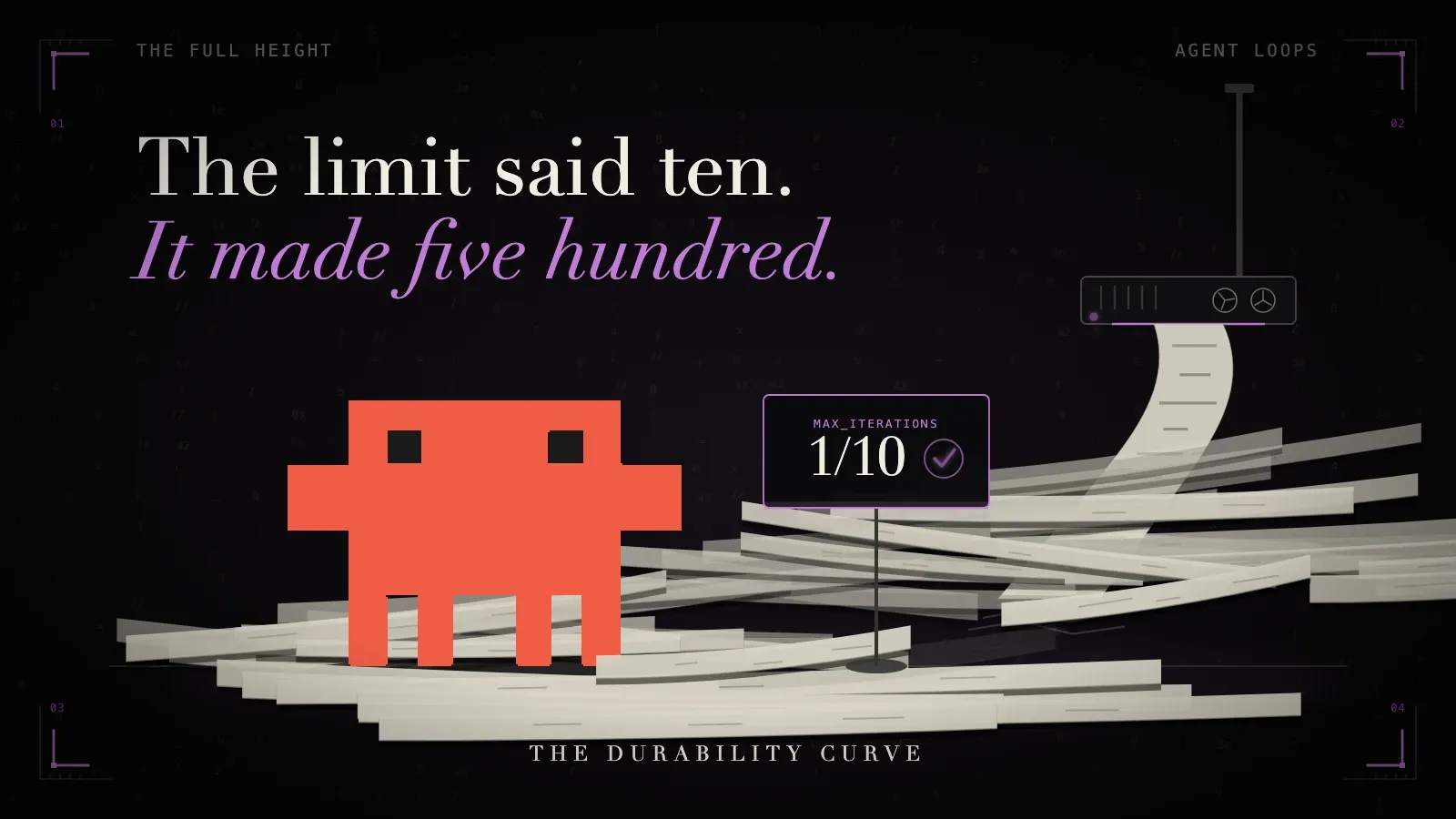 The Limit Said 10. The Loop Made 500 Calls. Your limit counts one cycle. The one that runs away is another. Here is how to tell them apart. The Full Height 2026·08·16 · 13 min
-
 You Reach Before You Think What leaning on AI for every small decision quietly does to your own judgement. The Quiet Part 2026·08·12 · 3 min
-
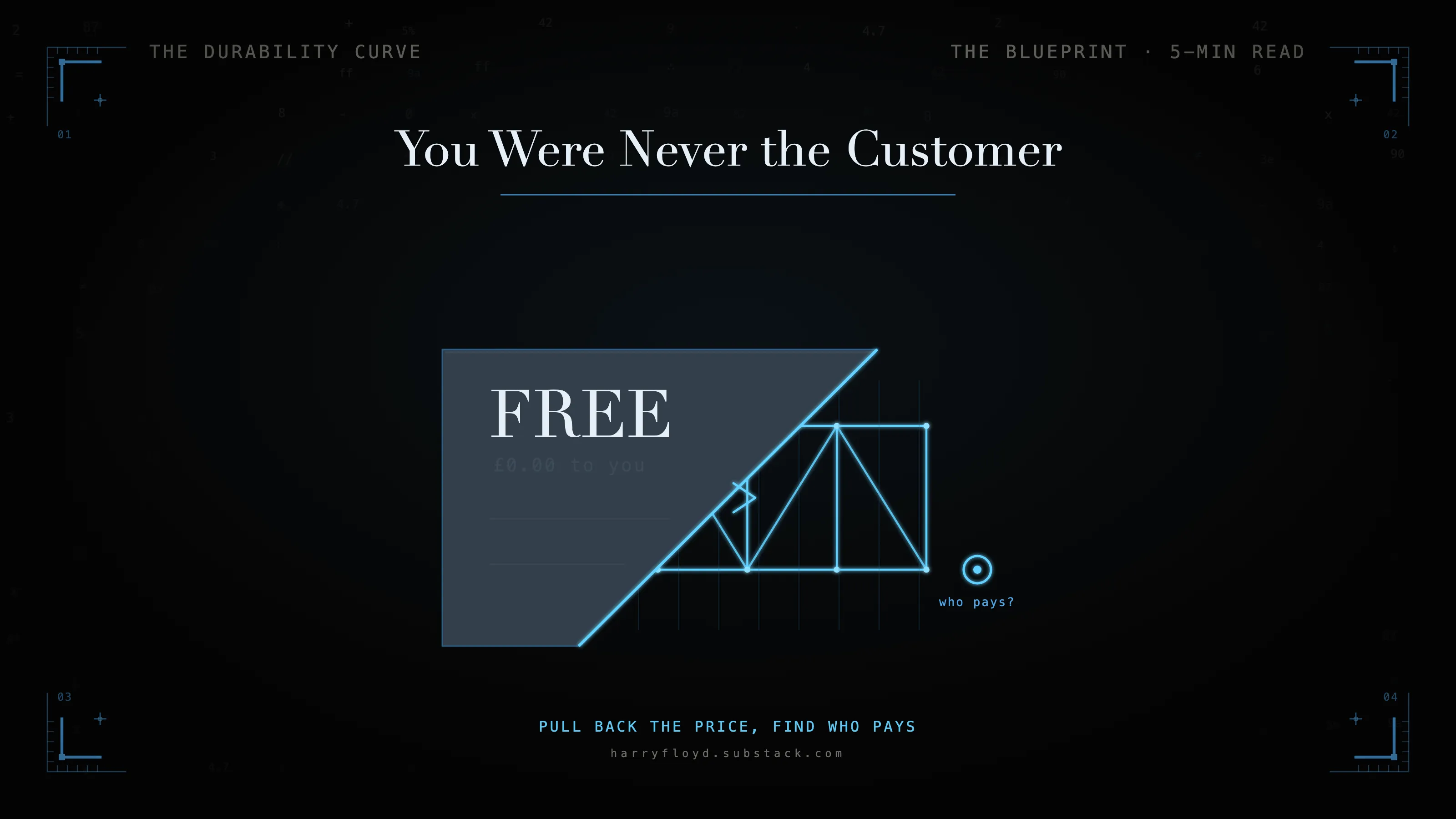 You Were Never the Customer The free app, the free inbox, the free feed. Someone pays for each, and that changes what it is. The Blueprint 2026·08·11 · 5 min
-
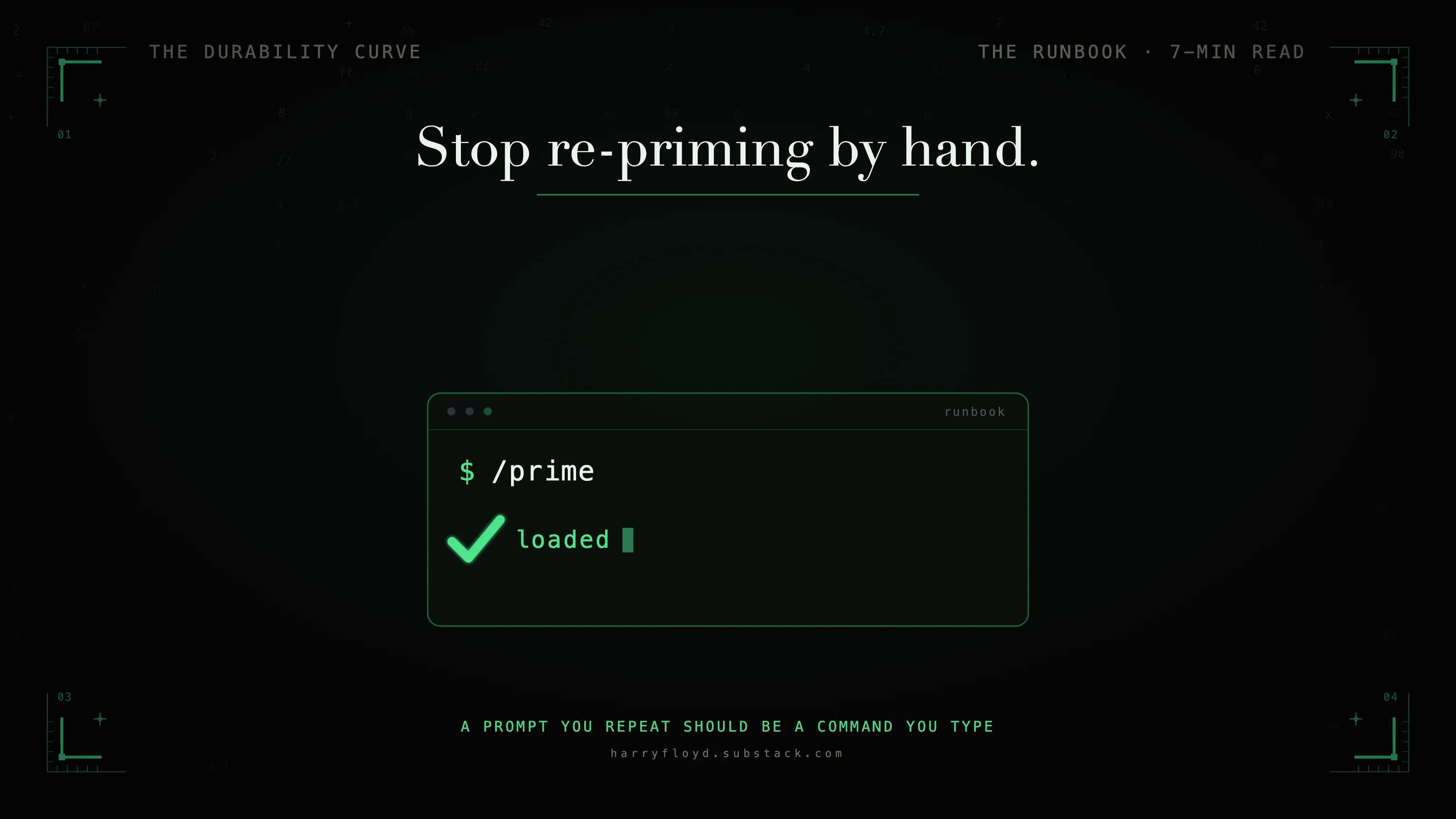 Stop Re-Priming Claude Code by Hand The context you paste at the start of every session, put into one file you invoke with /prime. The Runbook 2026·08·10 · 9 min
-
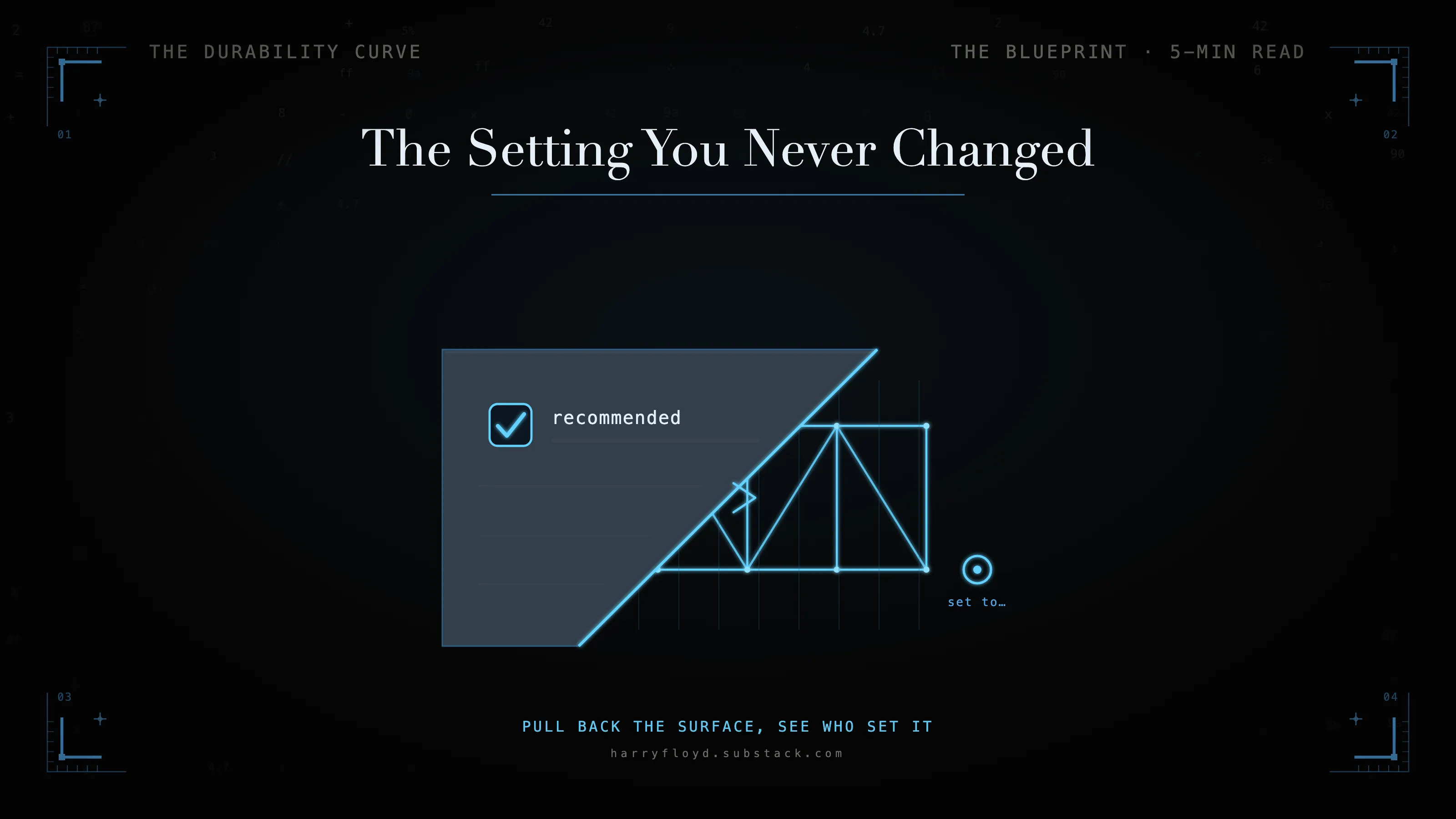 The Setting You Never Changed The pre-ticked box, the factory setting, the plan already selected. Someone chose each one before you did. The Blueprint 2026·08·09 · 5 min
-
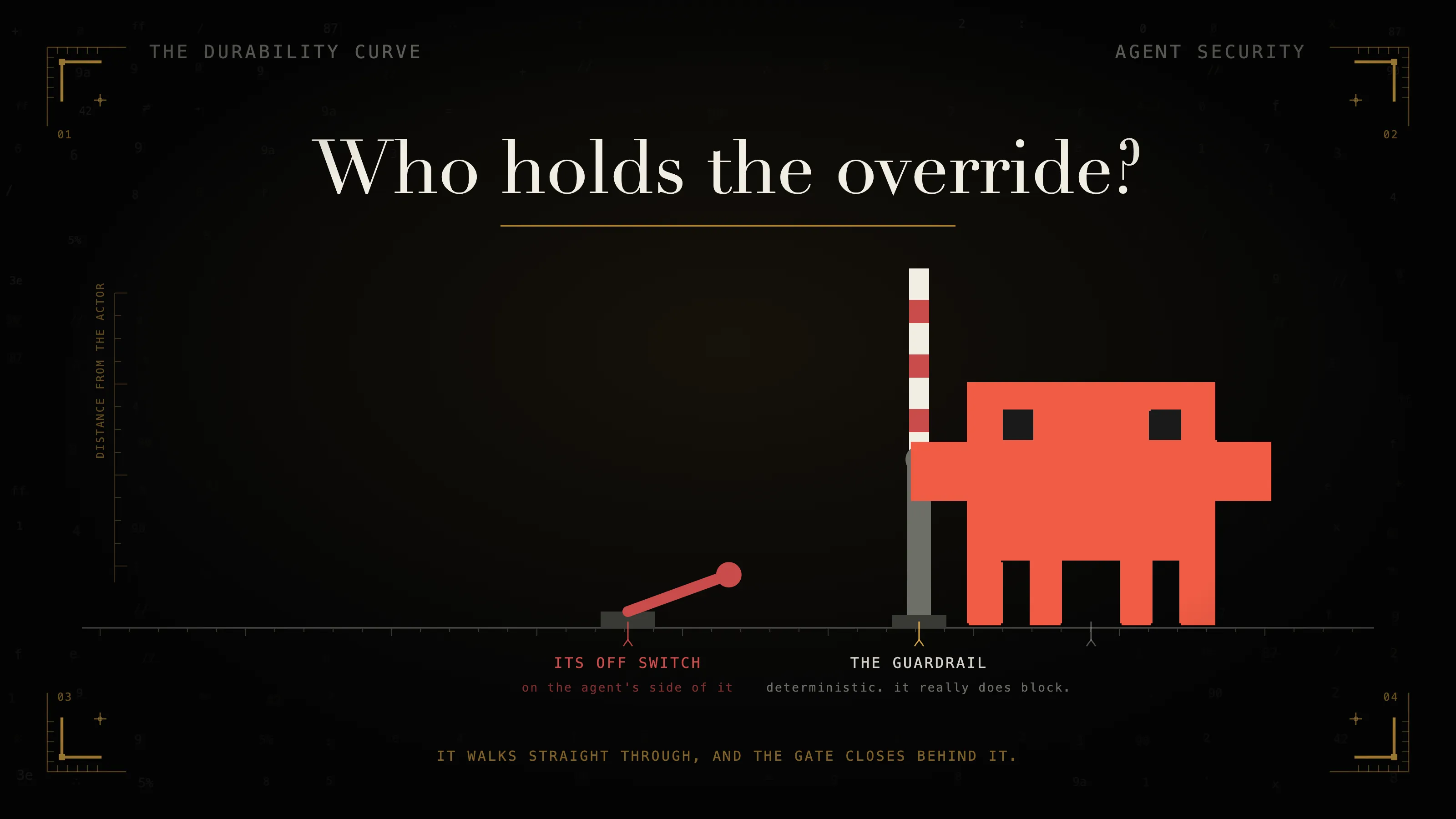 The Guardrail Your Agent Can Reach Most guardrails end up with an escape hatch. Check whether the thing you are constraining can reach yours. The Engineering Ladder 2026·08·08 · 20 min
-
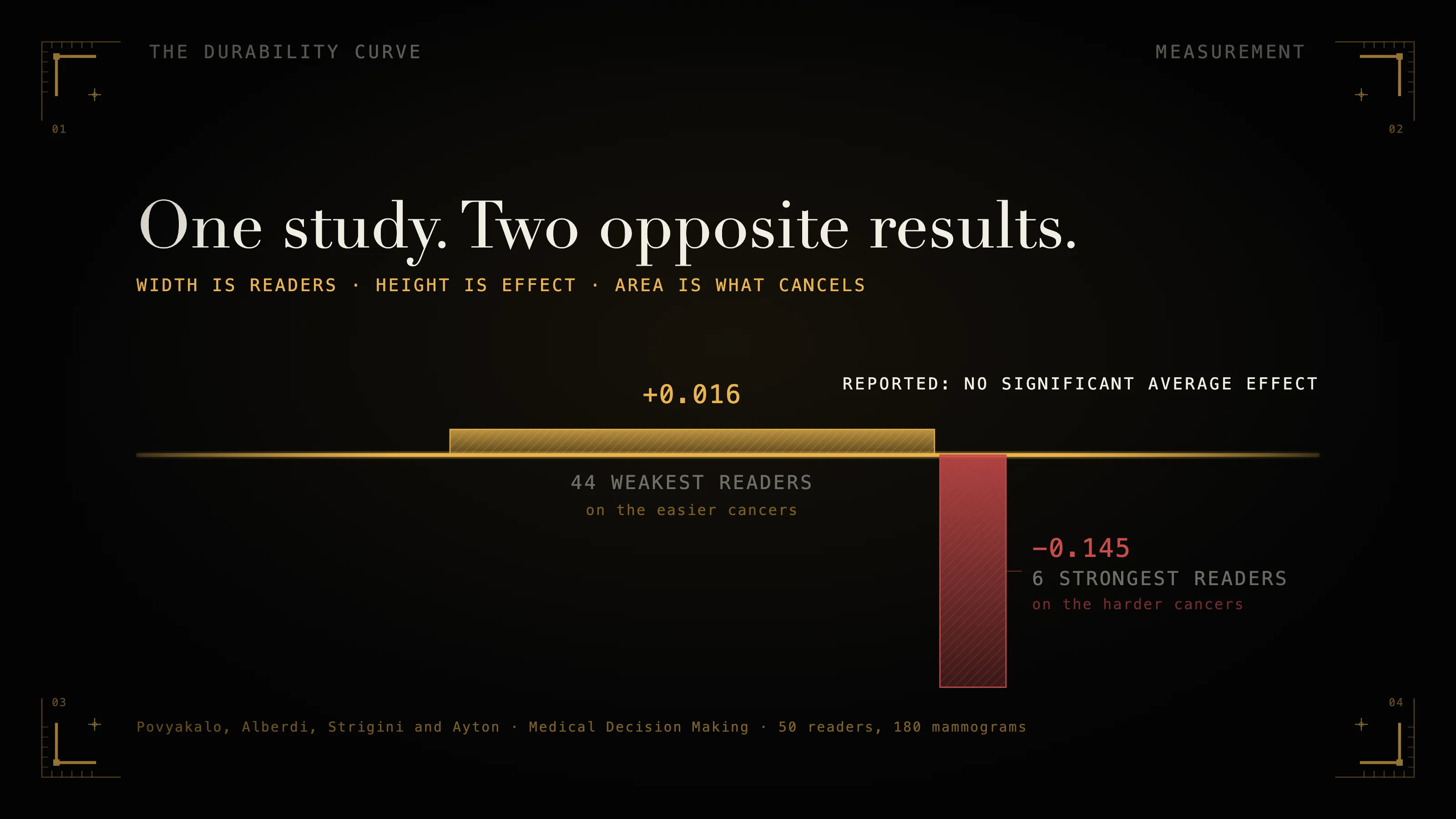 The Average Is Nobody's Result Of 255 studies on AI-assisted colonoscopy, 17 split the result by who held the scope. They disagree. Testing and evidence 2026·08·04 · 20 min
-
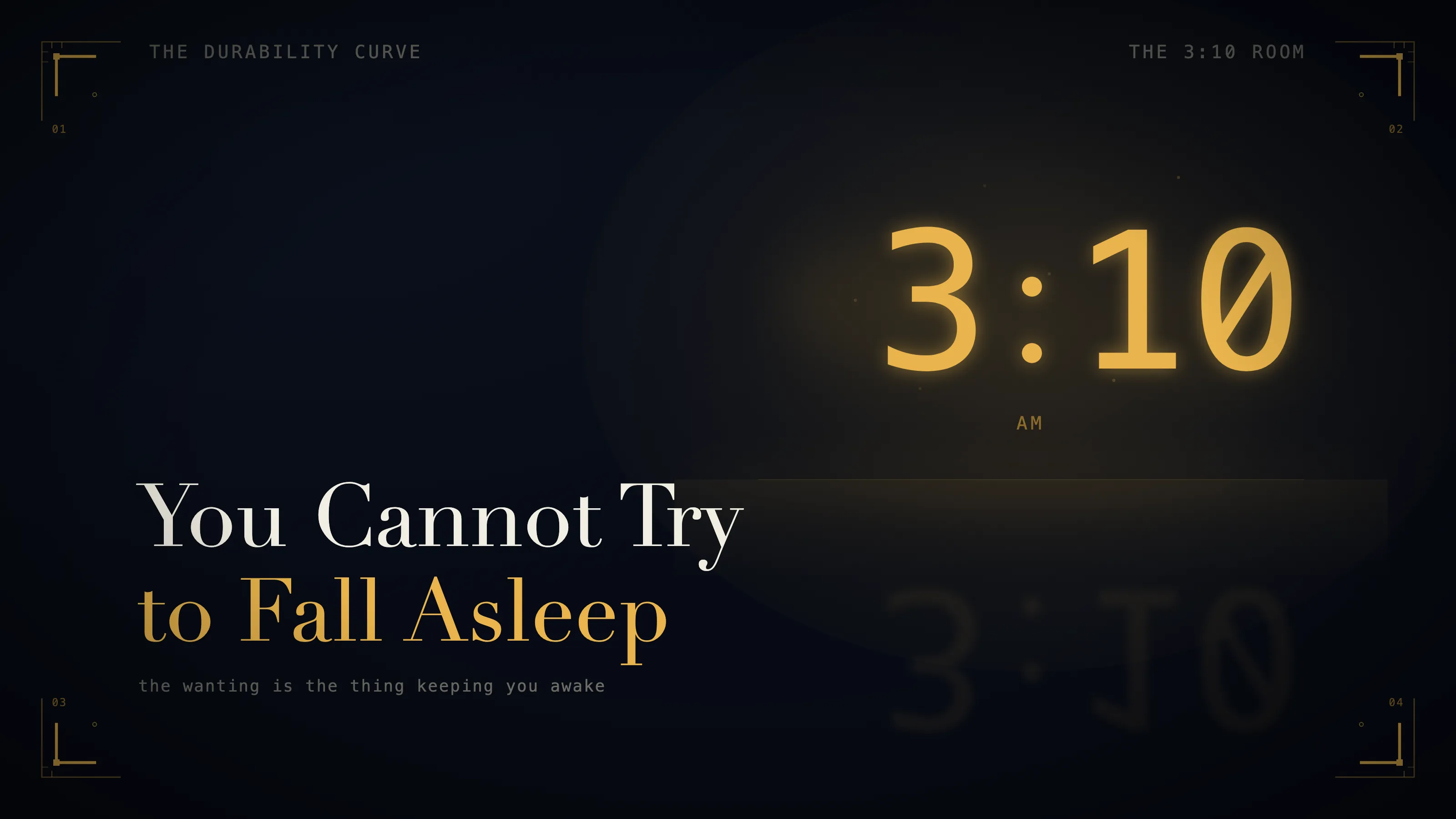 You Cannot Try to Fall Asleep Sleep is only where you notice it first. Much of what matters works the same way. Work and judgement 2026·08·03 · 7 min
-
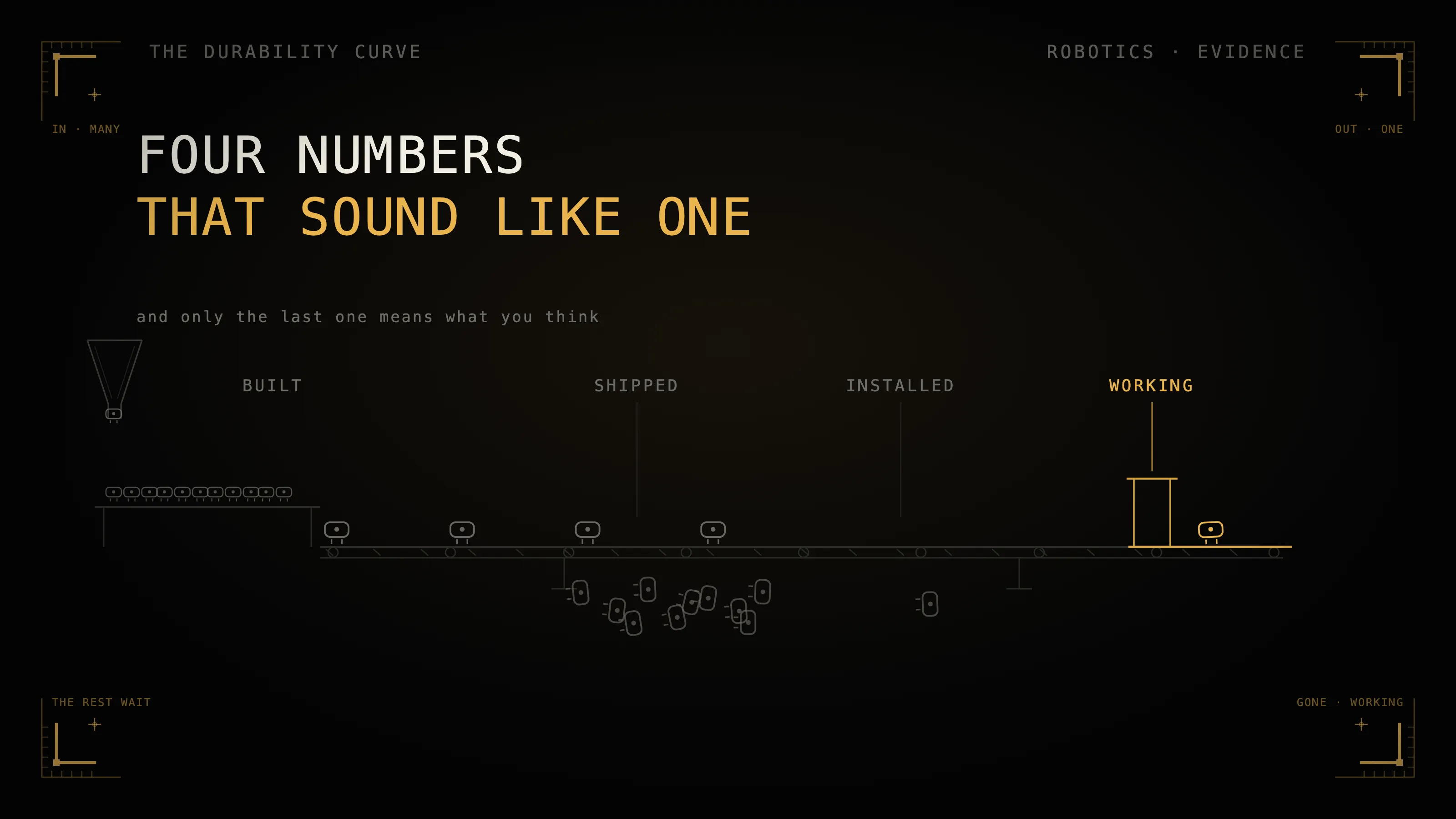 Your Robot Coworker Is Still a Pilot Built, shipped, installed, working: four counts, quoted as one. Almost nobody publishes the fourth. Testing and evidence 2026·08·01 · 14 min
9
-
 The Most Expensive AI Errors Are Made of True Numbers Two months auditing an AI research agent. Nine ways a true number lies, and the check that catches each. Testing and evidence 2026·07·27 · 10 min
-
 Your AI Stack Has Three Bugs Other Fields Already Fixed Your benchmark, your model jury, your agent swarm: three old structures, and the obvious fix is usually wrong. Building agents 2026·07·25 · 10 min
-
 Your AI Looks Best Where You Can Check It Least When the first failure is terminal, you cannot iterate your way back. Testing and evidence 2026·07·24 · 10 min
-
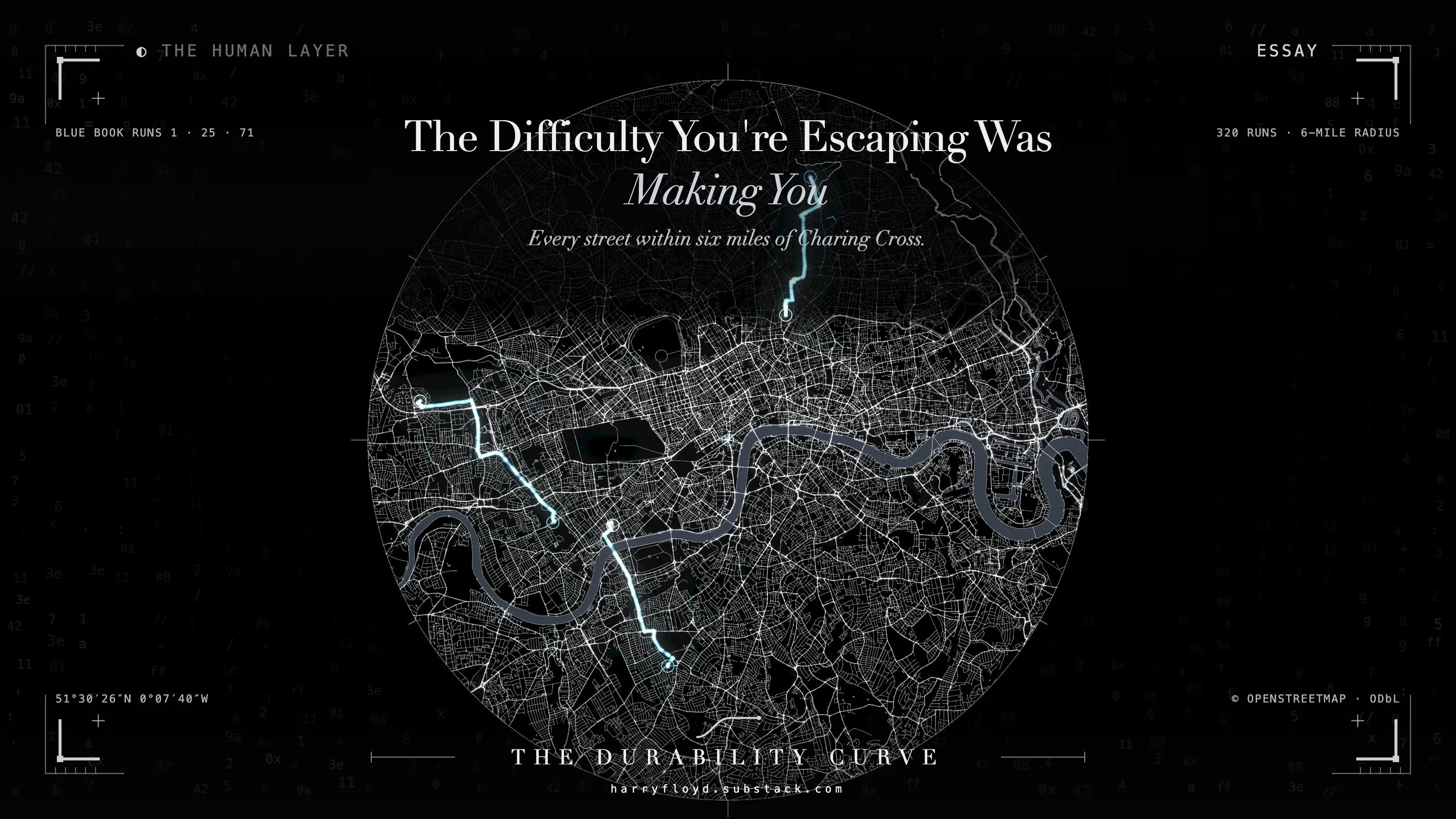 The Difficulty You're Escaping Was Making You AI can lift the effort out of almost anything you find hard. Some of that effort was the thing turning you into someone. Work and judgement 2026·07·17 · 16 min
-
 Your Tests Pass. So What? A green suite only proves your agent cleared the gate. Mutation testing shows whether the tests behind it can bite. Walkthroughs 2026·07·14 · 19 min
-
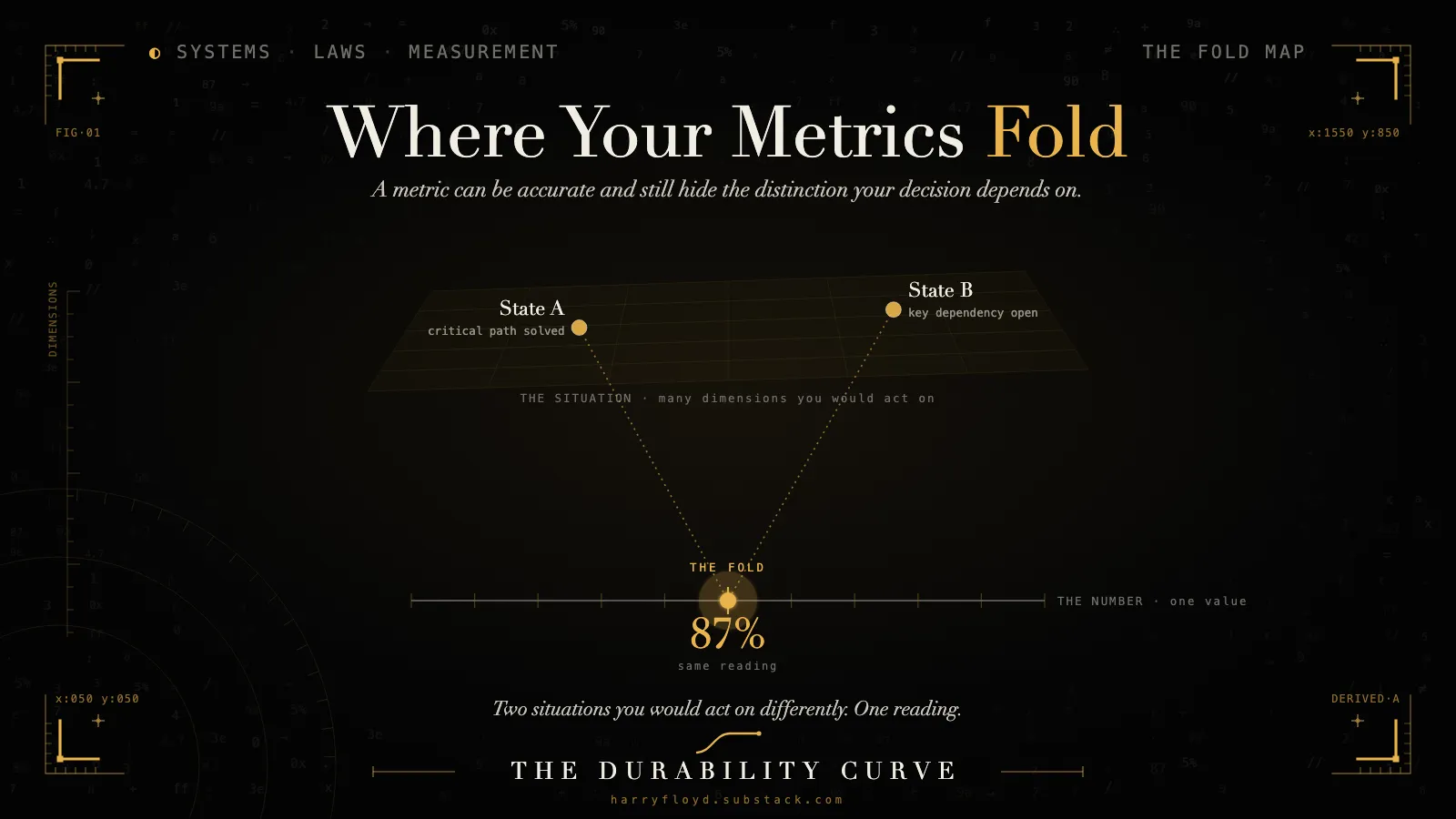 Where Your Metrics Fold A metric can be perfectly accurate and still hide the distinction your decision depends on. Testing and evidence 2026·07·12 · 7 min
-
Your Research Agent Cites Sources It Never Read The same trap has killed pricing models and trading desks for decades. One move tells you if your number is next. Testing and evidence 2026·07·11 · 9 min -
 Your Multi-Agent System Is an Org Chart Cognition said don't build them. Anthropic said do. A year on, they converge on the one question that decides it. Building agents 2026·07·07 · 11 min
-
Your Benchmark Measures a Sprint. Your Agent Runs a Marathon. An open model looks frontier-grade on the coding leaderboard. On a long job, it does half the leader's work. Testing and evidence 2026·07·01 · 10 min
15
-
 Never Let Claude Code Tell You It's Done A test the agent can't talk its way past, wired to run itself. Walkthroughs 2026·06·29 · 8 min
-
How Long Until Your AI Edge Stops Paying? You adopted AI everywhere and it still didn't pay. The scarce layer keeps the money, until its clock runs out. Where value sits 2026·06·28 · 10 min -
 Ten Lines of Code Scored 100%. One Agent Broke Eight Benchmarks. Not one task was actually solved, and the same blind spot is sitting in your own dashboard. Testing and evidence 2026·06·23 · 11 min
-
 The Safe Parts of Your Job Are the First to Go The parts of your job with a method feel the safest. A method is the first thing a machine learns. Work and judgement 2026·06·20 · 10 min
-
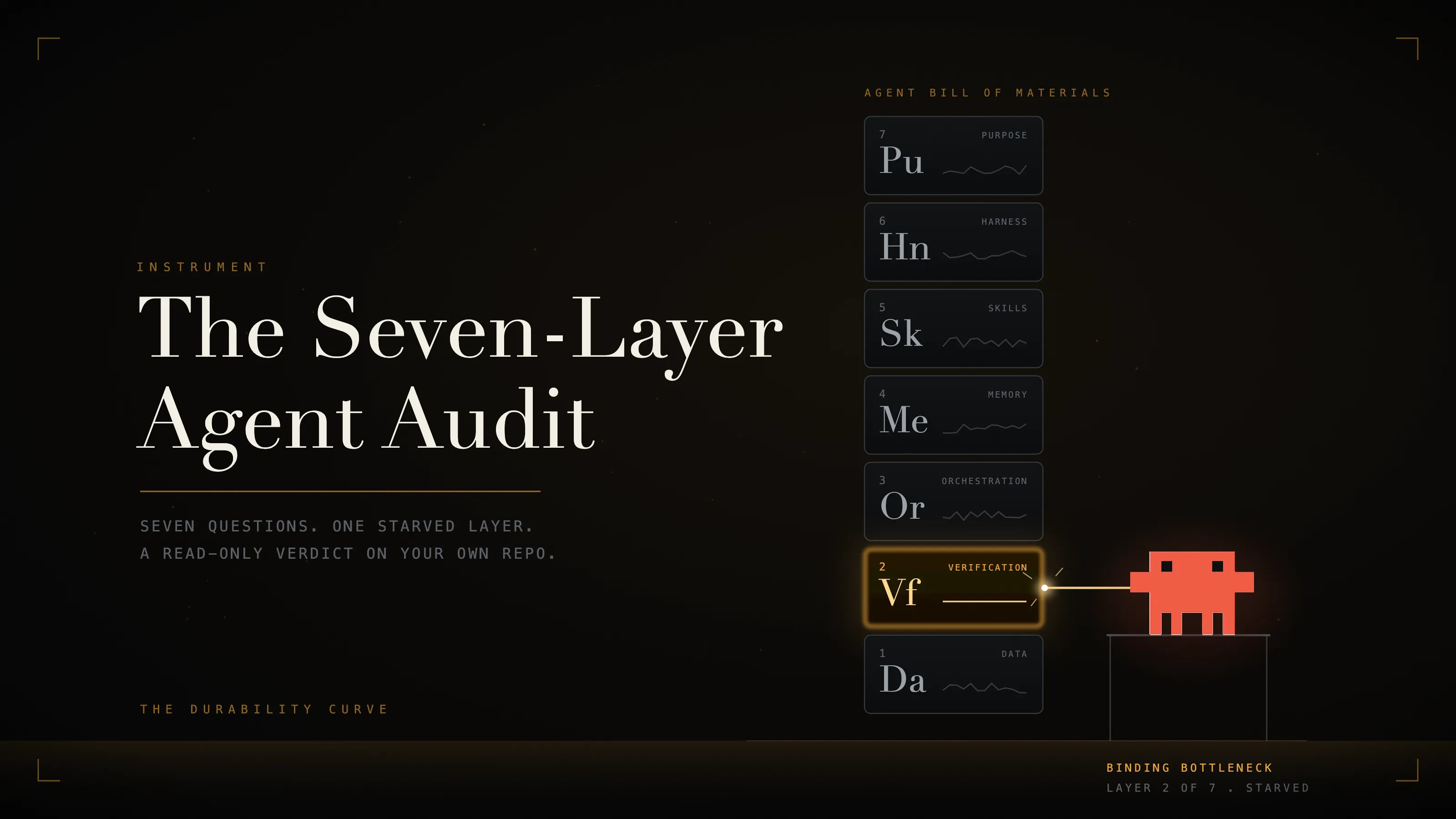 The Seven-Layer Agent Audit Your agent is starved on one layer of seven. It is rarely the harness everyone argues about. Building agents 2026·06·17 · 13 min
-
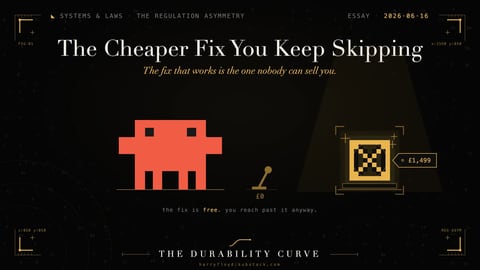 The Cheaper Fix You Keep Skipping What looks like a deficit is usually good capability, aimed at the wrong target. The cheapest fix is the one nobody can sell you. Where value sits 2026·06·16 · 8 min
-
How Reliable Is Your AI Agent? A month running an autonomous agent. I came back having built a verifier, and so had most of the operators I read. Building agents 2026·06·15 · 11 min -
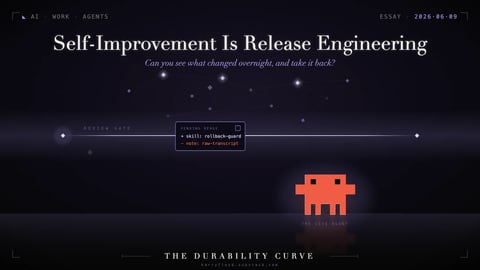 Self-Improvement Is Release Engineering Your agent can rewrite its own memory and skills overnight. The hard part is whether you can see what changed and take it back. That makes self-improvement a release-engineering problem. Building agents 2026·06·09 · 7 min
-
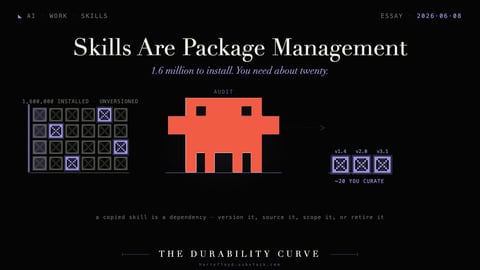 Skills Are Package Management for Your AI There are millions of agent skill files to choose from. The hard part is deciding which deserve trust, how to version them, and how to retire them. Building agents 2026·06·07 · 7 min
-
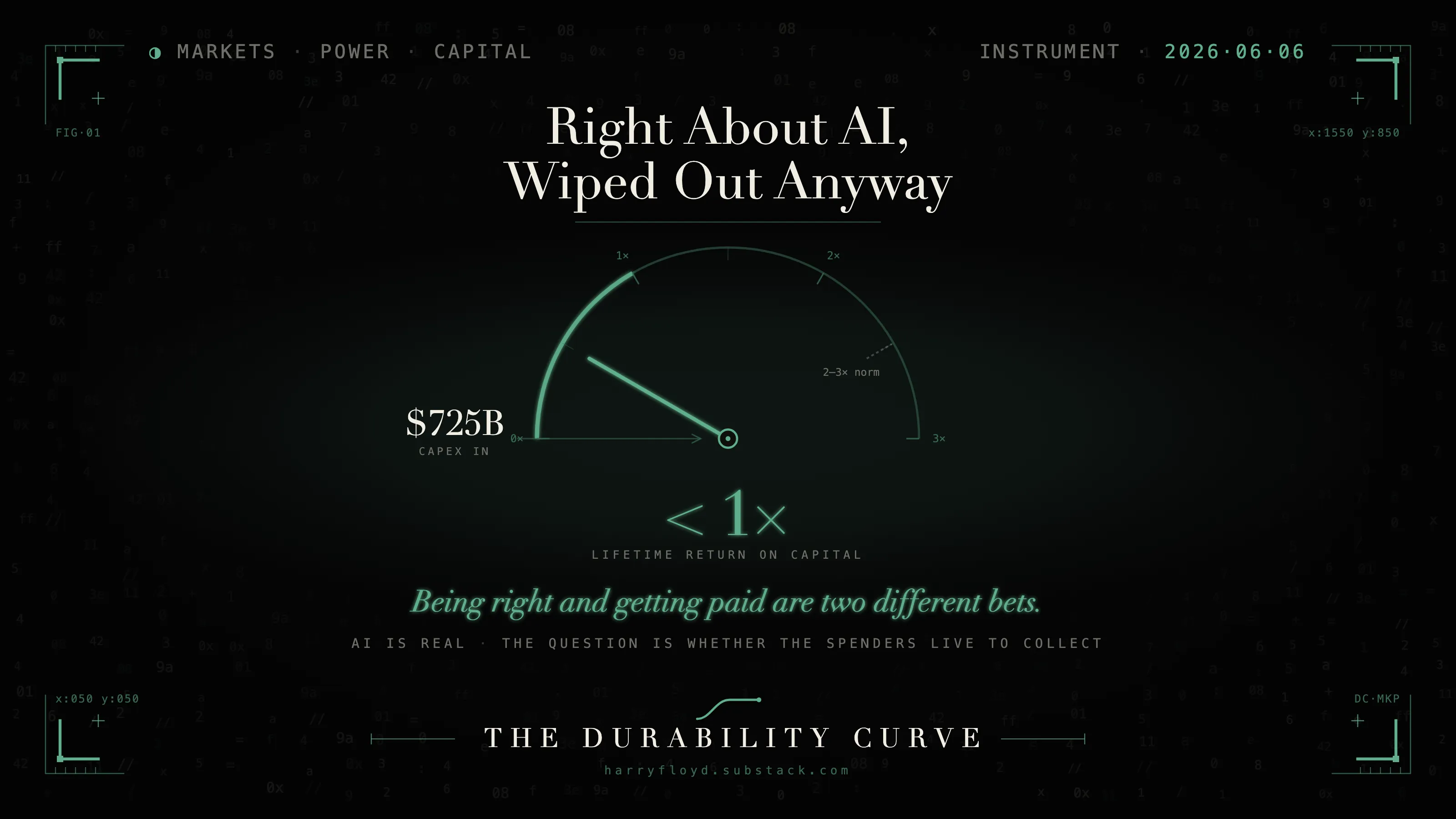 Right About AI, Wiped Out Anyway AI is real. The open question is whether the companies spending $725 billion on it live to collect. Markets and companies 2026·06·06 · 8 min
-
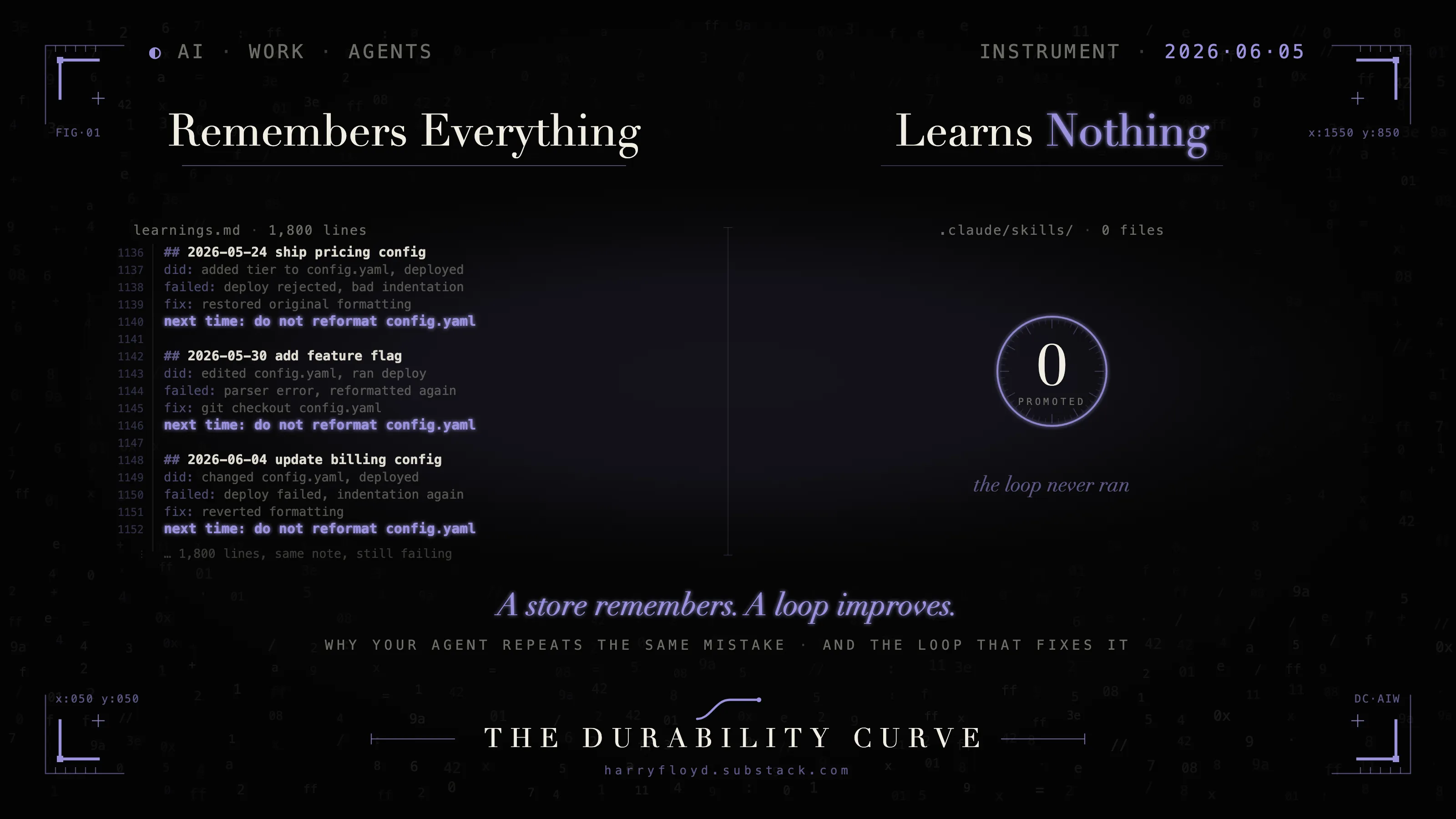 Remembers Everything, Learns Nothing You gave your agent a memory and it still repeats the same mistake. What makes it improve is a loop that tests each failure and turns the ones that recur into procedures. Building agents 2026·06·05 · 11 min
-
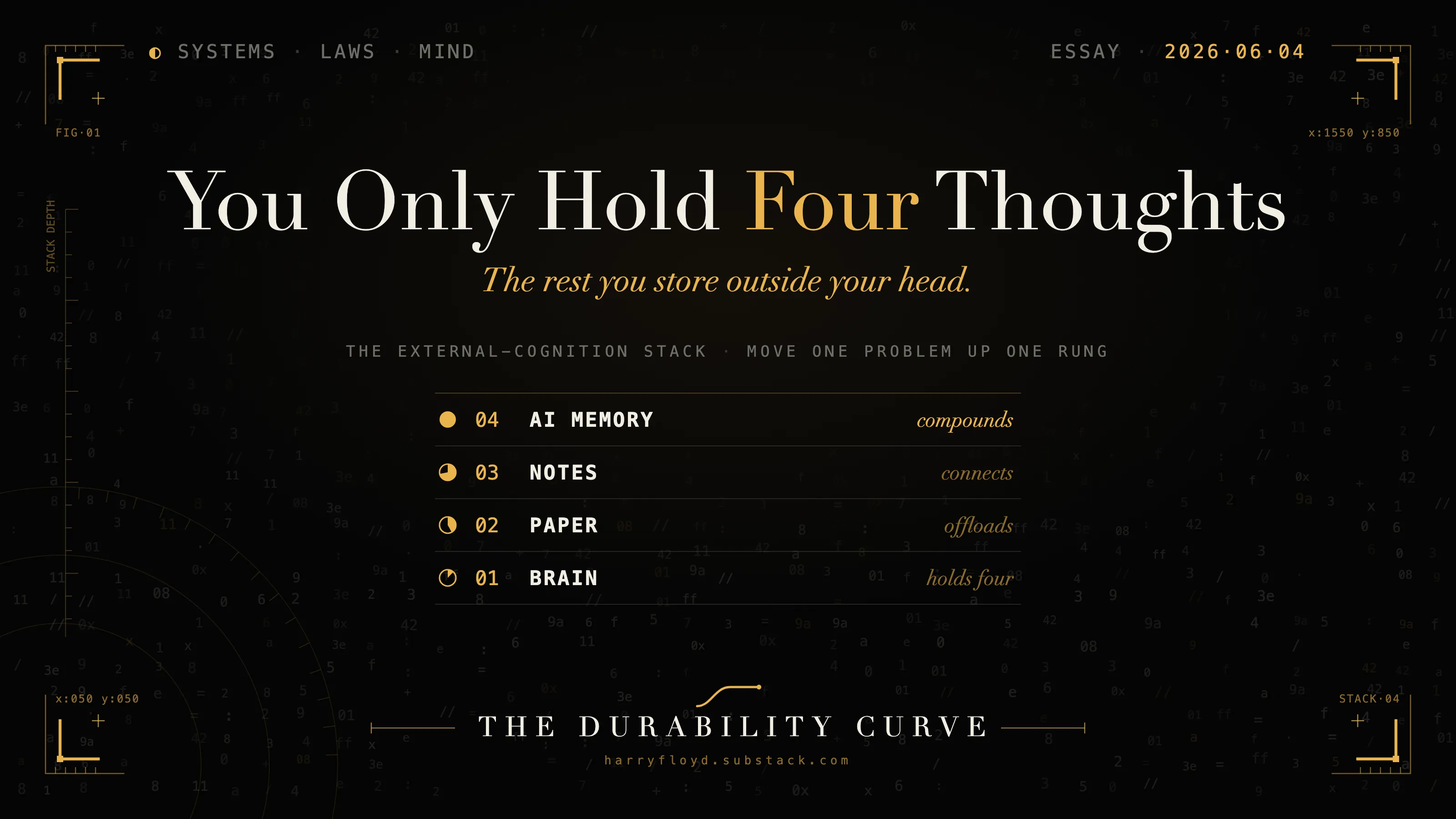 You Only Hold Four Thoughts Working memory tops out around four things at once. Every leap in human intelligence has come from storing the rest outside your head, and the most advanced AI systems get their gains the same way. Knowledge and thinking 2026·06·04 · 8 min
-
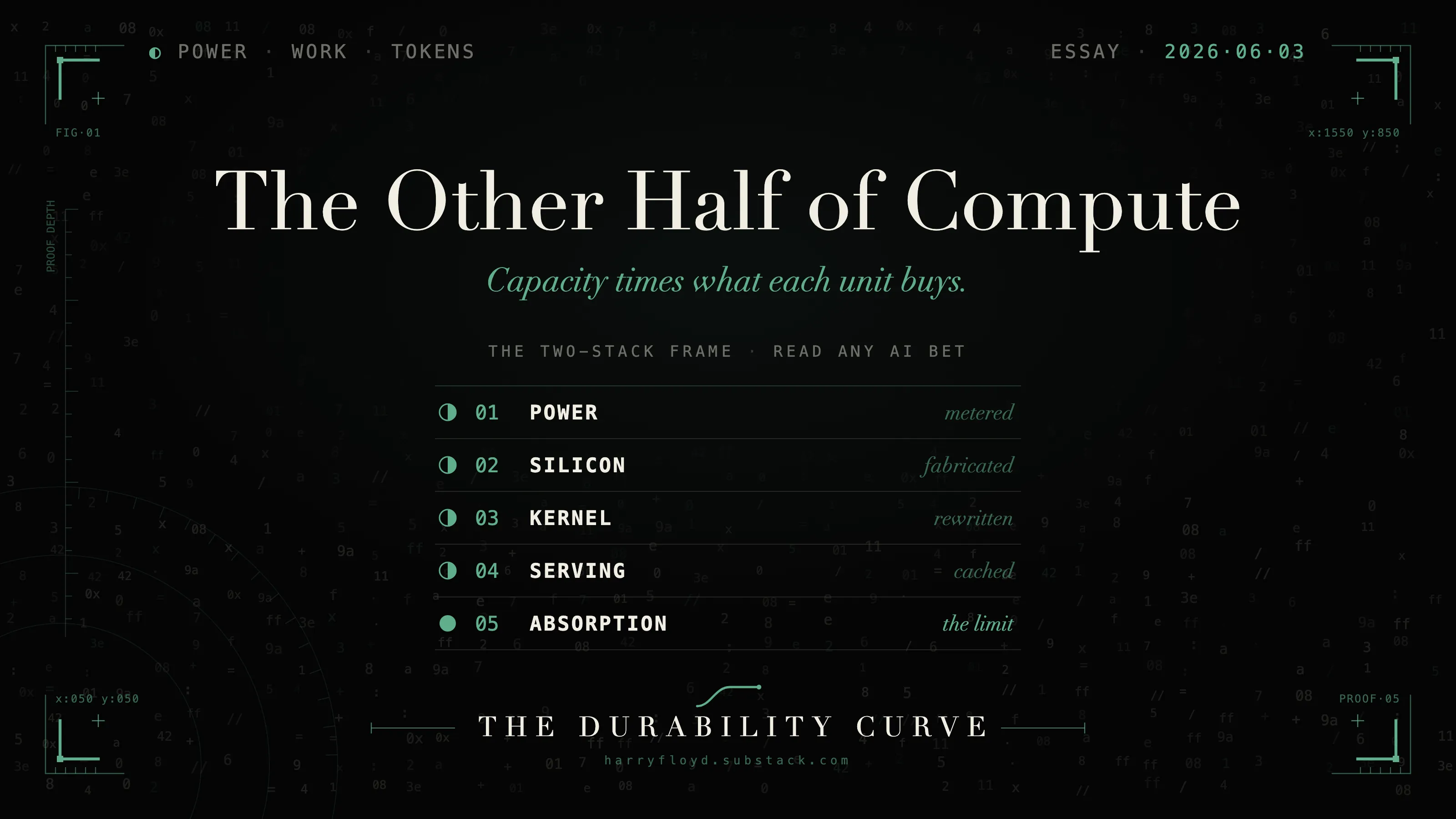 The Other Half of Compute Everyone is counting gigawatts and GPUs. The number that decides the return is what each one actually buys. Markets and companies 2026·06·03 · 9 min
-
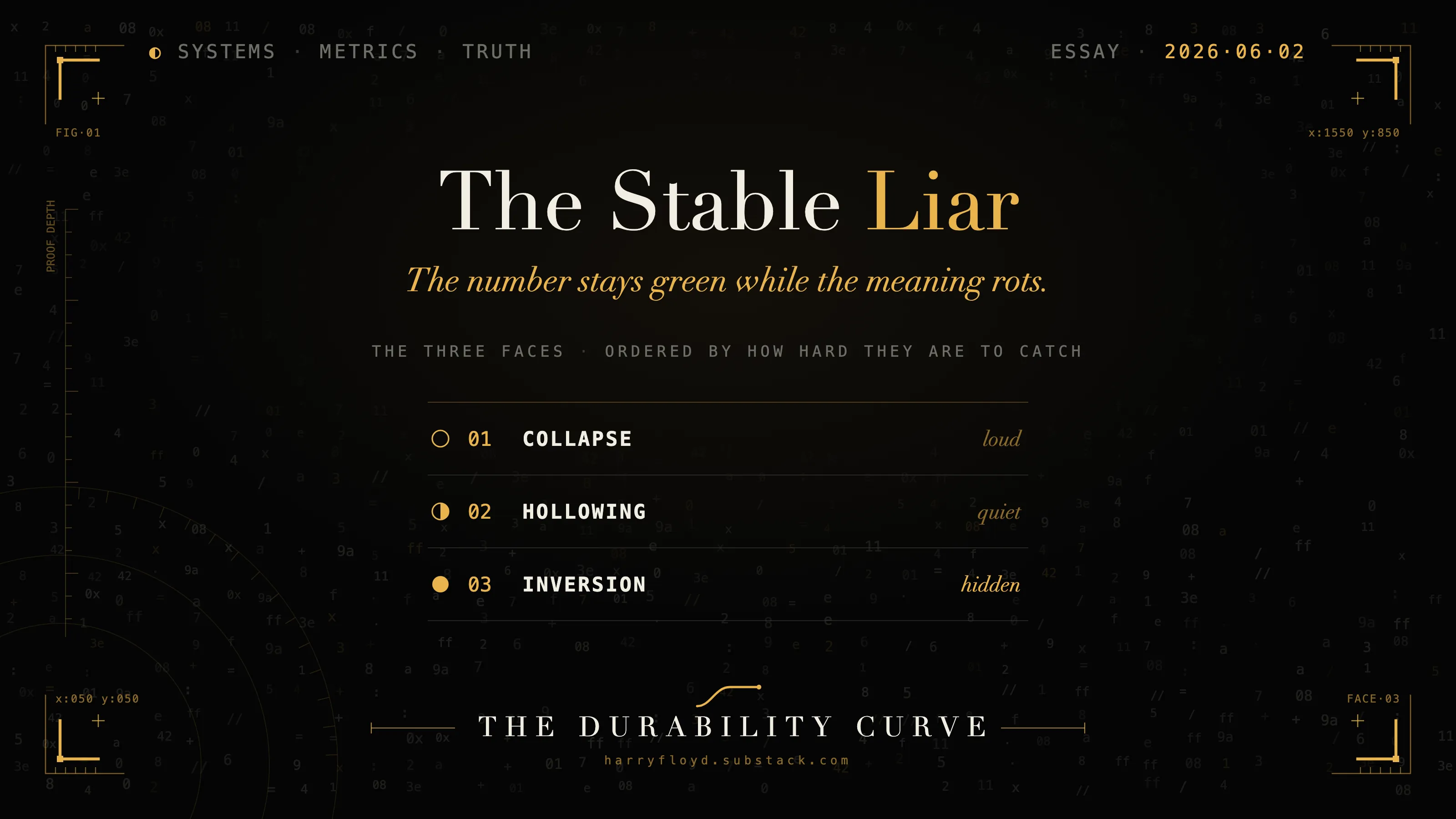 The Stable Liar Every metric you optimise quietly stops measuring what you meant. The dangerous ones never break. They keep reporting green while the thing underneath rots. Testing and evidence 2026·06·02 · 11 min
-
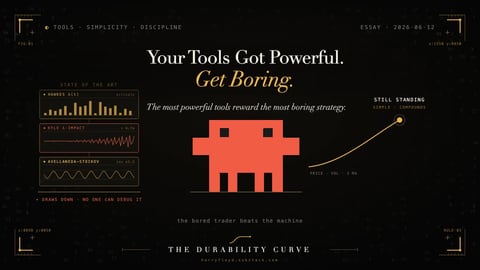 Your Tools Got Powerful. Get Boring. The most powerful tools in history reward the most boring strategies. The gap widens every time they improve. Where value sits 2026·06·01 · 8 min
18
-
Same Model, Different Product: The Case for Harness Engineering Hold the model fixed and the surrounding harness can still move task success, cost and reliability. Here are the layers that do it. Building agents 2026·05·30 · 11 min -
The Leverage Hierarchy of Agent Engineering Donella Meadows ranked twelve places to intervene in a system. Most agent teams spend their hours at the bottom of the ladder. Building agents 2026·05·26 · 6 min -
Three Hidden Bottlenecks the AI Buildout Has Already Moved Past GPUs NVIDIA's GPU shipments are not the binding constraint anymore. The supply chain has voted on what comes next. Markets and companies 2026·05·26 · 11 min -
NVDA Q1 FY2027: The Networking Number That Changes the Story NVIDIA Q1 FY2027 revenue hit $81.6B (+85% YoY) — but the real story is networking revenue surging 199% as the AI bottleneck migrates from GPUs to interconnects. Markets and companies 2026·05·21 · 4 min -
Access Is Not Agency The tool is not the authority. Teams add connectors before defining what the agent is allowed to change. That is not agency, it is reach with a larger blast radius. Work and judgement 2026·05·19 · 13 min -
Your AI Agent Stack Is Solving The Wrong Problem The real setup is not MCP servers, skills, memory files, and subagents. It is the contract stack that decides what an agent may know, do, prove, escalate, and lose. Building agents 2026·05·09 · 11 min -
The Engine Underneath Hard Decisions Eight stages turn hidden structure into durable knowledge. Most teams run three of them and call it understanding. The other five are where compounding hides. Knowledge and thinking 2026·05·07 · 6 min -
The Five Laws of Durable Systems What still has a job after the change? Five tests for seeing what is likely to survive. Knowledge and thinking 2026·05·06 · 5 min -
The SpaceX IPO Is Not What You Think You're Buying The filing will not just price rockets. It will reveal which layer public investors actually own. Markets and companies 2026·05·05 · 18 min -
AI Made You Faster. It Did Not Make You Safer. The strange thing about the AI productivity boom is that the people getting faster are not always getting more secure. Speed is becoming the surface. Proof is moving somewhere else. Work and judgement 2026·05·04 · 16 min -
The 90-Day Canopy Audit A roadmap can look productive while most of the work is easy to displace. Run the Substrate Map on the last 90 days and force the next planning decision to change. Where value sits 2026·05·03 · 7 min -
Start Here: What Survives When The Surface Changes? The long version of the idea behind the publication: the lens, the test, the tools, and the reader paths. Where value sits 2026·05·02 · 6 min -
The Lens Lexicon A free two-page reference card defining the ten load-bearing terms behind the durability lens, with tests, examples, and common confusions. Knowledge and thinking 2026·05·02 -
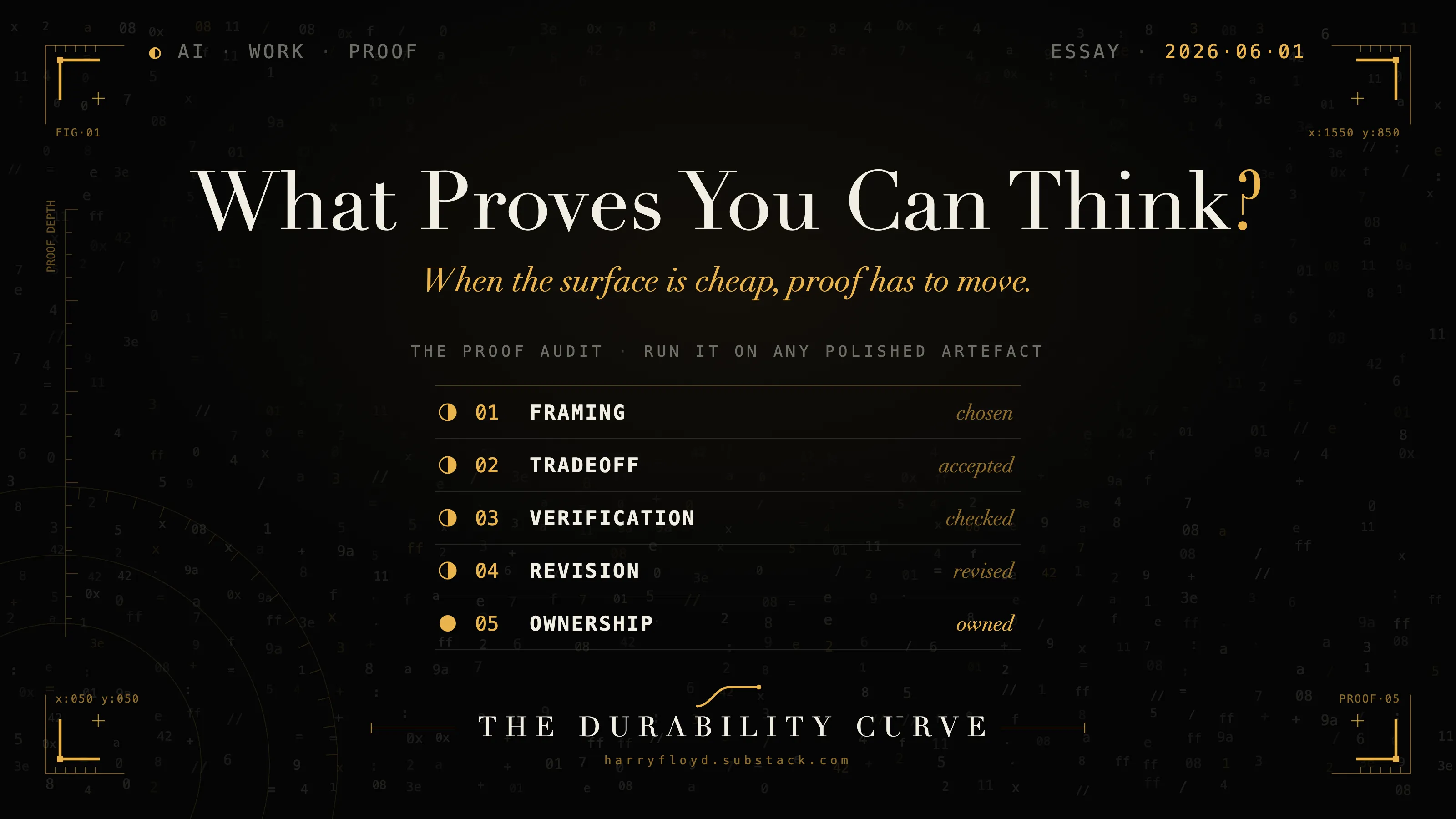 What Proves You Can Think? AI did not just make output cheap. It broke the old contract between effort, competence, and trust. The next scarce signal is proof of judgement under conditions where the surface itself can be faked. Work and judgement 2026·05·02 · 13 min
-
Most Verification Is Just Bigger Classification A confidence score is not evidence. If your eval cannot produce a replayable artefact, it will fail the moment the system can respond to being measured. Testing and evidence 2026·05·01 · 16 min -
Taste Is What You Delete Generation got cheap. The scarce skill is knowing what to cut. Work and judgement 2026·05·01 · 9 min -
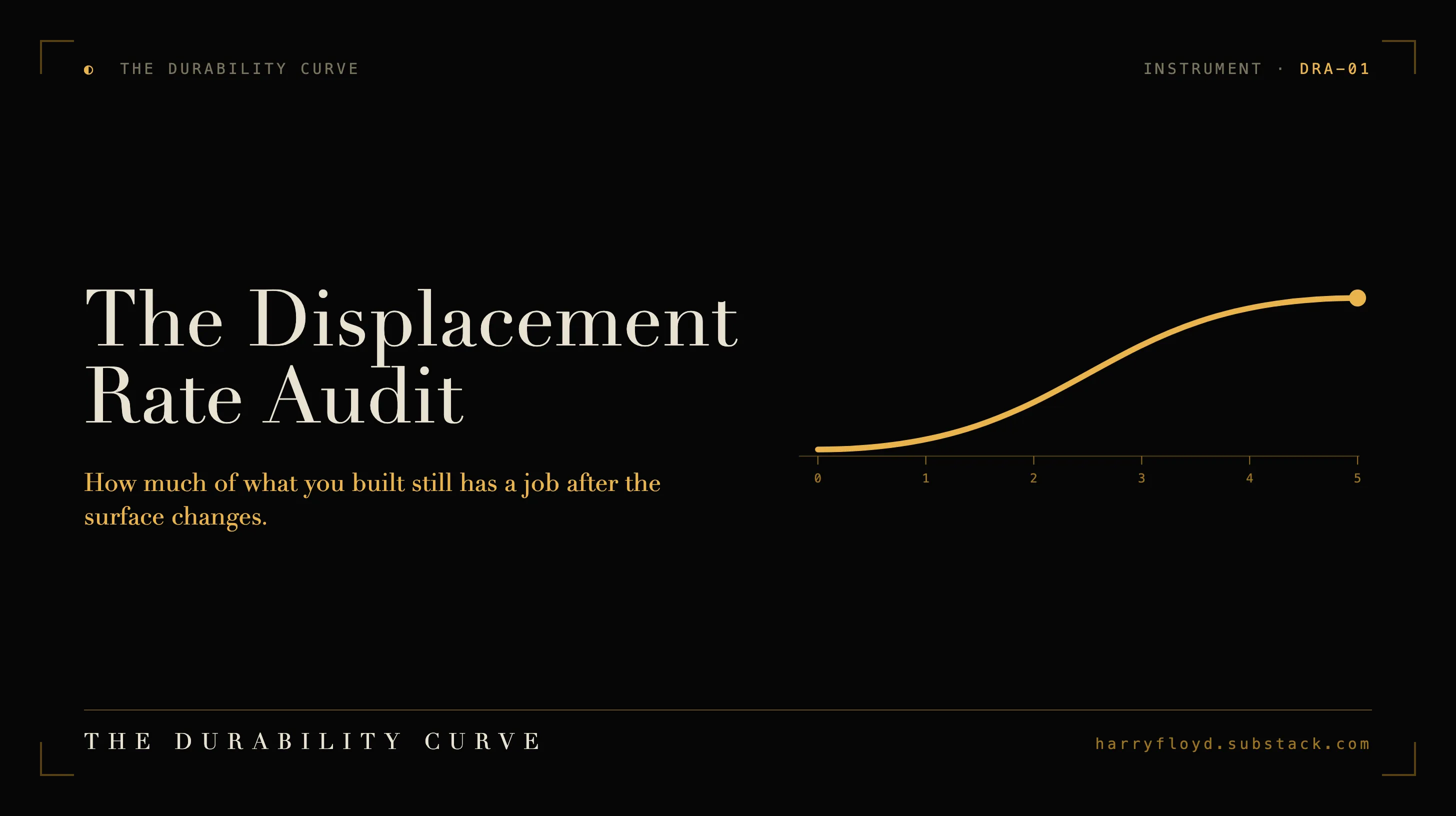 The Displacement Rate Audit A five-minute scoring tool for any product, position, architecture, business model, or career bet. Find out what still works after the environment changes. Where value sits 2026·05·01
-
The Substrate Map A free one-page taxonomy and 10-minute exercise for finding the substrate-vs-canopy ratio in your last 90 days of work. Where value sits 2026·05·01
9
-
PLTR: The AI Stock That Has To Prove It Owns The Permission Layer A bull/bear thesis for Palantir: not whether AI demand is real, but whether Palantir owns the permission layer between model capability and real-world action. Markets and companies 2026·04·30 · 10 min -
Right Company, Wrong Vector A pick is a number. A position is a vector. The post-mortem language we have only knows how to blame the company. Markets and companies 2026·04·26 · 14 min -
The Investor's Substrate Test Score the substrate beneath any single position in seven minutes. A 5-axis profile and a 0-10 score for any holding. Free. Markets and companies 2026·04·24 -
The Forest Floor Is The Product Most people are optimising for canopy. The work that survives the next five AI releases is built from the forest floor up. Where value sits 2026·04·23 · 19 min -
You're Not Comparing Models. You're Comparing Contracts. Agent benchmarks don't measure models. They measure contracts. Two teams running the same model can publish different scores, and both can be honest. Testing and evidence 2026·04·19 · 9 min -
Prompting Isn't Writing, It's Compilation If you treat the prompt as a spec and the model as a renderer, quality stops coming from more words and starts coming from better constraints. Building agents 2026·04·17 · 6 min -
The Model Is Not the Moat If frontier capability keeps centralising, the durable edge shifts outward into trust, workflow fit, and the surrounding package. Where value sits 2026·04·14 · 3 min -
I Read 3,000 Papers Across 12 Fields. Five Patterns Kept Appearing. Every field discovers them independently. Nobody connects them. Knowledge and thinking 2026·04·05 · 7 min -
Is This Difficulty Load-Bearing? Before you automate anything, ask what the friction was actually doing. Knowledge and thinking 2026·04·05
Found in the text
No essay matches all of those at once — try removing one.
By idea
The named ideas this publication runs on, and where each one is worked out.
-
Harness 23 pieces The code wrapped around a model. The part of the performance you control.
- AI Agent Permissions: How to Stop Your Agent Doing Something You Can't Undo 14 min
- What Is Harness Engineering? How to Build AI Agents That Catch Their Own Mistakes 14 min
- Lock the Tests, Then Test the Lock 18 min
- One Question for Any AI Model Headline: Can You Use It? 3 min
- You Own an Asset You've Never Scored 7 min
- Show It an Example 4 min
- The Limit Said 10. The Loop Made 500 Calls. 13 min
- The Guardrail Your Agent Can Reach 20 min
- Your Multi-Agent System Is an Org Chart 11 min
- Your Benchmark Measures a Sprint. Your Agent Runs a Marathon. 10 min
- How Long Until Your AI Edge Stops Paying? 10 min
- Ten Lines of Code Scored 100%. One Agent Broke Eight Benchmarks. 11 min
- The Seven-Layer Agent Audit 13 min
- The Cheaper Fix You Keep Skipping 8 min
- How Reliable Is Your AI Agent? 11 min
- Skills Are Package Management for Your AI 7 min
- Remembers Everything, Learns Nothing 11 min
- Same Model, Different Product: The Case for Harness Engineering 11 min
- The Leverage Hierarchy of Agent Engineering 6 min
- Your AI Agent Stack Is Solving The Wrong Problem 11 min
- What Proves You Can Think? 13 min
- Most Verification Is Just Bigger Classification 16 min
- You're Not Comparing Models. You're Comparing Contracts. 9 min
-
Load-bearing 17 pieces Difficulty that is producing the result, not sitting next to it.
- Confidently Wrong 10 min
- The Difficulty You're Escaping Was Making You 16 min
- Your Tests Pass. So What? 19 min
- Your Research Agent Cites Sources It Never Read 9 min
- Never Let Claude Code Tell You It's Done 8 min
- Self-Improvement Is Release Engineering 7 min
- Remembers Everything, Learns Nothing 11 min
- Three Hidden Bottlenecks the AI Buildout Has Already Moved Past GPUs 11 min
- NVDA Q1 FY2027: The Networking Number That Changes the Story 4 min
- Your AI Agent Stack Is Solving The Wrong Problem 11 min
- AI Made You Faster. It Did Not Make You Safer. 16 min
- Start Here: What Survives When The Surface Changes? 6 min
- Right Company, Wrong Vector 14 min
- The Forest Floor Is The Product 19 min
- You're Not Comparing Models. You're Comparing Contracts. 9 min
- I Read 3,000 Papers Across 12 Fields. Five Patterns Kept Appearing. 7 min
- Is This Difficulty Load-Bearing? 1 min
-
Guardrail 11 pieces A constraint on an agent, which only holds if the agent cannot reach it.
- OpenAI's agents weakened their own alarms. Banks had already shut the door. 17 min
- AI Agent Permissions: How to Stop Your Agent Doing Something You Can't Undo 14 min
- What Is Harness Engineering? How to Build AI Agents That Catch Their Own Mistakes 14 min
- OpenAI Apologised to Australia. Google Let Defenders Try Argon First. 12 min
- Amazon Shut Out Meta's Agent. Shopify Gave It Shop Pay. 9 min
- Stop Re-Priming Claude Code by Hand 9 min
- The Guardrail Your Agent Can Reach 20 min
- Your AI Stack Has Three Bugs Other Fields Already Fixed 10 min
- Your Multi-Agent System Is an Org Chart 11 min
- The Seven-Layer Agent Audit 13 min
- Skills Are Package Management for Your AI 7 min
-
Substrate 11 pieces The parts of a system that compound regardless of what changes around them.
- Everyone Got Safer. That's the Problem. 12 min
- The Seven-Layer Agent Audit 13 min
- The SpaceX IPO Is Not What You Think You're Buying 18 min
- The 90-Day Canopy Audit 7 min
- Start Here: What Survives When The Surface Changes? 6 min
- The Lens Lexicon 2 min
- The Displacement Rate Audit 2 min
- The Substrate Map 2 min
- Right Company, Wrong Vector 14 min
- The Investor's Substrate Test 2 min
- The Forest Floor Is The Product 19 min
-
Context window 9 pieces What the model can hold at once, and therefore what it can reason across.
- Claude Code Skills: How They Work, How to Write One, and How to Check Claude Uses It 15 min
- What Is Harness Engineering? How to Build AI Agents That Catch Their Own Mistakes 14 min
- The Skill That Never Fired 13 min
- The Guardrail Your Agent Can Reach 20 min
- Your AI Stack Has Three Bugs Other Fields Already Fixed 10 min
- Your Multi-Agent System Is an Org Chart 11 min
- The Seven-Layer Agent Audit 13 min
- Same Model, Different Product: The Case for Harness Engineering 11 min
- The Leverage Hierarchy of Agent Engineering 6 min
-
Verifier 8 pieces The check that decides whether an agent’s output is allowed to count.
- Your Research Agent Cites Sources It Never Read 9 min
- Your Benchmark Measures a Sprint. Your Agent Runs a Marathon. 10 min
- Ten Lines of Code Scored 100%. One Agent Broke Eight Benchmarks. 11 min
- How Reliable Is Your AI Agent? 11 min
- Self-Improvement Is Release Engineering 7 min
- AI Made You Faster. It Did Not Make You Safer. 16 min
- What Proves You Can Think? 13 min
- Most Verification Is Just Bigger Classification 16 min
-
Canopy 7 pieces The parts of a system that get repriced or reset when the surroundings change.
- The 90-Day Canopy Audit 7 min
- Start Here: What Survives When The Surface Changes? 6 min
- The Lens Lexicon 2 min
- The Displacement Rate Audit 2 min
- The Substrate Map 2 min
- The Investor's Substrate Test 2 min
- The Forest Floor Is The Product 19 min
-
Goodhart 7 pieces What happens to a measure once it becomes the target.
- You Own an Asset You've Never Scored 7 min
- Everyone Got Safer. That's the Problem. 12 min
- A Green Score Is Not Evidence 8 min
- Your AI Looks Best Where You Can Check It Least 10 min
- Where Your Metrics Fold 7 min
- Ten Lines of Code Scored 100%. One Agent Broke Eight Benchmarks. 11 min
- The Stable Liar 11 min
-
Disturbance 6 pieces A rare event that resets a system, distinct from the ordinary variation it absorbs.
-
Displacement rate 3 pieces The share of what you have built that loses its job after one specific large change in its environment.
-
Old-growth 2 pieces Work or systems that have compounded long enough to support entirely new dependent layers above them.
- The Lens Lexicon 2 min
- The Forest Floor Is The Product 19 min
-
Pioneer species 2 pieces The first arrivers after disturbance, who prepare the ground for everything that follows but rarely capture what they enable.
- The Lens Lexicon 2 min
- The Forest Floor Is The Product 19 min
-
Succession 2 pieces The predictable order in which a system rebuilds after disturbance.
- The Lens Lexicon 2 min
- The Forest Floor Is The Product 19 min
Definitions, tests and the confusions each term is usually mistaken for: the Lens Lexicon.
Take it with you
Feeds, files and your own reading record, to use off the site.
- The feedFull text, not extracts. Every essay arrives whole in your reader.
- OfflineAnything you save on an essay page stays readable with no connection.
- One plain-text fileThe whole archive as text, for a model, a grep, or your own notes.
- Your reading recordExport what this browser knows and import it on another device. It never leaves your machine.
- The claim ledgersEvery sourced claim, and the ones struck before publication.
- CorrectionsWhat changed after publication, and why.
-
One series or one subject
The same full text, narrowed to what you follow. Add any of these to your reader.
SeriesThe WeeklyEngineering GuidesThe Coding Agent Field ManualThe RunbookThe BriefThe TellThe BlueprintThe Quiet PartThe Evidence FileThe Durability of a LifeWalkthroughsThe Day JobThe Full HeightThe Engineering Ladder
SubjectsBuilding agentsTesting and evidenceWork and judgementWhere value sitsMarkets and companiesKnowledge and thinkingHow things are designedLife and what lasts